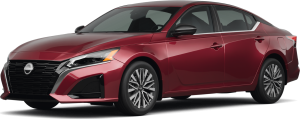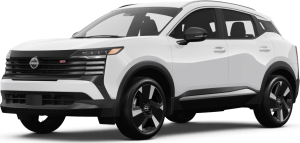

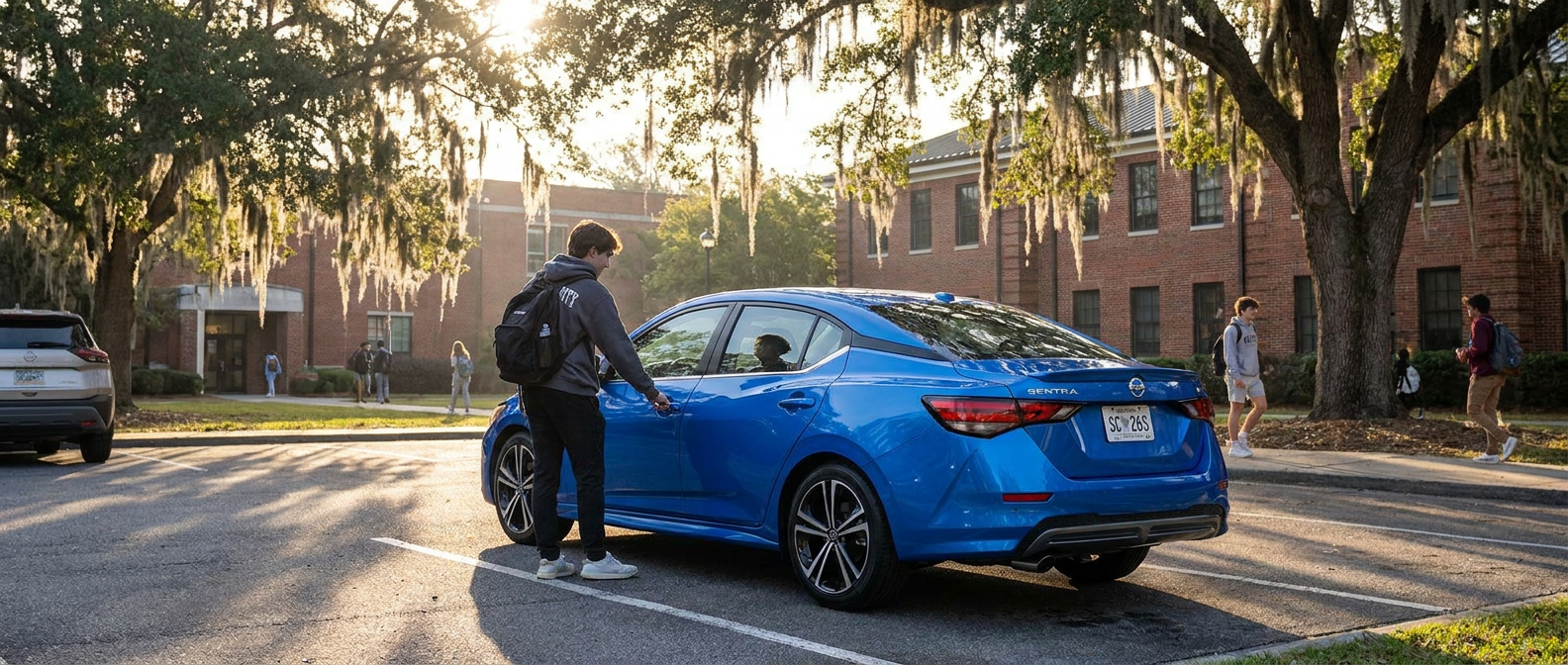
A practical guide to choosing between two Nissan sedans for college commuting. Learn how daily mileage, highway driving frequency, parking constraints, passenger count, fuel economy, and cargo needs determine whether the 2026 Sentra or 2026 Altima better serves a student commuter in the Orangeburg area.
Our read comes down to your commute. If your daily loop is campus-to-campus and you're watching every dollar, the 2026 Sentra is the easier yes. If you're running the I-26 corridor to Columbia two or three days a week with a carload, the Altima earns its keep.
We're not hedging here. What follows is the actual split we see play out on our lot when students from Claflin University and South Carolina State walk in asking which sedan makes sense. Both are genuinely good cars. They serve different students, and this checklist will tell you which one you are.
Browse the 2026 Nissan Sentra at Nissan of Orangeburg
What Goes on the Checklist?
Run through these items before you set foot in a showroom, and be straight with yourself on each one, because a commuter sedan that fits your parking lot and your mileage will serve you better than the one wearing the bigger badge. Answer each one plainly and the decision mostly makes itself.
Your College Commuter Decision Checklist
- [ ] Know your daily mileage. Is your commute under 20 miles round-trip (on-campus or around Orangeburg), or are you regularly running 40-plus miles out to Columbia or the Charleston corridor?
- [ ] Count your highway miles. I-26 is real highway driving. If you're merging from US-601 onto the interstate at least twice a week, engine size starts to matter more than it does in town.
- [ ] Check your parking situation. Some campus lots are tight. The 2026 Sentra is 183.3 inches long. The 2026 Altima stretches to 192.9 inches. You're looking at nearly a full foot of difference in a crowded row.
- [ ] Be real about your cargo. Moving-in weekend is one thing. What does a normal Tuesday look like? Two backpacks and a gym bag, or a full back seat plus a crammed trunk?
- [ ] Settle your budget range. The Sentra's entry trim sits meaningfully lower than the Altima's base. Finance terms aside, the gap between them is real and worth naming in your head before you walk in.
- [ ] Decide how long you're keeping it. The Altima's lineup was trimmed to two trims for 2026, and it may be approaching the end of its production run. None of that is a dealbreaker, but it's worth knowing before you sign.
- [ ] Think about fuel cost over a school year. The EPA rates the 2026 Sentra S/SV at 33 mpg combined. The 2026 Altima FWD comes in at 30 mpg combined. Across 12,000 annual miles, that difference is real gallons, real dollars.
- [ ] Consider who else rides with you. The Altima gives rear passengers 35.2 inches of legroom. The Sentra offers 34.9 inches. Functionally the same for one tall friend, but four adults on a long drive will feel that half-inch gap in comfort after an hour.
- [ ] Ask yourself whether you need AWD. The Sentra is FWD only. The Altima offers available all-wheel drive, which is genuinely useful if you go home to the Upstate or the mountains for breaks.
Understanding the Key Items
See the 2026 Nissan Altima at Nissan of Orangeburg
The checklist above marks the fork in the road, and each item on it maps to a real difference you'll feel driving out of Orangeburg, not just a number on a window sticker. Let's walk through why each one carries weight for a student behind the wheel.
The MPG Gap Is Smaller Than It Looks, Until It Isn't
The EPA-certified difference between these two is 3 mpg combined (33 for the Sentra S/SV, 30 for the Altima FWD). That sounds minor on paper. Spread over a full academic year on the I-26 corridor, it compounds. The Sentra also runs on a 12.4-gallon tank, which means every fill-up is a smaller hit. If you're budgeting tight on a student income, that rhythm matters more than the spec sheet suggests.
The other side of the ledger is power. The Altima's 2.5-liter engine delivers 188 horsepower against the Sentra's 149. Those 39 extra horses don't mean much in a parking lot, but you'll notice them merging onto I-26 at peak morning traffic with two passengers and a trunk full of weekend gear. We hear this from commuters who run the Columbia stretch. The Sentra handles the merge fine at normal loads. Add two more bodies and it works harder.
Explore financing options at Nissan of Orangeburg
Parking Reality on Tight Campus Lots
The Sentra is 183.3 inches long. The Altima is 192.9 inches. Nearly ten inches shorter means the Sentra fits more comfortably in compact spots, parallel parks with less stress, and slides into older lot designs that weren't built with midsize sedans in mind. On a campus with a packed commuter lot, that physical footprint is a daily quality-of-life difference. It isn't glamorous. But neither is circling for twenty minutes.
Claflin University and South Carolina State are both in Orangeburg. Their student lots sit a short drive apart.
Cargo: The 1.1 Cubic Foot Gap Is Smaller Than You Think
Nissan lists the Altima trunk at 15.4 cubic feet. The Sentra comes in at 14.3 cubic feet. That 1.1-cubic-foot difference is real but modest. Both have 60/40 split-folding rear seats. Both swallow a week's worth of groceries without drama. Where the Altima earns its extra space is on move-in/move-out weekend, or if you're hauling equipment for an internship, sports gear, or a commute that doubles as a delivery run.
Both sedans share the same core reliability reputation. Service and parts run through the same Nissan network.
The Altima's 2026 Lineup Context
For 2026, Nissan trimmed the Altima from four trim levels to two (SV and SR, plus limited special editions). It's still a strong, capable car. But it's worth understanding you're buying into a lineup that's being simplified, which can affect future parts availability and resale perception over a five-year horizon. We're not being alarmist. If you're keeping a car for two to three years through college and selling before graduate school, it may not matter at all. If you're planning to drive it for seven or eight years, file that information away.
Start Your Financing Application
Browse pre-owned inventory at Nissan of Orangeburg
Item / Why It Matters
| Checklist Item | Why It Matters for Orangeburg Commuters |
|---|---|
| Daily mileage under 20 miles vs. 40-plus | Shorter loops reward the Sentra's fuel efficiency and easier parking; longer I-26 runs reward the Altima's highway composure |
| Engine size (149 hp vs. 188 hp) | Sentra handles solo and light loads well; Altima gives a clearly more relaxed merge with 2-4 passengers |
| Car length (183.3" vs. 192.9") | Ten-inch gap matters in tight campus lots and parallel spots on Russell Street or around the SC State campus |
| Trunk space (14.3 vs. 15.4 cu ft) | Negligible for daily use; meaningful on move-in weekend or heavy haul days |
| FWD only vs. AWD available | Orangeburg winters are mild, so AWD is optional comfort, not a necessity, unless you travel to the Upstate or mountains |
| Altima trim count (2 trims for 2026) | Simpler lineup means fewer choices but also signals a model at or near end-of-production |
| EPA combined MPG (33 vs. 30) | Three mpg difference adds up over a full school year on consistent commuting miles |
| Rear legroom (34.9" vs. 35.2") | Functionally identical for two adults; a long ride with four adults may show the Altima's slight edge |
Your Print-and-Go Recap
You don't need the spec sheets memorized to make a smart call here. You do need clear answers to three things before you visit us. How far you drive, how many people ride along, and how tight your parking runs.
Choose the 2026 Sentra if:
- Your daily drive is within Orangeburg or under 20 miles round-trip
- You park in tight campus lots regularly
- Fuel economy over the school year is your primary concern
- You're usually driving solo or with one passenger
Choose the 2026 Altima if:
- You're running the I-26 corridor to Columbia or the Charleston direction multiple times a week
- You routinely carry three or four passengers
- You want the option of AWD for trips home to the Upstate
- Rear passenger comfort on 45-minute-plus drives matters to you
The Altima is the more capable car at highway speed with a full load. The Sentra is the smarter daily-use tool for tight budgets and tight parking. Neither choice is wrong. They're just built for different commuters.
When you're ready, our team at Nissan of Orangeburg is here to put you in the seat of each one and let the drive do the talking. No pressure. Just two good sedans and some straight questions.
Frequently Asked Questions
Is the 2026 Nissan Sentra powerful enough for regular highway driving on I-26?
Yes, with one honest caveat. The 2026 Sentra's 2.0-liter engine produces 149 horsepower, which is adequate for solo and light-load highway driving on I-26 between Orangeburg and Columbia. Merge and passing power feel slightly more strained when the car is fully loaded with passengers and cargo, especially at higher highway speeds. If your commutes run mostly in town or lightly loaded, you'll find it perfectly comfortable. If you're regularly carrying three or four passengers on 40-plus mile stretches, the Altima's 188-horsepower 2.5-liter engine gives you a noticeably more relaxed experience on the interstate.
Does the 2026 Altima being discontinued mean I shouldn't buy one?
Not necessarily. The 2026 Altima is a current, fully supported model on sale right now, and it remains a well-rounded midsize sedan. For 2026 Nissan has trimmed the lineup from four trims to two, which does signal the model is approaching the end of its run. For a student who plans to own the car for two to three years and then sell or trade, that timeline likely doesn't create a practical problem. If you're planning a longer ownership of seven or more years, it's worth factoring in that parts sourcing and resale demand may shift as the model ages out. Ask our team about the current inventory and your specific situation so we can give you a straight answer.