

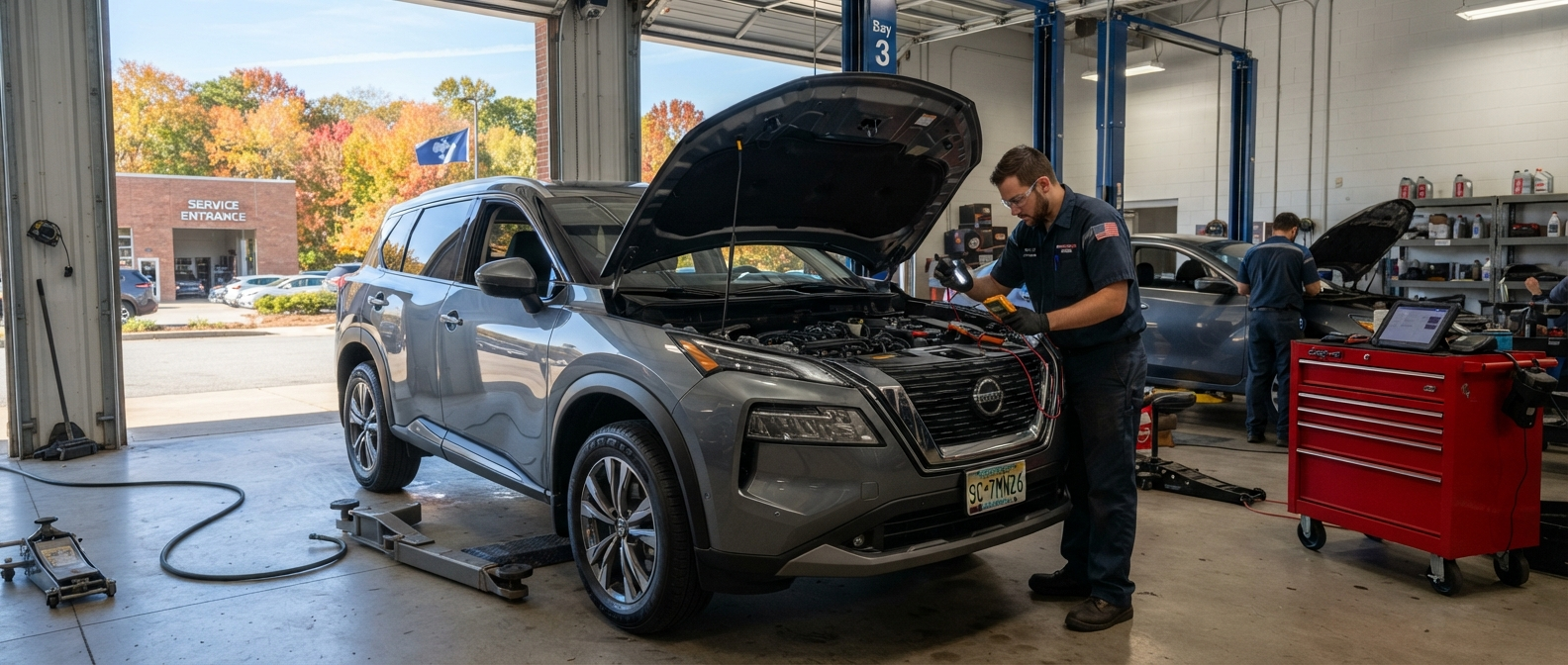
A practical guide to October maintenance in Orangeburg. Learn why fall temperature swings stress Nissan tires and batteries after months of summer heat, how South Carolina's I-26 corridor mileage amplifies that wear, and what checks to complete before cooler weather arrives.
October is a good month for Nissan maintenance in Orangeburg because South Carolina's long, hot summer pre-fatigues tires, batteries, and fluids just as the calendar's first real temperature swings arrive. Orangeburg sees highs near 80F in early October dropping to lows around 49F by month-end, a swing that stresses components that already took a beating from months of summer heat. Getting ahead of it now costs far less than a roadside call on I-26.
Browse available Nissan Rogues
What Does October's Temperature Swing Actually Do to Your Nissan?
October's temperature swing works on two systems of your Nissan more than any others, your tires and your battery. It does the damage quietly. The daytime still feels mild even as the overnight lows slide far enough to matter. The National Weather Service's climate record for Orangeburg Airport shows average highs hovering around 75F through most of the month, but the lows drop into the upper 40s by the end of October. That gap is what matters, and it lands on your tires and your battery.
Tires lose pressure as temperatures fall. Tire pressure drops approximately 1 PSI for every 10-degree Fahrenheit drop in temperature, a physics principle confirmed by the Car Care Council and cited by NHTSA. Run the Orangeburg numbers for yourself. If your tires were set at 35 PSI on a warm early-October afternoon, a late-October overnight low around 49F represents a 25-to-30-degree swing from the 80F daytime fill. You'll lose 2.5 to 3 PSI before you leave the driveway, and your Nissan's door-jamb placard is what tells you the right target (not the max stamped on the sidewall). A tire running 3 PSI low runs hotter, wears the outer edges faster, and uses slightly more fuel.
Batteries show stress they hid all summer. According to AAA, an average vehicle battery lasts three to five years. Cold weather reduces battery output, and a battery that's been running accessories through five months of SC heat (think AC compressor cycling constantly) may already be near the edge of its rated cold-cranking amps. NHTSA notes that lower temperatures reduce battery power while engines require more power to start. A battery that starts fine at 75F can struggle on a 45F morning once it's been quietly depleted.
| System | What Summer Does to It | What October's Temperature Swing Adds |
|---|---|---|
| Tires | UV and high-heat cycling weaken rubber compounds; pressure fluctuated all summer | Each 10F drop pulls roughly 1 PSI; a 30F overnight swing can cost 3 PSI before you drive |
| Battery | Heat accelerates electrolyte loss and plate degradation over 5+ months | Cold reduces output; a summer-stressed battery may fall below CCA spec on first cold morning |
| Engine oil | High summer temps break down conventional oil faster if intervals were stretched | Thicker cold-start oil flow stresses an engine with already-degraded lubrication |
| Wiper blades | SC summer UV and ozone crack rubber; blades streak or chatter | Fall rain and morning fog make streaking blades a real visibility problem, not just an annoyance |
| Cabin air filter | Pollen and dust load from spring-through-summer accumulates | Closed windows in cooler weather concentrate whatever is in that filter |
Schedule your fall service appointment
Why Does the Timing Make Sense Specifically for Orangeburg Drivers?
The timing makes sense for Orangeburg drivers even though our winters stay mild. The wear here comes from summer heat and highway mileage. The first cool mornings of late October are when that hidden wear starts to surface. The standard advice on fall car care assumes you live somewhere that gets real winter. We don't. Orangeburg's January average low is around 37F, and hard freezes are short-lived. So why bother in October?
The argument for October maintenance here isn't about preparing for snowstorms. It comes down to the I-26 corridor and the mileage that comes with driving it.
See Nissan Sentra options on the lot
If you're commuting to Columbia (about 40 miles northwest on I-26) or making the longer run toward Charleston (roughly 75 miles southeast), you're putting serious highway miles on your Nissan every week. A tire that's 3 PSI low on a highway run wears unevenly and costs more in fuel over a month than the rotation you skipped. A battery that's borderline is more likely to leave you waiting for a jump at a rest stop on US-601 than it is in your driveway at home.
Explore available Nissan Kicks
How Do You Get Your Nissan Serviced at Nissan of Orangeburg This Month?
You get your Nissan serviced at Nissan of Orangeburg this month by booking while there's still room on the calendar. October stays calmer than December, and a fall visit splits cleanly into what you can check at home and what a technician should handle. Scheduling service in October is practical precisely because it's not a crisis month. December appointments fill up faster; October has room. A fall service visit at our dealership covers the items below, and you can run a few checks yourself first.
What you can check at home before you come in:
- Tire pressure. Check all four tires cold (before driving, or after sitting at least three hours). Match the PSI on your driver's door placard. If you're at or below that number, come in.
- Tread depth. Place a quarter upside down in the main tread groove. If you can see the top of Washington's head, it's time to talk about tires.
- Wiper blade condition. Run them on a wet windshield. Any streaking or chattering means the rubber has degraded.
- Dashboard lights. A TPMS light, battery light, or check-engine indicator that's been easy to ignore all summer is worth bringing in now.
What needs a technician:
- Battery load test (a voltage reading alone doesn't capture cold-cranking capacity; a proper load test does).
- Alignment and rotation check (our team can tell you whether uneven wear is just mileage or something that needs adjustment).
- Fluid inspection, including coolant concentration and brake fluid condition.
- Cabin air filter inspection, especially if anyone in the car has allergy concerns.
October is Fall Car Care Month, recognized by both the Car Care Council and ASE (the National Institute for Automotive Service Excellence) as the practical window to complete a pre-winter inspection before the season's appointments get congested.
Schedule Your Fall Service at Nissan of Orangeburg
There's a fair tradeoff worth naming. A basic fall service visit takes time out of your schedule, and for a Nissan that's only a year or two old with low mileage, some of these checks may come back clean. A clean result is a fine outcome. Knowing your battery is solid and your tires are properly inflated before November costs you an afternoon appointment. Finding out they weren't costs more.
Frequently Asked Questions
Why is October specifically called out as a car care month?
The Car Care Council designates October as Fall Car Care Month each year, alongside April as spring Car Care Month. The October designation reflects the timing between summer wear-and-tear and the onset of colder temperatures, making it the practical window for a pre-winter inspection before holiday schedules and cold-weather demand push service appointments out further.
Does Orangeburg SC actually get cold enough to need fall maintenance?
Orangeburg's winters are mild compared to northern states, but October in Orangeburg brings a real temperature swing: highs around 75F in early October drop to overnight lows near 49F by month-end. That roughly 30-degree swing is enough to pull 3 PSI from your tires overnight and to expose a battery that's been weakened by five months of summer heat. Fall maintenance in Orangeburg is less about snow preparation and more about catching summer wear before the temperature shifts reveal it.
How often should I have my Nissan's battery tested?
The Car Care Council recommends testing your battery every fall, and suggests considering replacement if it's three years or older, since the chance of failure increases with age. AAA states that the average battery lasts three to five years. A proper battery load test (not just a voltage check) measures whether the battery can deliver sufficient cold-cranking amps under starting conditions, which a resting-voltage reading alone won't tell you.