
A practical guide to fall tire safety for Nissan owners on US-301. Learn how tread depth and tire pressure affect stopping distance on wet roads, why cold-weather pressure drops matter, and when to schedule rotations before winter arrives.
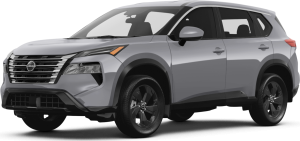
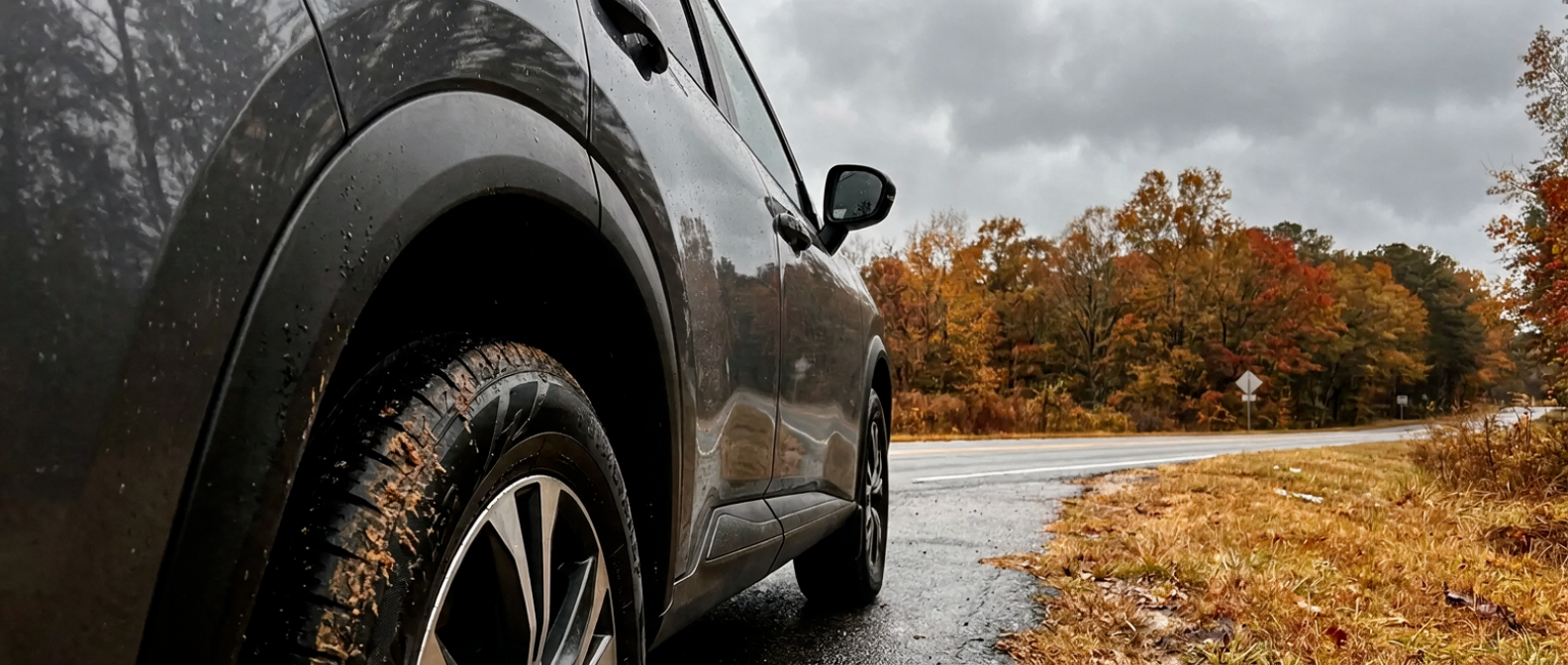
Fall turns US-301 through Orangeburg County into complicated driving. Afternoon showers roll in without much warning, the pavement stays warm enough to mask how much traction you've already lost, and the blend of rural two-lanes, commercial truck traffic, and long straightaways makes worn or underinflated tires a real problem before your dashboard light ever blinks. A 2026 Nissan Rogue or an Altima leaving our lot with 33 PSI and 5/32 of tread is genuinely ready for October. The same vehicle at 27 PSI and 3/32 of tread is not, and the gap between those two states is exactly what this guide covers.
What Tread Depth Does Your Nissan Really Need for Wet Roads on US-301?
South Carolina sits among a handful of states with no statutory minimum tread depth written into law, so nothing on paper stops you from running worn tires, yet the physics of a wet US-301 doesn't care what the code book leaves out. There's a general "unsafe vehicle" provision in the SC Code, but no inspection line where a trooper pulls you over for 2/32 of an inch. That sounds like freedom. It isn't.
The numbers tell you what matters on a wet fall road.
| Tread Depth | Wet-Road Stopping Distance (from 70 mph) | What to Do |
|---|---|---|
| 10/32" (new) | ~195 feet | You're good |
| 4/32" | ~290 feet (~50% longer than new) | Plan your replacement now |
| 2/32" | ~380 feet (~95% longer than new) | Replace immediately |
| Below 2/32" | Tread-wear indicators flush with grooves | Do not drive on wet roads |
Those figures come from tread-depth research that informed federal DOT standards. The legal floor in most states is 2/32 of an inch, where tread-wear indicators are molded to sit flush with the groove. At that depth, according to NHTSA's own technical guidance, a tire has already lost its ability to channel water effectively. Water that can't escape the grooves is water you're hydroplaning on.
Our advice is to plan your replacement at 4/32 of an inch, ahead of the legal floor. On US-301's rural stretches between Orangeburg and Santee, where you're running at speed with commercial trucks and passing zones, the extra stopping distance that 2/32 costs you decides whether you stop before the intersection or after it.
Check your tread with a quarter whenever you're unsure. Insert it into the groove with Washington's head pointing down. If you can see the top of his head, you're at or below 4/32 of an inch. Time to talk to us.
Schedule your tread-depth inspection
What PSI Should Your Nissan Be Running This Fall, and Why Does It Change?
Your Nissan should run the PSI stamped on its doorjamb placard, but that target drifts in fall, because tire pressure drops roughly 1 PSI for every 10-degree Fahrenheit temperature drop, according to NHTSA, so a reading that looks fine at noon can sit low by the morning commute. Our service team keeps an eye on this every October.
Orangeburg's fall mornings can run 15 to 20 degrees cooler than the afternoon high. A tire that reads 33 PSI on a 75-degree afternoon can be sitting at 31 PSI or lower when you leave for work at 7 a.m. That's not a crisis, but it's worth understanding.
Each Nissan model carries its own placard spec (the Kicks and the heavier trucks sit higher than the sedans). The number on the tire sidewall marks the tire's maximum rather than your car's target. Always use the doorjamb sticker.
| Nissan Model | Recommended PSI (front/rear) |
|---|---|
| Altima | 32 PSI |
| Sentra | 33 PSI |
| Kicks | 35 PSI |
| Rogue | 33 PSI |
| Murano | 35 PSI |
| Pathfinder | 35 PSI |
| Armada | 35 PSI |
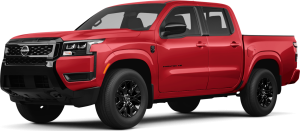
| Frontier | 35 PSI |
Take your reading cold, first thing in the morning before you've driven more than a mile, or after the vehicle has sat for at least three hours. Checking after a highway run will give you a reading that's 4 to 6 PSI high, and you'll think you're fine when you're not.
Nissan's TPMS (Tire Pressure Monitoring System) activates when any tire drops about 25% below its placard spec, a threshold established by federal mandate. For a Rogue at 33 PSI, that light comes on around 25 PSI. Underinflation at that level generates heat through sidewall flexion, and that flexion is the mechanism that leads to tire failure. But the catch is worth noting. You can be meaningfully underinflated for weeks before the light ever appears. The TPMS tells you something is seriously wrong, and a monthly morning check tells you everything.
- Check PSI cold, first thing in the morning before driving
- Use the doorjamb sticker, not the number printed on the tire sidewall
- Recheck after any significant temperature swing (more than 15 degrees)
- Don't forget the spare; it's easy to ignore until you need it
Schedule a Fall Tire Pressure Check
How Often Does Your Nissan Need a Tire Rotation Before Winter Arrives?
Nissan's official maintenance schedule calls for tire rotation every 5,000 to 7,500 miles under standard driving conditions, and most of our Orangeburg lineup fits comfortably inside that window, though a Frontier that spends its days hauling or running gravel tightens up to the shorter end. For the Nissan Frontier specifically, the published schedule from Nissan's own maintenance guide tightens that to every 5,000 miles under severe driving conditions, which includes hauling, towing, or consistent rural-road use. If you're running the Frontier between Orangeburg and a job site on unpaved county roads, that 5,000-mile mark is your number.
The practical split across our lineup breaks down by drivetrain.
- Altima and Sentra (FWD): The front axle handles steering and power delivery, so front tires wear faster. Rotate every 5,000 to 7,000 miles with the standard forward-cross pattern.
- Rogue (FWD standard): Same front-heavy wear pattern. Nissan recommends every 5,000 to 7,500 miles. Stay toward 5,000 if you're running the I-26 corridor regularly.
- Pathfinder and Murano (AWD): All four tires share the torque load, so any tread-depth mismatch stresses the drivetrain. Don't stretch beyond 5,000 miles between rotations.
- Frontier (4x4 or 4x2 with rear-wheel drive): Use the rearward-cross pattern. Figure 5,000 miles if you're working the truck and 7,500 miles for light-duty highway use.
- Armada (4WD): Same principle as the Pathfinder. A 5,000-mile rotation interval keeps all four corners even.
Fall is a natural anchor point. If you're near the 5,000-mile mark and October has arrived, that's your reminder. Rotating on schedule all summer and then letting October slip by is an easy habit to fall into. By December, the front tires on a Rogue or Kicks that hasn't been rotated since July are noticeably more worn than the rears, and you've spent money you didn't need to.
Frequently Asked Questions
Does my Nissan's TPMS light mean the tire is flat?
Not necessarily. Nissan's Tire Pressure Monitoring System activates when a tire pressure drops approximately 25% below the placard recommendation. For most Nissan models, that works out to somewhere between 24 and 27 PSI. A flat sits much lower, but the TPMS light can show up on a tire that's simply shed several pounds of pressure overnight in cooler air. Check all four tires with a gauge when the light comes on. If pressure is 5 to 8 PSI below spec, inflate to the doorjamb target and see if the light clears. If it returns, or if one tire is dramatically lower than the others, bring it in.
South Carolina has no minimum tread depth law. Does that mean 2/32 of an inch is actually safe for driving US-301?
No. SC's lack of a statutory minimum means there's no inspection threshold that flags your tires, but it doesn't change how tires behave on wet pavement. Tread-depth research cited in federal DOT standards shows that at 2/32 of an inch, wet-road stopping distance from 70 mph is close to double what it was when the tires were new. NHTSA cites underinflation and worn tread as the primary mechanical contributors to tire failure. On US-301's high-truck-traffic, rural stretches, the practical threshold is 4/32 of an inch, well above the legal floor that doesn't even exist in this state.
Can I just add air to underinflated tires and skip the inspection?
Topping off pressure is a smart immediate step, but it won't replace an inspection. A tire that keeps losing pressure may have a slow puncture, a bead-seal issue, or a valve-stem problem that adding air won't solve. Tires also develop sidewall damage, cracking from UV exposure, and internal issues you can't spot from outside. Our service team checks tread depth, sidewall condition, and pressure across all four corners during a tire inspection. If the tire is holding pressure fine and wearing evenly, you're done in minutes. If something needs attention, you'll know before US-301 tells you.