

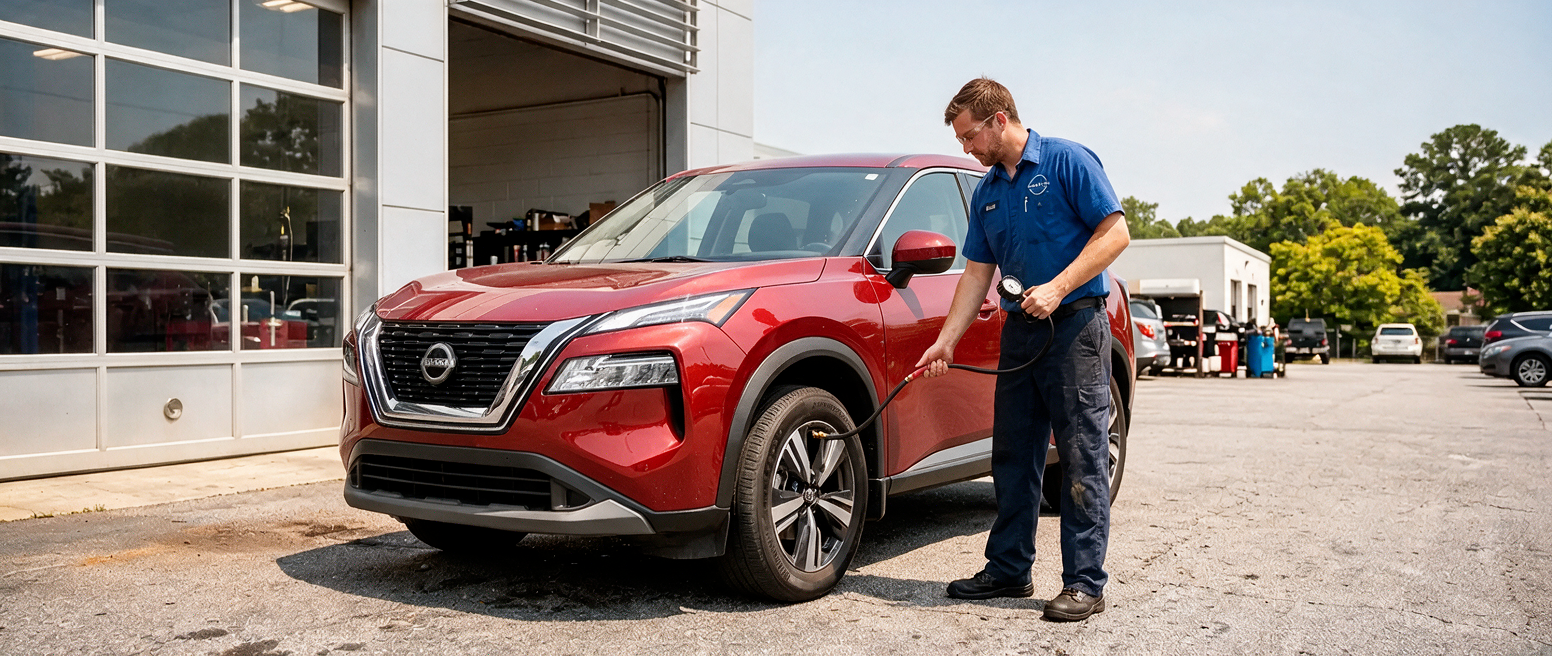
A practical guide to three common maintenance myths that can strand a Nissan on the highway during back-to-school season. Learn why TPMS warning lights don't indicate tire condition, what Nissan's actual oil change intervals are, and why summer heat damages batteries more than winter cold. Discover the real checks your vehicle needs before carpool starts.
Late August in Orangeburg means real heat. The temperature is sitting at 95F, pavement on I-26 soaks up warmth all day, and plenty of Nissan owners glance at the dashboard, see no warning lights, and figure there's nothing wrong. That kind of thinking is what strands cars on the shoulder of the highway during the first week of September.
Three maintenance myths are floating around this community right now, and each one sounds reasonable until you look at how the systems actually work. The truth behind each is short, verifiable, and worth two minutes before school schedules kick into gear.
The short version
- Myth: "My TPMS light is off, so my tires are fine." Reality: Per federal safety standard FMVSS 138, the TPMS warning only triggers when a tire is 25% or more below its recommended pressure. A tire quietly 8 PSI low will show no light at all.
- Myth: "I need an oil change every 3,000 miles." Reality: Nissan recommends oil changes every 5,000 to 7,500 miles for most models, and up to every 10,000 miles with full synthetic, depending on driving conditions and the oil life monitor in your vehicle.
- Myth: "Summer heat is hard on batteries, but I only need to worry in winter." Reality: Heat is actually the primary cause of battery cell damage. A battery approaching its third year should be tested now, not in December.
- All three myths share the same flaw: they sound like they're protecting you, but they're actually causing you to skip checks your Nissan genuinely needs in August heat.
- Bring the car in before carpool starts, not after the first roadside call.
the Nissan Rogue is a common sight around Nissan of Orangeburg heading into back-to-school season, and it's one of the vehicles where these three myths do the most damage. Here's why each one fails in South Carolina's late-summer conditions.
Are These Back-to-School Service Myths Actually True?
No, none of these three myths holds up, though each carries just enough surface logic to sound responsible, which is exactly why they keep spreading. Not one of them survives a close look at the systems your Nissan relies on. Below is the myth-vs-reality breakdown with the numbers behind it.
| The Claim | What's Actually True | Source |
|---|---|---|
| "No TPMS light = tires are properly inflated." | TPMS triggers only at 25% or more below recommended cold pressure. A 2026 Rogue set to 33 PSI needs to drop to roughly 25 PSI before the light appears. | NHTSA federal standard FMVSS 138 |
| "I inflate to the number printed on the tire sidewall." | The sidewall number is the maximum the tire can hold, not the vehicle's target. Your Nissan's recommended PSI is on the driver-side door jamb placard. | Vehicle door jamb placard (Nissan of Orangeburg service dept.) |
| "Change oil every 3,000 miles to be safe." | Nissan recommends 5,000 to 7,500 miles for most models (or up to 10,000 miles with full synthetic). The oil life monitor in newer Nissan vehicles tracks conditions, not just mileage. | Nissan USA maintenance schedule |
| "Summer heat is mainly a winter-battery problem." | Heat degrades battery cells directly; cold only reveals damage already done. A battery typically lasts three to five years, and climate is a major factor. | AAA automotive research |
| "New-ish cars don't need pre-school checks." | Stop-and-go carpool traffic is classified as "severe driving" by most OEM maintenance schedules, shortening intervals for oil, brakes, and filters. | Nissan USA maintenance guidelines |
The Real Cost of Getting These Wrong on I-26
Getting the tire myth wrong on a South Carolina highway in August turns into a very specific kind of trouble, and the physics are what make it dangerous rather than any one thing you did behind the wheel. Black asphalt under direct summer sun can reach surface temperatures of 130 to 160F even when the air reads "only" 90F. A tire that's quietly 8 PSI below spec (no TPMS warning, since it hasn't crossed that 25% threshold) already sits in a stress zone. The sidewall flexes more than it should on every rotation, and on a long run from Orangeburg to Columbia or down to Charleston, that flex builds heat from the inside out.
We check tire pressure against the driver-side door placard rather than the number stamped on the sidewall. On most Nissan Altima trims the placard calls for 32 PSI, and on most Rogue trims, 33 PSI is the baseline cold-pressure target.
Those numbers get chosen because the vehicle's suspension, braking geometry, and fuel efficiency are all calibrated around them. Inflating to the sidewall's maximum figure (often 44 or 51 PSI) overinflates the tire, concentrates wear in the center tread, and makes emergency stops less predictable.
Check pressure cold, which means the car has sat for at least three hours. If you drove to the station first, the reading is already elevated by three to six PSI from friction heat. Don't bleed air from a hot tire to hit the cold-spec number. That just leaves you under-inflated once the tires cool overnight.
The Nissan Sentra and the Nissan Kicks are two other common daily drivers for students and commuters in this area, and the same placard rule applies to both. Check the sticker. It's right there on the door.
What the Nissan Maintenance Schedule Actually Says
Nissan recommends oil and filter changes every 5,000 to 7,500 miles for most models under normal driving conditions, according to the Nissan USA maintenance schedule, which makes the 3,000-mile rule one of the most expensive habits in automotive history. The myth has survived because it sounds cautious, and caution isn't the same thing as accuracy. With full synthetic oil, many 2026 Nissan models can go up to 10,000 miles between changes. Changing oil before that interval does no real harm. You're just spending on a service the engine doesn't need yet.
The Orangeburg context matters here. Russell Street runs through Orangeburg. Carpool routes, short school-zone trips under two miles, and stop-and-go traffic on Russell Street or around Claflin University all count as "severe" driving conditions in Nissan's own maintenance guidelines. Severe conditions shorten the oil change interval, and the reason has nothing to do with the 3,000-mile myth being right. Short trips don't fully warm the engine, so moisture and fuel dilute the oil faster. So the move isn't "change it every 3,000 miles regardless." Watch the oil life monitor if your Nissan has one, and let it tell you when conditions have worn the oil down.
The battery question gets misunderstood just as often. Heat is the primary driver of battery cell degradation, while cold weather mostly reduces cranking power and exposes damage the heat already did. AAA found that car batteries typically last three to five years, with driving habits and climate both significant factors. A battery approaching its third year in a South Carolina summer deserves a load test now, well before the first 6 a.m. school run. That lot bakes in the sun all day.
What our service team watches for heading into September.
- Tires that read fine on a hot afternoon but sit low when measured cold at dawn
- Batteries between two and four years old that haven't had a load test since purchase
- Cabin air filters clogged with summer pollen and road dust (Orangeburg County's long pollen season runs well into summer)
- Wiper blades cracked from three months of UV exposure and heat cycling
- CVT fluid levels on higher-mileage Rogues and Pathfinders, which Nissan flags as a longer-interval check that tends to get overlooked
So What Should You Actually Do Before School Starts?
Before school starts, the single most useful move is one service visit where a technician checks the exact items these myths talk people out of, and a printed list will only get you part of the way there. A checklist is fine as far as it goes. A trained set of eyes on the car is what confirms its condition on the day.
Book a service appointment online before the school-rush crunch hits. You'll want to confirm a handful of things in person.
- Tire pressure cold, from the door placard. Pull the target off the placard, cold, right now, not from the sidewall or from memory.
- Battery load test. Voltage on its own won't tell you whether the battery can hold up to cranking under real August heat. A proper load test will.
- Oil life, beyond mileage. If the vehicle has an oil life monitor, read it. Below 15%, take care of it now. Above 40%, you're good for another month or two.
- Brake pad thickness. Carpool-line driving and school-zone braking wear front pads fast. A visual inspection takes two minutes.
- Cabin and engine air filters. A clogged cabin filter makes the A/C work harder through a South Carolina summer, which strains the compressor. An engine air filter choked with red-clay road dust from the Santee Cooper corridor drags down fuel economy.
None of this takes long. What it does is trade three myths for five verified facts about your specific car's condition on the day your kids start school.
Frequently Asked Questions
Does a Nissan's TPMS light mean my tires need air right now?
Not necessarily, and not always enough air. Per federal safety standard FMVSS 138, the TPMS warning light triggers only when a tire drops 25% or more below the vehicle's recommended cold pressure. On a model with a 33 PSI target, that means the light may not appear until a tire is down to roughly 25 PSI. A tire sitting at 28 or 29 PSI is already affecting fuel economy, handling, and heat resistance without triggering any warning. Check pressure manually against the driver-side door placard, cold, with a calibrated gauge.
How often does a Nissan actually need an oil change?
It depends on the model, the oil type, and your driving conditions. Nissan's maintenance schedule recommends oil and filter changes every 5,000 to 7,500 miles under normal driving conditions for most models. Full synthetic oil on newer models can stretch that interval to 10,000 miles. If your Nissan has an Intelligent Oil Life Monitor, that system tracks real engine conditions rather than miles driven, and it's the most accurate indicator of when you need a change. Frequent short trips and stop-and-go driving in school-zone traffic do count as "severe" conditions and can shorten the real-world interval, so watch the monitor rather than leaning on a fixed number.