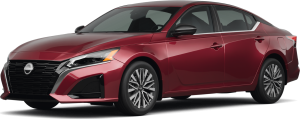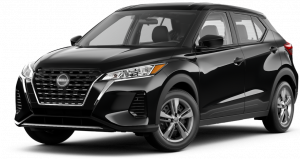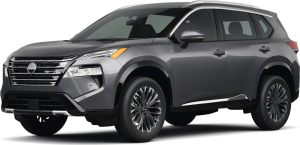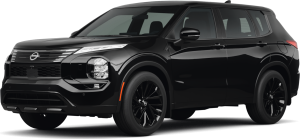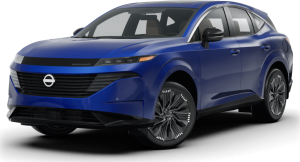

Connect with us!

CATEGORIES

09-03-26

Your I-26 Commute to Columbia Just Got a Lot More Interesting

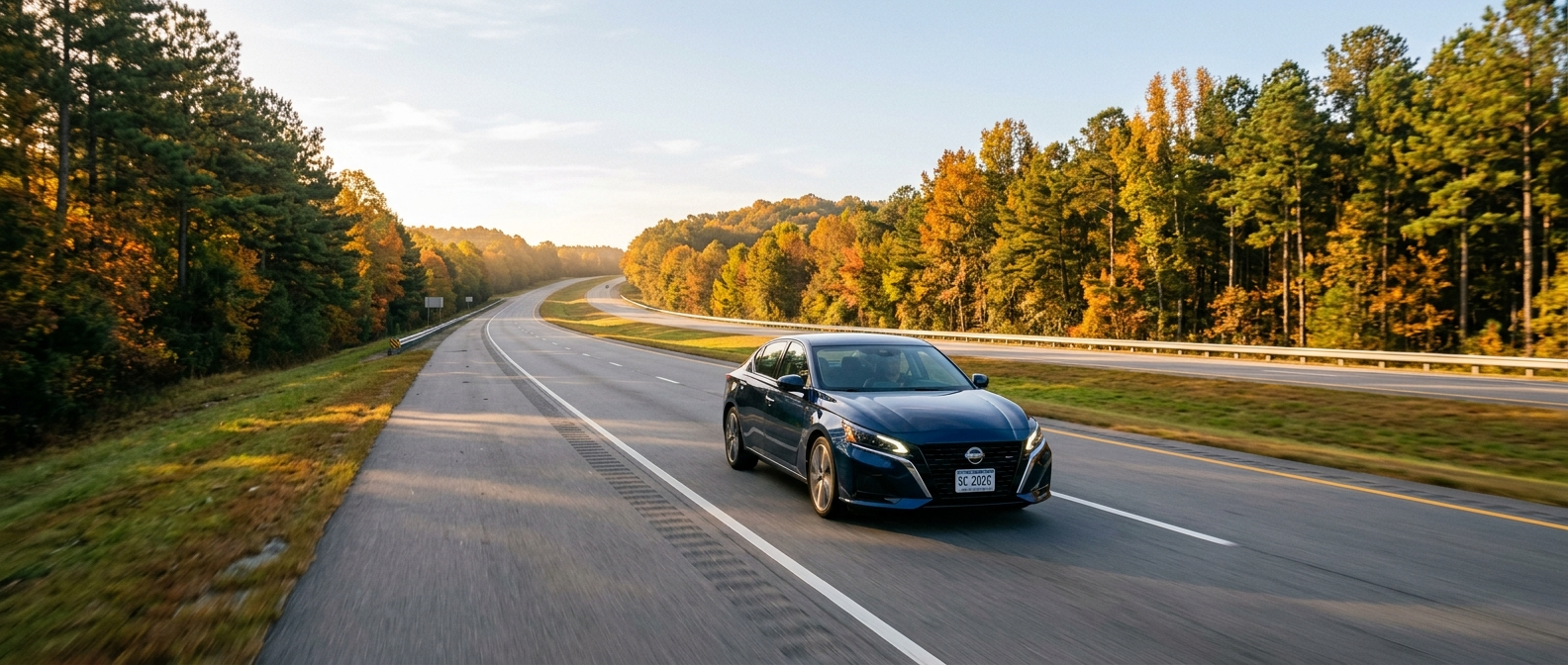
A guide to choosing the right sedan for the I-26 commute between Orangeburg and Columbia. Learn how the 2026 Nissan Altima's highway efficiency, available all-wheel drive, and safety features address the specific demands of a 44-mile interstate run, and why FWD and AWD models suit different driver priorities on this corridor.

If you're driving the Orangeburg-to-Columbia stretch on I-26 five days a week, the 2026 Nissan Altima is built for exactly this run. Forty-four miles each way, mostly flat, mostly 70 mph, minimal stop-and-go once you clear Russell Street. On a profile like that, the EPA's highway estimate of 39 mpg for FWD models stops being a brochure number and starts being something you can count on at the pump.

We'll be straight with you about one thing first. The Altima doesn't offer a hybrid powertrain for 2026. If your baseline is a hybrid Camry, the Altima won't match it on paper. But for a no-fuss midsize sedan that keeps things uncomplicated and stays affordable, that 39-mpg highway figure on a long flat interstate is genuinely in reach. For our Orangeburg customers making the Columbia run, the highway number matters more than the combined figure anyway.

What's the Plan at a Glance?

For anyone mapping out whether the Altima fits their actual routine, here's how the I-26 corridor breaks down from our lot on St. Matthews Road.

SegmentWhat to KnowBest ConditionNotes
Orangeburg city leg (US-601 to on-ramp)5-10 min local drivingLight morning trafficSome stop-and-go near Russell St
I-26 westbound to Columbia (approx. 44 mi)Sustained 70 mph four-laneFall mornings, lower trafficPrime Altima highway-MPG territory
I-126 spur into downtown Columbia3.7 miles of urban drivingOff-peak hoursCity MPG applies here
Return leg eastboundSame corridor, PM trafficWeekday afternoonsReal-world average between city and hwy

The reason it suits the Altima is structural. Most of what you'll drive is open highway.

The Powertrain Behind the Numbers

The 2026 Altima lineup keeps it simple with one powertrain across both available trims, the SV and the SR. You'll find a 2.5-liter four-cylinder producing 188 horsepower under the hood, paired with Nissan's Xtronic CVT. The EPA rates FWD models at 27 mpg city and 39 mpg highway. AWD models come in at 26 city and 36 highway.

One tradeoff here is worth knowing up front. The Altima is one of the only midsize sedans to offer available Intelligent All-Wheel Drive, which is truly useful in wet weather. South Carolina's fall doesn't bring snow or ice, so the AWD's real value on the I-26 corridor shows up during those afternoon thunderstorms that roll through the Midlands. You'll give up a few mpg for that traction insurance. The trade is a fair one. If your commute is dry most days and the mild SC fall-through-winter climate isn't throwing ice at you, the FWD SV trim is where the efficiency story is strongest.

The Xtronic CVT deserves a word too. Older CVTs earned a reputation for an annoying drone, and you'd hear it under hard acceleration. The 2026 version uses D-Step Logic Control, which simulates stepped gear shifts when you press the throttle, like merging onto I-26 from US-601. At a steady 70 mph cruise it settles in quietly and stays efficient. Steady cruise is its sweet spot.

Insider note: The flat terrain between Orangeburg and the Columbia metro is about as favorable as highway driving gets for a naturally aspirated four-cylinder. I-26 through the Midlands doesn't hand the engine grades to fight. For drivers doing this run regularly, that translates directly to real-world numbers that track closer to the EPA highway figure than the combined one.

FWD vs. AWD: Where the Difference Actually Shows Up

The gap between FWD and AWD is real but modest, and you'll see it in two spots, the fuel rating and the tank. The FWD Altima carries a 16.2-gallon tank. At the EPA highway rate of 39 mpg, that works out to a theoretical highway range of roughly 630 miles per fill-up. AWD models run a 15.4-gallon tank and hit 36 mpg highway, putting range around 554 miles. Neither figure requires a stop on the 88-mile round trip to Columbia. Both are comfortable daily numbers.

The Sentra handles a Columbia commute too, and it'll do it at a lower entry point. But the Altima gives you a quieter highway ride, more interior room (over 100 cubic feet of passenger space per the EPA's interior-volume measure), and a larger back seat for carpoolers or afternoon school pickups. For many Orangeburg families, that size difference is the practical reason to move up.

ConfigurationEPA CityEPA HighwayTank SizeApprox. Highway Range
Altima 2.5 FWD27 mpg39 mpg16.2 gal~630 miles
Altima 2.5 AWD26 mpg36 mpg15.4 gal~554 miles

The choice is simple for most Orangeburg commuters. If weather is your concern and you want traction confidence in the rain, AWD earns what it costs. If you're prioritizing every mpg on a route that rarely sees wet pavement, FWD is the call.

Next step: Bring in your last few fill-up receipts and we'll run a quick side-by-side on what your yearly fuel spend looks like against an Altima. Takes about five minutes, and the math tends to be eye-opening.

Why the Altima Fits This Corridor Specifically

The Rogue is the right answer if your life involves cargo hauling, a full family, and the occasional rural Orangeburg County road. We'd tell you that straight. But if your daily reality is drive to Columbia, work, and drive back, the Altima's highway efficiency paired with the comfortable Zero Gravity front seats makes the case without much effort on our part.

NHTSA gave the 2026 Altima a five-star overall safety rating. Every trim comes standard with Safety Shield 360, and you'll get forward-collision warning with automatic emergency braking, blind-spot monitoring, lane-departure warning, and rear cross-traffic alert. Those features earn their keep on I-26 when traffic bunches near the Cayce interchange heading into Columbia.

For 2026, the lineup trimmed down to just the SV and SR. The SV is the volume pick, and it's the one that covers the commuter bases, carries the full Xtronic CVT efficiency, and keeps things uncomplicated. Step up to the SR and you add a sport-tuned suspension and paddle shifters for a slightly more engaging feel. New for 2026, the SR Midnight Edition brings a blacked-out appearance package for drivers who want the styling to match the commute energy.

Check the calendar, because fall is good timing to evaluate this car. The Orangeburg summer heat breaks in September, morning humidity drops, and the A/C load on the engine comes down. Air conditioning is a serious drain on any four-cylinder, and you'll feel it in the numbers. Fewer miles of AC use in the cooler mornings translates directly into better real-world MPG on that first hour of your Columbia run.

Schedule Your Pre-Commute Service Check

Making the Orangeburg Run Work for You

The I-26 commute rewards a deliberate vehicle choice, and if you've been fueling up more often than feels right or the Columbia run feels longer than 44 miles, the 2026 Altima is worth experiencing on that specific stretch of road. Come see what we have at 2827 St. Matthews Road, three miles from the I-26 on-ramp, and let our team walk you through both trims.

The Altima isn't the right answer for every household in Orangeburg. But for the commuter whose daily reality is a long, flat, predictable interstate run five days a week? It's a sensible fit.

By the Nissan of Orangeburg Team | September 2026
Nissan of Orangeburg

2827 St Matthews Rd, Orangeburg, SC 29118

(803) 813-1000

Read More
CATEGORIES »
TAGS »

09-02-26

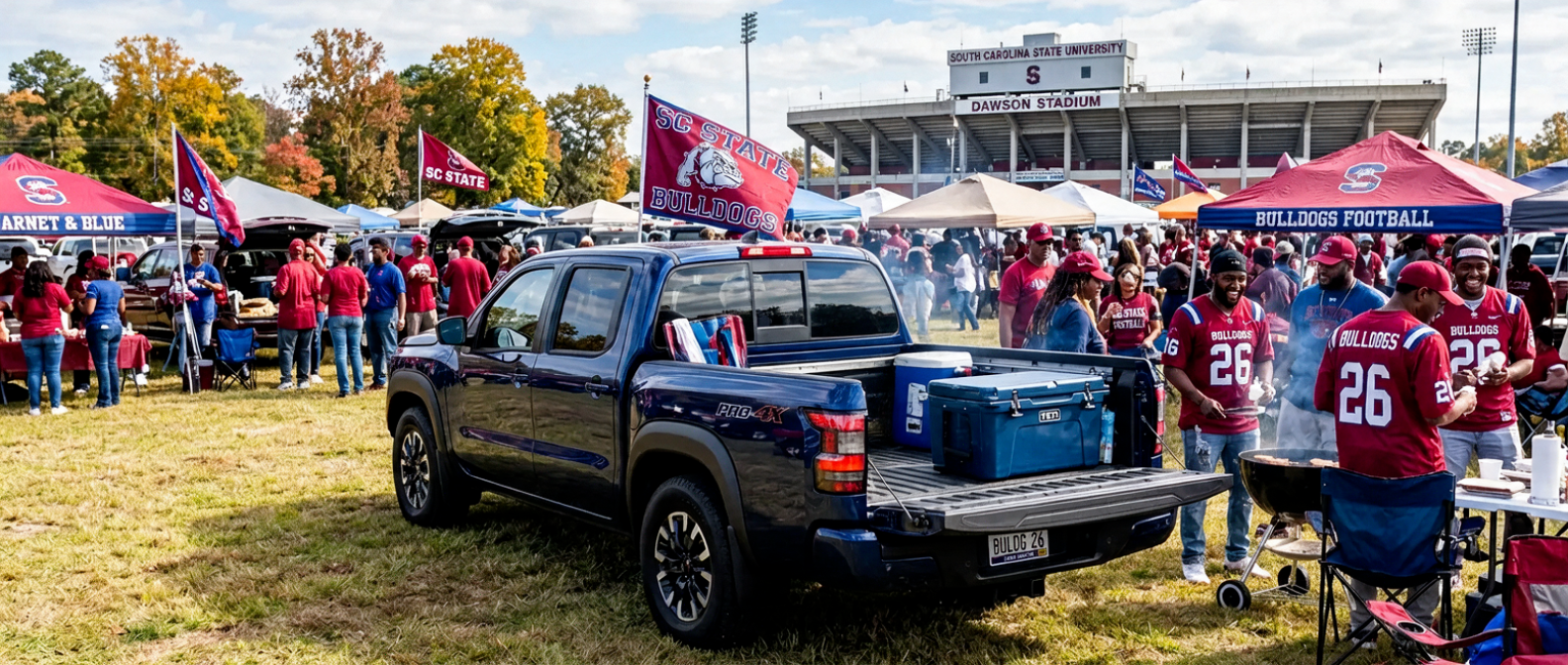
Your Nissan Frontier Game-Day Playbook for SC State Bulldogs Football in Orangeburg

A practical guide to game-day parking and tailgating at SC State Bulldogs football games. Learn how to navigate Oliver C. Dawson Stadium's parking system, arrive at the optimal time, and choose the right Frontier configuration to fit your tailgate setup on campus streets that run tight. This guide covers arrival timing, lot assignments, bed length considerations, and essential preparation for a smooth pregame experience.

Oliver C. Dawson Stadium packs 22,000 fans onto the South Carolina State campus for every home game. Campus parking is gated, assigned by lot, and fills fast on big nights. The Frontier is built for this exact scenario, with enough bed to run a proper tailgate, a turning radius that handles campus streets, and a payload that laughs at a full cooler plus four camp chairs. Here's how to use it right.

Browse the 2026 Nissan Frontier at Nissan of Orangeburg and see what's on our lot before game day.

Where Do You Park, and When?

Plan to roll in at least 90 minutes before kickoff, because campus fills from the outer lots inward and the general public lot goes faster than you'd guess. The 2026 season features several 6 p.m. starts, which puts your arrival target at 4:30 p.m. on those game days.

Per SCSU's official game-day guidance, general public parking is at Gate 2 on Buckley Street, which feeds the Crawford-Zimmerman lot. Point the Frontier there. Pull through cleanly, grab your spot early, and you'll have room to drop a tailgate and actually use it.

Who needs a ticket? Every single person in your vehicle needs a valid ticket to enter campus, not just the driver. Every passenger. Have them ready before you roll through the gate, or you'll be the reason the line backs up onto Buckley Street.

Arrive byLot / GateFrontier fit noteGame-day tip
4:00-4:30 p.m.Gate 2 / Crawford-Zimmerman (Buckley St.)Crew Cab: standard maneuverability; long-bed: pull-through preferredBest early spot selection; room to open the tailgate
5:00 p.m.Gate 2 / Crawford-ZimmermanCrew Cab fits any open slot; long-bed may need end-rowLots filling; tailgate time cut short
5:30 p.m.Gate 2 / Crawford-Zimmerman or overflowAny config; plan on a tighter walk to the gateRush hour; skip the grill, go straight in
After 5:45 p.m.Overflow / streetShort-bed Crew Cab easiest to squeeze inYou'll catch kickoff, not pregame

The Maneuvering and Fit Play

Campus streets around Dawson Stadium run tight, so the Crew Cab with the standard 59.5-inch bed is the easier truck to thread, while the long-bed trades a little parking patience for real cargo room. We'll be straight with you about that on the lot. Oliver C. Dawson Stadium sits on the South Carolina State campus in Orangeburg. The shorter wheelbase on that standard bed keeps the rear end from swinging wide in parking rows, and the long-bed configuration (73.3 inches) gives you significantly more cargo room but asks for a little more patience at crowded intersections on College Street.

Check current Frontier inventory to see which cab and bed configurations we have in stock right now.

The practical split comes down to your setup. If you're running a full spread (grill, 150-quart cooler, pop-up canopy, four chairs), the long-bed Crew Cab SV or PRO-4X earns its extra length. For a lighter setup with a portable grill and a couple of chairs, the standard Crew Cab short-bed parks more easily and still carries everything you need. Nissan lists payload at up to 1,590 lbs on the Crew Cab 4x2, so the weight isn't the concern. Space is.

The Frontier's three available Utili-track channel positions in the bed earn their keep here. Anchor a canopy frame, tie down a cooler, and slide a portable grill in sideways, and none of it moves when you back in hard. The payoff is the gap between a usable setup and a scrambled mess at the tailgate.

Explore Frontier financing options if you're weighing a trade-up before football season ends.

Insider parking tip: For Homecoming (October 24, Norfolk State), plan on arriving even earlier than usual. Homecoming crowds at Dawson have historically pushed well past a normal-game crowd. The Marching 101 starts its pregame performance before the general gates fill, and that pulls people in early.
Tailgate etiquette at Dawson: SC State is a gun-free, smoke-free campus. Open-flame grills are common in the parking areas before kickoff, but once you're asked to clear for pedestrian flow, break it down quickly. Being the truck that's still running a full grill at 5:55 p.m. is a way to make enemies of 300 people trying to get to their seats.

Run through this list before you leave the house, because the Frontier's bed will carry all of it, but forgetting one item on a hot September Saturday in Orangeburg turns a quick errand into a 40-minute round trip.

  • [ ] Valid tickets for every passenger in the truck (SCSU policy: no entry without one)
  • [ ] Clear bag for stadium entry (12 x 6 x 12 in. max per SCSU official policy)
  • [ ] Cooler secured with Utili-track tie-downs (a full cooler shifts hard on campus speed bumps)
  • [ ] Portable grill or camp stove (verify local fire restrictions in effect for the date)
  • [ ] Pop-up canopy tied at all four corners (September in Orangeburg runs hot and humid)
  • [ ] Camp chairs and a folding table strapped flat against the bed wall
  • [ ] Sunscreen and a spray bottle for the tailgate (afternoon heat before evening kickoff is real)
  • [ ] Garnet and blue (or white for whiteout games per SCSU game-day calls)
  • [ ] Cash and card for food vendors on campus
  • [ ] Jumper cables or a jump pack (a common sense item on a long tailgate day with accessories running)
  • [ ] Truck ID and registration visible in the cab

Schedule a pre-season service check before your first road trip to Dawson so you're not managing a warning light in the parking lot.

Value Your Trade Before Football Season Ends

September kicks off Orangeburg's best stretch of football, and the Frontier's built to handle exactly this kind of day. Capable enough to carry everything. Compact enough to navigate campus. Go enjoy it.

Nissan of Orangeburg

2827 St Matthews Rd, Orangeburg, SC 29118

(803) 813-1000

Read More
CATEGORIES »
TAGS »

09-01-26

How to Pick the Right 2026 Nissan Rogue Setup for Fall Drives Near Edisto Memorial Gardens

A practical guide to choosing the right 2026 Nissan Rogue setup for fall driving around Orangeburg. Learn how drivetrain selection, safety tech features, and cargo space align with local roads, highway commutes, and seasonal needs, from Edisto Memorial Gardens trips to I-26 corridor runs.

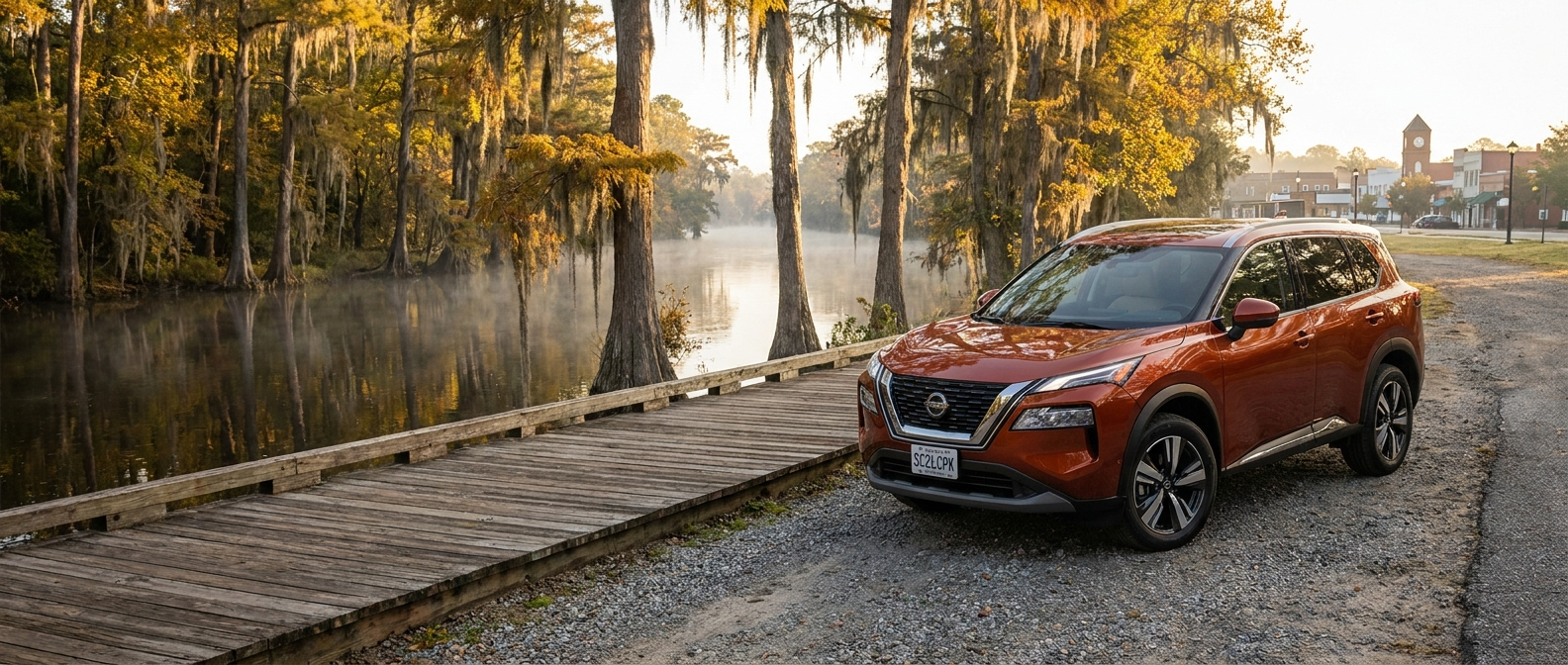
September in Orangeburg reads a little differently than it does most places. The air cools just enough to make a slow drive along the Edisto River worth doing at half speed. Cypress trees at Edisto Memorial Gardens start turning amber. And the I-26 corridor opens into something you'll want to take at an easy pace instead of a commuter crawl. So the Rogue question stops being "which one fits my budget" and becomes "which one fits how I actually drive around here."

We field this one at Nissan of Orangeburg because we live here too. The answer gets specific once you line it up against local roads. The biggest choice on the 2026 Rogue isn't a color or a trim level. It's the drivetrain, and if you're moving higher in the lineup, which safety tech tier you want for those long I-26 stretches toward Columbia or Charleston.

The short version

  • FWD (front-wheel drive) is the right call for most Orangeburg families. The EPA rates the 2026 Rogue FWD at 29 city / 36 highway / 32 combined mpg. Our flat roads, the US-301 corridor, and the Edisto Gardens parking lot don't demand all-wheel drive.
  • AWD adds real value on wet fall mornings and for anyone running I-26 frequently. The EPA rates it at 28 city / 35 highway / 31 combined mpg. One mpg combined is the honest tradeoff.
  • Rock Creek AWD drops to 27 city / 32 highway / 29 combined mpg (EPA). Worth it only if you're threading dirt trails around the Edisto River or heading to Lake Marion boat ramps.
  • ProPILOT Assist (SL trim and up) is the one feature worth stretching your budget for if the Columbia or Charleston commute is real for you.
  • Cargo space is 36.5 cubic feet with seats up, 74.1 cubic feet with rear seats folded (Nissan). Pack the picnic gear or the stroller without worrying.

What Actually Matters When Choosing Your Rogue Setup for Local Fall Driving?

Orangeburg isn't mountain country, so the setup that matters here comes down to drivetrain and safety tech rather than rugged hardware, though a wet leaf-covered morning still rewards a little extra grip if you run the highway often. The variables driving this decision differ from what you'd read in a generic national buying guide.

OptionBest ForKey SpecTradeoff
Rogue S / SV FWDLocal runs, Edisto Gardens, commuter dutyEPA 32 mpg combinedNo AWD; less grip on wet leaf-covered asphalt
Rogue SV / SL AWDI-26 corridor, wet fall mornings, light boat-ramp useEPA 31 mpg combined1 mpg combined vs. FWD
Rogue Rock Creek AWDEdisto River dirt access roads, Lake Marion boat rampsEPA 29 mpg combinedLowest mpg in the lineup; overkill for paved drives
ProPILOT Assist (SL+)Columbia / Charleston highway commutesCombines Intelligent Cruise Control and Steering AssistHigher trim investment
Divide-N-Hide cargo (Platinum)Families with strollers, sports gear, garden center haulsUp to 74.1 cu ft with seats foldedTop trim required
The EPA rates the 2026 Rogue FWD at 32 mpg combined and AWD at 31 mpg combined. For most Orangeburg-area driving, that one-mpg gap is the entire real-world tradeoff between the two drivetrains.

FWD vs. AWD: The Honest Case for Orangeburg Roads

For most fall driving around Orangeburg, front-wheel drive is the right pick, because our roads stay flat and the weather holds mild well into October, though a driver running I-26 in wet early mornings will feel the pull toward all-wheel drive. South Carolina's fall isn't the Smokies, and we rarely see ice before December. Browse our current Rogue inventory to see which drivetrains are in stock right now.

Front-wheel drive handles the majority of fall drives in and around Orangeburg. The Rogue's 1.5L VC-Turbo engine puts out 201 horsepower and 225 lb-ft of torque (Nissan), and the CVT keeps that power smooth on US-301 and the flat two-lane roads out toward the Edisto corridor. You won't need it. All-wheel drive doesn't change the loop through Edisto Memorial Gardens, where the parking area is paved, the boardwalk winds through the Horne Wetlands on a flat path, and the biggest variable is a wet October morning when fallen leaves mat down on the pavement.

When does all-wheel drive earn its keep? Not in deep mud, but in the low-grip scenario a South Carolina fall actually produces. Warm afternoons, cool nights, morning dew, leaf fall. Nissan's Intelligent AWD is reactive rather than permanent. It monitors traction and sends power rearward automatically when grip drops, so you don't have to think about it. For families heading north on I-26 for work several days a week, that passive reassurance is worth something.

Team observation: The US-301 corridor and the I-26 run to Columbia are where all-wheel drive pays off. You'll feel it on the ramps out of Orangeburg, where a curve or two rewards confident traction on a wet September morning, especially with a full family aboard.

See financing options if the AWD trim is the one you want but the budget needs a look.

Matching the Rogue's Features to How You Actually Drive Around Here

Fall around Orangeburg isn't one big trip, it's a string of smaller ones, so the feature that matters most shifts with each errand rather than sitting in any single spec, and matching the Rogue to your season means weighing safety tech and cargo room against how often you actually leave the county. A Saturday coffee run to pick up pumpkins. A slow loop through Edisto Memorial Gardens once the roses finish their second bloom (they run through November, per the City of Orangeburg). A long I-26 run to visit family in Charleston. Each of those pulls on a different part of what this Rogue offers.

ProsCons
Safety Shield 360 is standard on every trim (automatic braking, blind-spot warning, lane departure)Rock Creek trim sacrifices highway mpg for off-road styling most SC buyers won't use
ProPILOT Assist on I-26 genuinely reduces fatigue on the 75-minute Columbia-to-Charleston stretchProPILOT Assist is SL trim and above only, not base
74.1 cubic feet of cargo with seats folded handles full-family fall gear (Nissan)Divide-N-Hide cargo system requires Platinum trim
8.2 inches of ground clearance (consistent across all trims) handles Orangeburg's railroad crossings and park access roads1,500-lb tow rating is light (properly equipped). Limits to small trailers and personal watercraft
Roses at Edisto Gardens bloom through November; fall really does earn this driveFWD in wet leaf conditions requires attentive driving regardless of brand

A specific note on Safety Shield 360. Nissan lists this as standard on every 2026 Rogue trim. For a parent loading kids into the back at the Edisto Gardens parking area, having automatic emergency braking and rear cross-traffic alert work every time without an upgrade is genuinely useful. You won't have to think about which trim includes it.

The ProPILOT Assist question deserves real thought. It pairs Intelligent Cruise Control with Steering Assist to manage stop-and-go and highway lane-centering, and Nissan offers versions 1.1 and 2.1 on higher trims. If the I-26 corridor is your daily or weekly reality, this feature reshapes that drive. If you almost never leave Orangeburg County, it's a nice-to-have. We'll tell you that straight.

Match the Gear to How You Really Drive This Fall

For a family threading between Edisto Memorial Gardens, the I-26 corridor, and the Lake Marion boat ramps this fall, the Rogue in the right configuration is plenty, though anyone planning on a third row of kids or serious towing will want to size up. The Nissan Pathfinder is that step up. The Rogue's 36.5 cubic feet of cargo behind the rear seats (Nissan) still fits a weekend's worth of fall outing gear without putting anything on the roof, and you won't miss the extra size on a garden-center haul.

Run through it in five quick steps.

  1. Start with FWD if your driving is mostly Orangeburg County, local errands, and the occasional Charleston trip. EPA 32 mpg combined is a real number for flat South Carolina roads.
  2. Move to AWD if you drive I-26 frequently, run early-morning routes when the roads are wet, or want the passive traction assurance for a vehicle carrying your family.
  3. Add ProPILOT Assist (SL trim or above) if highway miles are a genuine, recurring part of your week, not just a twice-a-year thing.
  4. Skip Rock Creek unless you are actively accessing unpaved boat-ramp roads to the Edisto River or Lake Marion regularly. The 29 mpg combined (EPA) is a real cost on every fill-up.
  5. Consider Platinum only if the Divide-N-Hide cargo system or available ProPILOT Assist 2.1 features are on your must-have list.

Fall at Edisto Memorial Gardens is a low-key, wandering kind of drive. The boardwalk, the cypress stands, the rose beds still going in September and October. None of that asks for an adventure-spec SUV. What it rewards is one that's comfortable, efficient, and carrying the safety tech to get everyone home easily. For most of us here, that's the Rogue in FWD or standard AWD.

See What Your Current Vehicle Is Worth

Frequently Asked Questions

Does the 2026 Nissan Rogue need AWD for fall drives around Orangeburg, SC?

No, not for most local fall driving. The Orangeburg area is flat, and our fall weather stays mild through October. The EPA-rated 32 mpg combined on FWD handles daily drives, the US-301 corridor, and visits to Edisto Memorial Gardens without any traction concern. AWD becomes a meaningful upgrade if you're frequently on I-26 in early-morning wet conditions, or if you want the added confidence of Intelligent AWD on family-loaded highway trips toward Columbia or Charleston.

What is the cargo space in the 2026 Nissan Rogue?

Nissan lists the 2026 Rogue at 36.5 cubic feet behind the rear seats with all passengers on board, and up to 74.1 cubic feet with the rear seats folded flat. The available Divide-N-Hide cargo system (standard on the Platinum trim) adds flexible dividers for hidden storage or a flat load floor. Wide-opening rear doors make loading strollers, camp chairs, or coolers easier than it looks on paper.

Nissan of Orangeburg

2827 St Matthews Rd, Orangeburg, SC 29118

(803) 813-1000

Read More
CATEGORIES »
TAGS »

08-31-26

3 Nissan SUVs That Are Ready for Your Labor Day Weekend Trip from Orangeburg

A practical guide to choosing the right Nissan SUV for Labor Day weekend travel from Orangeburg. Learn how the Rogue delivers fuel economy for highway runs to Charleston, the Pathfinder balances eight seats with towing capacity for family trips to Santee or the coast, and the Armada handles heavier trailers and larger groups with its twin-turbo V6 and 8,500-pound towing limit.

Want to drive to Charleston and back without stopping twice for gas? You'll want the Rogue. Full stop.

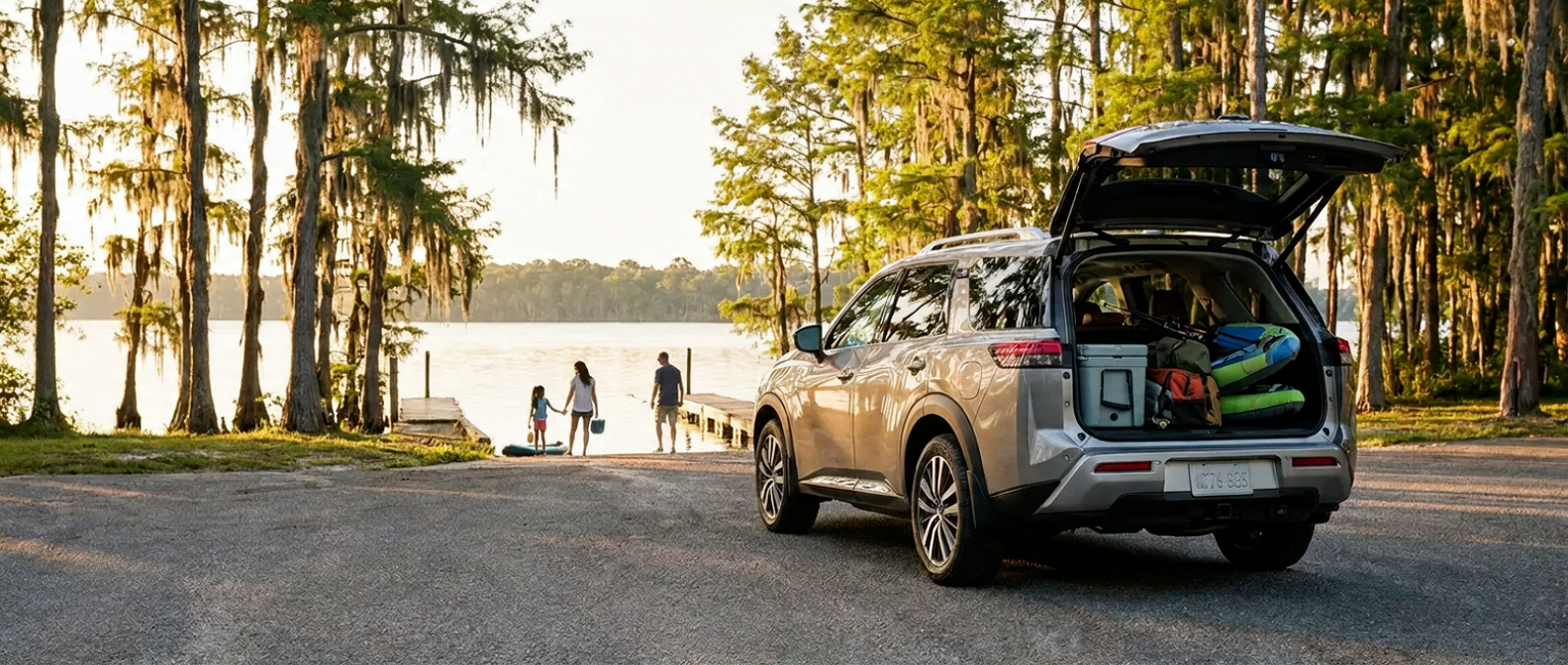
But if you're towing a jon boat out to Lake Marion, or loading three rows with cousins and coolers for Edisto Beach, a different Nissan makes more sense. Labor Day weekend from Orangeburg puts you about 45 minutes from Santee State Park, roughly 75 minutes from the Charleston peninsula, and squarely in the heart of South Carolina's late-August heat. Fuel economy matters. Cargo space matters. And if you've got a trailer hitch involved, towing capacity matters a lot.

We rank the three Nissan SUVs our team reaches for first when you're planning a trip like that, with the verified specs behind each pick below.

Check out the Nissan Rogue on our lot

The 2026 Nissan SUV Lineup for Labor Day Road Trips: Quick Ranking

RankPickBest ForStandout Spec
1RogueSolo travelers, couples, small families (fuel economy run to Charleston or the coast)EPA-rated 36 mpg highway (FWD)
2PathfinderFamilies of 5-8, lake weekends with a light trailerUp to 6,000 lb towing, seats 8, 27 mpg highway
3ArmadaLarge groups, heavy towners, go-big tripsUp to 8,500 lb towing, 425 hp twin-turbo V6

No. 1: Rogue Is the Fuel Economy Champion for the I-26 Run

For a trip built around highway miles and fuel savings, the Rogue answers best, since Orangeburg sits right on I-26 with Charleston 75 miles southeast and Columbia 40 miles northwest, both popular Labor Day destinations and both pure highway running. The 2026 Rogue's 1.5L VC-Turbo engine earns an EPA-estimated 36 mpg on the highway in FWD configuration, which means a round trip to Charleston costs you roughly one tank. Call it a real number, not a combined-cycle figure that's inflated by mild city driving.

There's a real tradeoff, though. The Rogue tows only up to 1,500 pounds (when set up for it). A kayak cart or a light utility trailer works fine. A bass boat does not.

What it does give you is 74.1 cubic feet of maximum cargo space when the second row folds flat, and 36.3 cubic feet with seats up. You get room for beach chairs, a cooler, luggage for two or three, and the inflatable something your kids insist on bringing. The Rogue also carries Nissan's Intelligent AWD system on available trims, useful if your coastal getaway involves a sandy access road off SC-174 near Edisto Island. For a two- or three-person trip focused on fuel savings and comfort, it's the strongest fit in the lineup. The Rogue wins that trip.

Explore Financing Options for the Rogue

No. 2: Pathfinder Handles the Full Family Haul to Santee or the Beach

See available Pathfinder inventory

For a full family haul out of Orangeburg, the Pathfinder is the practical answer, pairing eight seats with up to 6,000 pounds of towing capacity when properly equipped and an EPA-estimated 27 mpg on the highway for standard FWD trims. You won't find that combination easy to beat for a genuine family trip.

Think about what Labor Day actually looks like for a lot of Orangeburg families. You've got two adults, three or four kids, a grandmother, a cooler, and a carry-on bag per person. All of that fills a five-seat SUV past capacity before you've touched the bikes or the fishing rods. The Pathfinder's EZ FLEX second-row seating lets an adult in row two slide the seat forward (even with a child safety seat installed in the outboard position) so a grandparent or teenager can get to the third row without a gymnastics routine. It holds 80.5 cubic feet of total cargo when rows two and three fold flat, and 16.6 cubic feet behind the third row with everyone aboard.

Santee State Park on Lake Marion is about 45 minutes east of Orangeburg on I-26 and US-301. If your trip includes a small boat or a PWC on a trailer, the Pathfinder can pull it. The 3.5L V6 produces 284 horsepower and 259 lb-ft of torque (295 hp and 270 lb-ft in the Rock Creek trim), paired with a nine-speed automatic. Standard trims max out at 3,500 pounds of towing, so make sure you're inside that range or step up to a towing package or the Rock Creek trim to reach the 6,000-pound ceiling.

One tradeoff is worth naming. The Pathfinder's fuel economy runs noticeably below what the Rogue delivers on the highway. The gap is significant when you're towing. Call it a fair trade for eight seats and genuine trailer capability, though it's worth knowing before you plan a 300-mile loop of the Lowcountry.

The 2026 Nissan Pathfinder earns a NHTSA 5-Star Overall Safety Rating, which matters when you're running a loaded three-row SUV down I-26 at summer-weekend speeds.

No. 3: Armada Is the Right Call When You're Pulling Something Big

Browse Armada options at Nissan of Orangeburg

When you're pulling something big for the weekend, the Armada is the clear call, and the 2026 model earns that with a full powertrain overhaul, though it asks for more room and more fuel than the other two in return. Nissan replaced the old 5.6L V8 with a 3.5L twin-turbocharged V6 that produces 425 horsepower and 516 lb-ft of torque (460 hp on the NISMO trim with premium fuel), and it still tows up to 8,500 pounds when properly equipped. Enough for a pontoon boat, a pair of jet skis plus a gear trailer, or whatever you've been waiting for a long weekend to justify hitching up.

The body-on-frame construction is part of why the Armada can handle that kind of load comfortably where a unibody crossover starts working too hard. It also seats up to eight with a second-row bench, and folds flat to 97.1 cubic feet of cargo when you'd rather haul gear than people.

The honest caveat here is size and fuel cost. The Armada is a full-size, body-on-frame SUV. Parking in downtown Charleston or threading through a Beaufort neighborhood is a different experience than it is in a Rogue. And the twin-turbo V6 returns noticeably lower highway fuel economy than either the Rogue or the Pathfinder. If your Labor Day trip is a day at Edisto Beach with four people and no trailer, the Armada is more truck than you need. But if you're loading up the boat and the whole extended family, nothing else in our lineup is going to do that job as well.

Pre-trip check: South Carolina late-August heat stays consistent. Tires run hotter, and trailer lighting connections that were fine in April sometimes show their age under sustained load. Before you hitch anything up for Labor Day weekend, let our service team run a tow-prep check that'll cover tire pressure, brake fluid, trailer lighting, and hitch hardware. It takes about 20 minutes and saves a lot of trouble on US-301.

The Real Deciding Factor: Match the SUV to the Trip, Not the Other Way Around

The right move is to match the SUV to the trip, so with two or three people and no trailer running to Charleston or Columbia, you'll find the Rogue's 36 mpg highway figure and generous cargo floor hard to beat. Fuel savings on a round trip are real, and the compact footprint makes city parking manageable, or at least easier.

For a family of five or more, or a lightweight boat headed for Lake Marion, the Pathfinder is the practical center of the lineup. Eight seats, real towing capacity when configured for it, and 27 mpg highway means you're not sacrificing efficiency entirely for size.

If the trailer is heavy or the headcount is large and non-negotiable, the Armada is built for exactly that scenario. Its 8,500-pound tow rating and body-on-frame structure handle loads that would stress a crossover, and 97.1 cubic feet of max cargo means nobody's lashing gear to the roof.

All three are on our lot right now. Come in, describe your actual trip, and we'll point you at the right one.

See our current Nissan SUV inventory

Nissan of Orangeburg

2827 St Matthews Rd, Orangeburg, SC 29118

(803) 813-1000

Read More
CATEGORIES »
TAGS »

08-28-26

Your Nissan Is Fine for Back to School: Three Myths That Make That Statement Dangerous

A practical guide to three common maintenance myths that can strand a Nissan on the highway during back-to-school season. Learn why TPMS warning lights don't indicate tire condition, what Nissan's actual oil change intervals are, and why summer heat damages batteries more than winter cold. Discover the real checks your vehicle needs before carpool starts.

Late August in Orangeburg means real heat. The temperature is sitting at 95F, pavement on I-26 soaks up warmth all day, and plenty of Nissan owners glance at the dashboard, see no warning lights, and figure there's nothing wrong. That kind of thinking is what strands cars on the shoulder of the highway during the first week of September.

Three maintenance myths are floating around this community right now, and each one sounds reasonable until you look at how the systems actually work. The truth behind each is short, verifiable, and worth two minutes before school schedules kick into gear.

The short version

  • Myth: "My TPMS light is off, so my tires are fine." Reality: Per federal safety standard FMVSS 138, the TPMS warning only triggers when a tire is 25% or more below its recommended pressure. A tire quietly 8 PSI low will show no light at all.
  • Myth: "I need an oil change every 3,000 miles." Reality: Nissan recommends oil changes every 5,000 to 7,500 miles for most models, and up to every 10,000 miles with full synthetic, depending on driving conditions and the oil life monitor in your vehicle.
  • Myth: "Summer heat is hard on batteries, but I only need to worry in winter." Reality: Heat is actually the primary cause of battery cell damage. A battery approaching its third year should be tested now, not in December.
  • All three myths share the same flaw: they sound like they're protecting you, but they're actually causing you to skip checks your Nissan genuinely needs in August heat.
  • Bring the car in before carpool starts, not after the first roadside call.

the Nissan Rogue is a common sight around Nissan of Orangeburg heading into back-to-school season, and it's one of the vehicles where these three myths do the most damage. Here's why each one fails in South Carolina's late-summer conditions.

Are These Back-to-School Service Myths Actually True?

No, none of these three myths holds up, though each carries just enough surface logic to sound responsible, which is exactly why they keep spreading. Not one of them survives a close look at the systems your Nissan relies on. Below is the myth-vs-reality breakdown with the numbers behind it.

The ClaimWhat's Actually TrueSource
"No TPMS light = tires are properly inflated."TPMS triggers only at 25% or more below recommended cold pressure. A 2026 Rogue set to 33 PSI needs to drop to roughly 25 PSI before the light appears.NHTSA federal standard FMVSS 138
"I inflate to the number printed on the tire sidewall."The sidewall number is the maximum the tire can hold, not the vehicle's target. Your Nissan's recommended PSI is on the driver-side door jamb placard.Vehicle door jamb placard (Nissan of Orangeburg service dept.)
"Change oil every 3,000 miles to be safe."Nissan recommends 5,000 to 7,500 miles for most models (or up to 10,000 miles with full synthetic). The oil life monitor in newer Nissan vehicles tracks conditions, not just mileage.Nissan USA maintenance schedule
"Summer heat is mainly a winter-battery problem."Heat degrades battery cells directly; cold only reveals damage already done. A battery typically lasts three to five years, and climate is a major factor.AAA automotive research
"New-ish cars don't need pre-school checks."Stop-and-go carpool traffic is classified as "severe driving" by most OEM maintenance schedules, shortening intervals for oil, brakes, and filters.Nissan USA maintenance guidelines

The Real Cost of Getting These Wrong on I-26

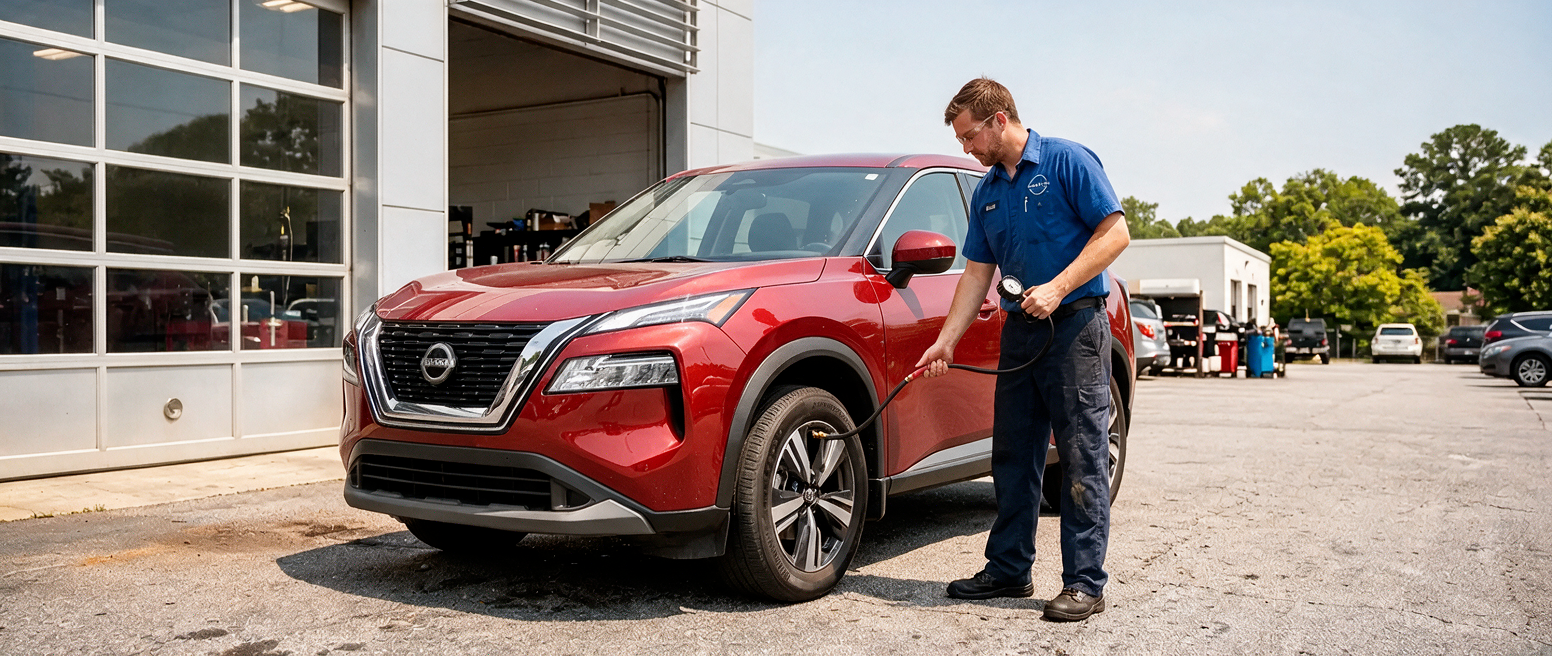
Getting the tire myth wrong on a South Carolina highway in August turns into a very specific kind of trouble, and the physics are what make it dangerous rather than any one thing you did behind the wheel. Black asphalt under direct summer sun can reach surface temperatures of 130 to 160F even when the air reads "only" 90F. A tire that's quietly 8 PSI below spec (no TPMS warning, since it hasn't crossed that 25% threshold) already sits in a stress zone. The sidewall flexes more than it should on every rotation, and on a long run from Orangeburg to Columbia or down to Charleston, that flex builds heat from the inside out.

We check tire pressure against the driver-side door placard rather than the number stamped on the sidewall. On most Nissan Altima trims the placard calls for 32 PSI, and on most Rogue trims, 33 PSI is the baseline cold-pressure target.

Those numbers get chosen because the vehicle's suspension, braking geometry, and fuel efficiency are all calibrated around them. Inflating to the sidewall's maximum figure (often 44 or 51 PSI) overinflates the tire, concentrates wear in the center tread, and makes emergency stops less predictable.

Check pressure cold, which means the car has sat for at least three hours. If you drove to the station first, the reading is already elevated by three to six PSI from friction heat. Don't bleed air from a hot tire to hit the cold-spec number. That just leaves you under-inflated once the tires cool overnight.

The Nissan Sentra and the Nissan Kicks are two other common daily drivers for students and commuters in this area, and the same placard rule applies to both. Check the sticker. It's right there on the door.

What the Nissan Maintenance Schedule Actually Says

Nissan recommends oil and filter changes every 5,000 to 7,500 miles for most models under normal driving conditions, according to the Nissan USA maintenance schedule, which makes the 3,000-mile rule one of the most expensive habits in automotive history. The myth has survived because it sounds cautious, and caution isn't the same thing as accuracy. With full synthetic oil, many 2026 Nissan models can go up to 10,000 miles between changes. Changing oil before that interval does no real harm. You're just spending on a service the engine doesn't need yet.

The Orangeburg context matters here. Russell Street runs through Orangeburg. Carpool routes, short school-zone trips under two miles, and stop-and-go traffic on Russell Street or around Claflin University all count as "severe" driving conditions in Nissan's own maintenance guidelines. Severe conditions shorten the oil change interval, and the reason has nothing to do with the 3,000-mile myth being right. Short trips don't fully warm the engine, so moisture and fuel dilute the oil faster. So the move isn't "change it every 3,000 miles regardless." Watch the oil life monitor if your Nissan has one, and let it tell you when conditions have worn the oil down.

Nissan's maintenance schedule recommends oil changes every 5,000 to 7,500 miles under normal conditions, and the oil life monitor in newer models tracks real driving conditions, not just odometer miles.

The battery question gets misunderstood just as often. Heat is the primary driver of battery cell degradation, while cold weather mostly reduces cranking power and exposes damage the heat already did. AAA found that car batteries typically last three to five years, with driving habits and climate both significant factors. A battery approaching its third year in a South Carolina summer deserves a load test now, well before the first 6 a.m. school run. That lot bakes in the sun all day.

What our service team watches for heading into September.

  • Tires that read fine on a hot afternoon but sit low when measured cold at dawn
  • Batteries between two and four years old that haven't had a load test since purchase
  • Cabin air filters clogged with summer pollen and road dust (Orangeburg County's long pollen season runs well into summer)
  • Wiper blades cracked from three months of UV exposure and heat cycling
  • CVT fluid levels on higher-mileage Rogues and Pathfinders, which Nissan flags as a longer-interval check that tends to get overlooked

So What Should You Actually Do Before School Starts?

Before school starts, the single most useful move is one service visit where a technician checks the exact items these myths talk people out of, and a printed list will only get you part of the way there. A checklist is fine as far as it goes. A trained set of eyes on the car is what confirms its condition on the day.

Book a service appointment online before the school-rush crunch hits. You'll want to confirm a handful of things in person.

  • Tire pressure cold, from the door placard. Pull the target off the placard, cold, right now, not from the sidewall or from memory.
  • Battery load test. Voltage on its own won't tell you whether the battery can hold up to cranking under real August heat. A proper load test will.
  • Oil life, beyond mileage. If the vehicle has an oil life monitor, read it. Below 15%, take care of it now. Above 40%, you're good for another month or two.
  • Brake pad thickness. Carpool-line driving and school-zone braking wear front pads fast. A visual inspection takes two minutes.
  • Cabin and engine air filters. A clogged cabin filter makes the A/C work harder through a South Carolina summer, which strains the compressor. An engine air filter choked with red-clay road dust from the Santee Cooper corridor drags down fuel economy.

None of this takes long. What it does is trade three myths for five verified facts about your specific car's condition on the day your kids start school.

Frequently Asked Questions

Does a Nissan's TPMS light mean my tires need air right now?

Not necessarily, and not always enough air. Per federal safety standard FMVSS 138, the TPMS warning light triggers only when a tire drops 25% or more below the vehicle's recommended cold pressure. On a model with a 33 PSI target, that means the light may not appear until a tire is down to roughly 25 PSI. A tire sitting at 28 or 29 PSI is already affecting fuel economy, handling, and heat resistance without triggering any warning. Check pressure manually against the driver-side door placard, cold, with a calibrated gauge.

How often does a Nissan actually need an oil change?

It depends on the model, the oil type, and your driving conditions. Nissan's maintenance schedule recommends oil and filter changes every 5,000 to 7,500 miles under normal driving conditions for most models. Full synthetic oil on newer models can stretch that interval to 10,000 miles. If your Nissan has an Intelligent Oil Life Monitor, that system tracks real engine conditions rather than miles driven, and it's the most accurate indicator of when you need a change. Frequent short trips and stop-and-go driving in school-zone traffic do count as "severe" conditions and can shorten the real-world interval, so watch the monitor rather than leaning on a fixed number.

Nissan of Orangeburg2827 St Matthews Rd, Orangeburg, SC 29118

(803) 813-1000

Read More
CATEGORIES »
TAGS »

08-27-26

When You’re Already Exhausted at 3 PM, Your Car Needs to Do More Work

A practical guide to reducing commute fatigue through proper seat support. Learn how the 2027 Nissan Murano's Zero Gravity seat geometry, developed through research with NASA data on neutral posture, addresses lower back tightness and muscle tension during long highway drives, and how ProPilot Assist reduces the cognitive demand of sustained driving on familiar routes.

Teaching in Orangeburg County means you're on your feet from 7:30 in the morning. By the time the last student clears your room and you wrap that afternoon meeting, your lower back has held you upright for eight-plus hours. Then you sit down in your car. A standard seat pushes your pelvis forward and lets your lumbar collapse, so the drive home on I-26 never lets you decompress. It tightens you up instead.

The 2027 Nissan Murano is built for exactly that situation. The reason has less to do with marketing language about "comfort" and more to do with a documented engineering approach to the posture problem that makes a teacher's commute so draining.

What's Actually Going On When Driving Feels Exhausting?

The symptom you feelWhat's actually causing itWhat the Murano addresses
Lower back tightness after short drivesLumbar collapse from conventional seat shapeZero Gravity seat geometry holds neutral spine support from hip to shoulder
Stiff neck and shoulders on I-26Constant micro-corrections to stay centered in laneProPilot Assist steering and lane-keep support reduces correction load
Mental fog by the time you pull in the drivewaySustained alert-state driving with no reliefAdaptive cruise with stop-and-go management reduces cognitive demand on familiar routes
Arriving home more tired than you left schoolCumulative muscle tension from poor seating posture14-point pressure distribution in Zero Gravity seats reduces muscle recruitment needed to stay upright

The table above isn't guesswork. Nissan developed the Zero Gravity seat design through joint research with Yamazaki Laboratory at Keio University, anchored in NASA's data on neutral posture. When your body sits in a truly neutral spinal position, the muscles that normally fight gravity to keep you upright can rest. In a seat that doesn't support that posture, those muscles never stop working. That matters.

The Real Culprit Is Posture Collapse, Not Just Fatigue

The culprit here is usually posture collapse rather than plain fatigue, which is why a seat can feel perfectly fine in the school lot and still leave you aching by the time you reach Columbia twenty minutes up I-26 toward home. You pull out of the school lot comfortable enough. Twenty minutes later your pelvis has tilted forward, your lumbar has lost its curve, and your lower-back and hip muscles are working overtime to compensate. The problem is physiological, and no amount of gripping the wheel fixes it.

Our service team hears the same description often. Folks come in asking for a more comfortable vehicle, and what they describe rarely traces back to seat softness. The issue is the position their body settles into, and cushion density has little to do with it. Softer foam won't fix a pelvis that's rotated out of alignment, but the right seat geometry can.

The 2027 Murano's Zero Gravity seats use 14 pressure points to hold the spine in a neutral position throughout the drive. Nissan lists them as standard on every trim, meaning the SL, Dark Armor, and Platinum, so this isn't an upgrade you have to hunt for.

Rear outboard seats get the same treatment. It helps when you're driving colleagues home or moving family around after a long day.

Nissan lists Zero Gravity seating as standard on every 2027 Murano trim, front and rear outboard (no upgrade package required).

For the SL Comfort Package, add ventilated and massaging front seats. On a humid South Carolina afternoon in August, ventilated seats earn their keep (August around here rarely cools off before you're already home). They're climate management for someone who spent the morning and afternoon in a building that may or may not have caught up with the heat by noon.

Next step. If you're not sure which trim level fits your actual commute, and there are real differences between the SL and Platinum for a daily Orangeburg-to-Columbia run, bring the question to us. We'll walk you through exactly what each package adds and where the meaningful cutoff sits for your routine.

DIY Resets vs. Seeing Our Team

You can genuinely improve your daily drive on your own, and some of the best fixes cost nothing, but there's a hard limit to what settings alone will do once the seat itself is working against you on the drive home. Start with the free adjustments and see how far they get you.

  • Adjust your seat height so your hips sit level with your knees
  • Pull the lumbar support forward before you put the car in gear
  • Set the headrest so the center of the pad is level with the center of your skull

Every one of those helps, and none of it costs a thing.

What you can't DIY is the underlying seat architecture. Drive a car with a conventional seat and no adjustment will get you to Zero Gravity geometry. Changing that comes down to which vehicle you park in the driveway.

The Rogue handles this well for tighter budgets and shorter commutes, and it's a real alternative worth knowing about. For someone running 35-45 miles each way on I-26 five days a week, though, the Murano puts more into cabin refinement. Active Sound Cancellation comes on the SL and Platinum trims, and ProPilot Assist is standard on every trim, which changes what the commute feels like by Friday afternoon.

Nissan lists the 2027 Murano's EPA fuel economy at up to 27 mpg on the highway. For Orangeburg-Columbia commuters, that number carries weight, since a full week of I-26 runs won't send you to the pump every other day.

So when does it make sense to come see us instead of adjusting what you have? It comes down to how long you sit and how far you drive, and the list below sorts out where the line sits.

  • Come in if your current vehicle leaves you sore after commutes shorter than 30 minutes, because that points straight to seat geometry.
  • Come in if your commute involves regular I-26 time at highway speeds and you're handling all the lane-keeping mentally with no driver assist.
  • Come in if you're a school administrator running early mornings, late evenings, and occasional weekend events. The fatigue profile is different, and the case for the Murano's cabin gets stronger.
  • Adjust your current setup first if your commute is under 15 minutes each way, because the Zero Gravity benefit builds over distance and time, and short hops barely tap it.

The Pathfinder is worth knowing about if you need three rows. It shares the same VC-Turbo powertrain and a lot of the same comfort engineering, just in a larger package. We have both on the lot and can put you in each one back-to-back.

Schedule a Comfort Consultation

Standard Nissan Safety Shield 360 comes on every 2027 Murano trim, and it bundles automatic emergency braking with pedestrian detection, blind spot warning, lane departure warning, intelligent forward collision warning, and rear cross traffic alert. For administrators making early morning drives into Orangeburg when there's still pedestrian traffic around Claflin University and South Carolina State, automatic pedestrian detection on a dark road stops being a spec sheet line. You don't think about it until the moment it matters.

Frequently Asked Questions

Does the Nissan Murano's Zero Gravity seat technology actually reduce fatigue, or is it just marketing?

It's based on verifiable engineering research, not brand language. Nissan developed the Zero Gravity seat design through joint research with Yamazaki Laboratory at Keio University, drawing on NASA data about neutral posture in a weightless environment. The seat uses 14 pressure points to keep the spine in a position where the muscles that normally resist gravity can stay more relaxed.

Which 2027 Murano trim makes the most sense for a teacher commuting from Orangeburg to Columbia?

The SL is the practical starting point for that commute. It adds the panoramic moonroof, a 10-speaker Bose audio system, Google Built-in navigation, Active Sound Cancellation, and standard ProPilot Assist. The Platinum adds massaging and ventilated front seats standard, which on a hot South Carolina afternoon carries real value.

What's the difference between the Murano and the Rogue for a daily commute?

The Rogue handles shorter commutes and tighter budgets well. For someone running 35-45 miles each way on I-26 five days a week, the Murano's additional investment in cabin refinement and consistent driver assist features changes what the commute actually feels like by Friday afternoon.

By the Nissan of Orangeburg Team | August 2026

Nissan of Orangeburg

2827 St Matthews Rd, Orangeburg, SC 29118

(803) 813-1000

Read More
CATEGORIES »
TAGS »

08-26-26

Nissan Rogue by Model Year: The Sweet-Spot Guide for Orangeburg Families

A practical guide to choosing the right Nissan Rogue model year for families in the Orangeburg area. Learn how powertrain changes, CVT settlement history, and fuel economy improvements across generations affect ownership experience, and which model years offer the best balance of reliability and value for highway commuting and local driving.

Short version, we'd steer you toward a 2022 or newer Rogue if you can swing it, and we'd think hard before dropping below 2019. The year you pick changes the engine, the transmission calibration, and the ownership experience more than any other single variable on the used Rogue market. We're not being vague about that. Nissan made a documented powertrain swap between the 2021 and 2022 model years, and a class-action settlement covered CVT failures in 2014 through 2018 models. For a family running I-26 between Orangeburg, Columbia, and Charleston on a regular basis, those details matter in a very concrete way.

We've sold and serviced plenty of Rogues here at Nissan of Orangeburg, and one pattern keeps repeating. Families who land on the right year get a practical, fuel-efficient SUV they're genuinely happy with for years. Families who buy the wrong year spend too much time at an independent shop, sorting out a transmission that was already struggling before they drove it home. We wrote this guide to help you land in the first group.

Browse our current pre-owned inventory to see which model years are on the lot right now while you read through the breakdown below.

The short version

  • Sweet spot: 2022-2024 Rogue (turbocharged 1.5L engine, 201 hp, EPA-estimated 30 city / 37 hwy FWD, the powertrain Nissan finally got right)
  • Solid runner-up: 2019-2020 (late second-gen with refined CVT software; a reasonable lower-budget choice)
  • Inspect carefully: 2021 (good redesign, but 10 NHTSA recalls including fuel pump and wheel-stud concerns; always run the VIN first)
  • Avoid or scrutinize hard: 2014-2018 (subject of a major CVT class-action; the settlement remediation window has now closed for most of these vehicles)
  • Skip entirely: 2013 and older (first-gen CVTs with well-documented failure histories and no remaining remediation path)
  • Local note: For I-26 highway miles to Columbia or Charleston, the 2022 engine's EPA-rated 37 mpg highway is a real improvement over the pre-2022 second gen's 32 mpg highway ceiling

Which Rogue years are the sweet spot for a used family buy?

The 2022 through 2024 model years are the ones we'd point an Orangeburg family toward first, mainly because Nissan finally sorted the powertrain, though you'll pay a little more for that peace of mind than you would on an older second-gen car. Starting with the 2022 model year, Nissan replaced the old 2.5-liter four-cylinder (carried over from the first and second generations) with a turbocharged 1.5-liter three-cylinder producing 201 horsepower and 225 lb-ft of torque. That's the same engine architecture used in the current 2026 Rogue. The EPA rated the 2022 Rogue FWD at 30 city / 37 highway and the AWD version at 28 city / 35 highway. For a family making the roughly 40-mile run up I-26 to Columbia or the 75-mile haul to Charleston, those highway numbers show up at the pump every week.

The 2024 model year added a mid-cycle refresh with updated exterior styling, improved infotainment in upper trims, and a revised Xtronic CVT. It sits at the top of the used third-gen range and earns its slight premium when you find one in solid condition.

Model YearEngineEPA City / Hwy (FWD)Cargo Seats Up / FoldedKey Change
2014-20202.5L 4-cyl, 170 hp~26 / 32 mpg32 / 61 cu ft2nd gen; CVT problems 2014-2018
20212.5L 4-cyl, 181 hp27 / 35 mpg36.5 / 74.1 cu ft3rd gen redesign; 10 NHTSA recalls
2022-20231.5L Turbo 3-cyl, 201 hp30 / 37 mpg36.5 / 74.1 cu ftNew engine, revised CVT (sweet spot)
20241.5L Turbo 3-cyl, 201 hp29 / 36 mpg36.5 / 74.1 cu ftMid-cycle refresh, upgraded infotainment
20251.5L Turbo 3-cyl, 201 hp29 / 36 mpg36.5 / 74.1 cu ftRock Creek off-road trim added

Nissan lists 36.5 cubic feet of cargo space behind the rear seats and 74.1 cubic feet with the seats folded across the entire third generation. That covers two kids' weekend gear, a Costco run, and still fitting in a standard garage. Real numbers for real family logistics.

If budget points you toward the second generation, the 2019-2020 models are the late-refined versions of that platform. By those model years, Nissan had addressed the CVT software logic and cooling-system management that caused failures in the 2014-2016 cars. The fuel economy gap between a 2019 and a 2022 is still real (roughly 5 highway mpg), and so is the cabin quality step-up.

Which years should you watch out for?

The 2014 through 2018 models carry the heaviest documented history of any Rogue generation, and while a clean example can still run for years, this is the range where we'd want the most convincing paperwork before we'd let a family drive one home. Nissan faced a class-action lawsuit over CVT failures across those years and settled. Per NHTSA complaint data, the core problem was sudden loss of acceleration (sometimes mid-intersection, sometimes on a highway on-ramp) caused by a CVT that would overheat and drop into limp mode. For many of these vehicles today, the settlement remediation window has closed.

Our service team can pull the recall and service history on any used Rogue you're considering before you commit.

Go back further, and the 2013 and older first-generation cars show similar CVT complaint patterns with fewer remaining remediation options. We'd steer most Orangeburg families away from anything pre-2014 as a daily driver.

The 2021 Rogue is the nuanced case. The redesign itself was genuinely good, with a stiffer structure, a quieter cabin, and the first real exterior update in years. The problem is the 2021 accumulated 10 NHTSA recalls, covering fuel pump failure risk (engine stalls while driving), wheel studs that could break and cause wheel separation, rear seatback welds found insufficient for child-seat retention in crashes, and a fuel hose that could leak and create a fire hazard. Those are serious enough that we want to see complete recall documentation on any 2021 before we'll recommend it. Some have had every recall fully addressed and they're perfectly fine to own. Others haven't.

One newer concern is worth knowing about. NHTSA issued recalls in early 2026 covering 2023-2025 Rogues (more than 323,000 vehicles) for a potential engine bearing failure in the VC-Turbo engine that could cause hot oil to leak and create a fire risk. It has nothing to do with the old CVT issues. If you're buying a 2023-2025 used Rogue, confirm via the NHTSA VIN lookup that this recall's been resolved. Any Nissan dealer can run the check at no charge.

ProsCons
36.5 cu ft cargo seats-up, 74.1 cu ft folded (3rd gen)2014-2018 CVT failures extensively documented
201 hp turbo engine from 2022 onward2021: 10 NHTSA recalls, some safety-critical
EPA 30 city / 37 hwy FWD (2022-2023) cuts highway fuel costs2023-2025: engine bearing recall; verify completion before buying
Third-gen cabin noticeably quieter than second-gen2021 still runs older 2.5L engine, not the turbo
Safety Shield 360 standard across 3rd gen2022+ turbo too recent for 100K-mile reliability data

Our finance team can walk you through options for different model-year ranges and help you match the right year to your budget.

Schedule a Pre-Purchase Rogue Inspection

Which year fits which Orangeburg family?

The best year depends almost entirely on how and where you drive, so instead of crowning one model year for everyone, we'll walk through a few common driving profiles around Orangeburg County and match each one to the range that fits.

The I-26 commuter. If you're doing regular highway miles to Columbia or Charleston, the 2022-2023 Rogue's EPA-rated 37 mpg highway is the number that matters most to your monthly fuel budget. It's the easiest recommendation we make.

The family on a tighter budget. A 2019-2020 Rogue in clean condition with documented maintenance is a reasonable choice. The CVT had been meaningfully refined by those model years. Have it inspected first, and skip the 2016-2018 range unless the vehicle history is exceptionally clean.

The family who wants the latest safety tech without buying new. A 2024 Rogue is the right call. You get the refreshed interior, stronger infotainment, standard Safety Shield 360 (automatic emergency braking, blind-spot warning, rear cross-traffic alert), and the turbo powertrain Nissan has been refining for a few years now. On the used market, 2024 models sit at a point between "almost new" and "noticeably discounted." That's where peace of mind and value actually overlap.

The buyer tempted by a cheap 2015 or 2016. We get the appeal. But the documented CVT failure history on those years, combined with the likelihood that the settlement remediation window has already closed on a given VIN, means a low sticker can turn into a repair bill that erases the savings fast. We've watched it happen. If the budget only stretches to that range, a thorough pre-purchase inspection isn't optional. That inspection is the entire ballgame.

The family doing mostly local Orangeburg miles. Check what your week actually looks like first. School runs near Claflin University, practices around town, weekend trips out to Lake Marion, grocery runs along Russell Street. Russell Street runs through the center of Orangeburg. If that's your profile, a 2022 FWD Rogue is plenty of vehicle and gives you the best fuel economy in the lineup. AWD's worth a look if you travel regularly toward Aiken or the upstate, or if you want extra confidence during the occasional Midlands ice event. For mostly local, mostly dry driving, FWD handles it fine, and the AWD option is there when you want it.

See the Rogues currently on our lot and filter by year to find your range.

By the Nissan of Orangeburg Team | August 2026

Frequently Asked Questions

What is the most reliable used Nissan Rogue year to buy?

The 2022 and 2023 model years are the strongest choices on the used market right now. Starting with the 2022 model year, Nissan replaced the old 2.5-liter four-cylinder with a turbocharged 1.5-liter three-cylinder producing 201 horsepower and 225 lb-ft of torque, paired with a revised CVT. The EPA rated that combination at 30 city / 37 highway for FWD models. Those two years have enough on-road history to show a meaningfully better reliability profile than the pre-2022 generation, and they haven't piled up the recall count the 2021 model did. For an Orangeburg family covering highway miles to Columbia or Charleston regularly, the fuel economy difference alone makes a strong case for going 2022 or newer.

Should I buy a 2021 Nissan Rogue?

The 2021 Rogue is a genuinely better vehicle than the second generation in interior quality, ride comfort, and structural refinement. The catch is it carries 10 NHTSA recalls, including safety-critical concerns around fuel pump failure, wheel-stud integrity, and rear seatback welds affecting child-seat security. It also still runs the older 2.5-liter engine rather than the stronger turbo that arrived with the 2022 model year. A 2021 with complete recall documentation and solid service history can be a good value. Without that paperwork, the risk runs higher than we'd want a family to take on. Run the VIN through NHTSA's recall lookup before you sign anything.

Do Nissan Rogues have CVT transmission problems?

Yes, specifically in the 2014-2018 model years. Those vehicles sat at the center of a class-action lawsuit, and Nissan reached a settlement. Per NHTSA complaint data, documented symptoms included sudden loss of acceleration, shuddering under load, and the transmission dropping into limp mode from overheating. The 2022 and newer Rogues use a substantially revised CVT paired with a different engine architecture, and the complaint profile on those later cars looks meaningfully different from the second-generation era. If you're buying a pre-2019 Rogue, check the vehicle history and inspection report carefully before committing.

Nissan of Orangeburg

2827 St Matthews Rd, Orangeburg, SC 29118

(803) 813-1000

Read More
CATEGORIES »
TAGS »

08-25-26

Which Nissan Can Handle Your Columbia School Shopping Run?

A guide to choosing the right Nissan for back-to-school trips to Columbia. Learn how the 2026 Rogue, Pathfinder, and Murano compare in cargo space, seating, fuel efficiency, and comfort features for the 47-mile drive on I-26, and discover which model works best for your family's needs and priorities.

Our honest answer is that it depends on how much you're hauling and how many people are riding along. The drive up I-26 from Orangeburg runs 47 miles and takes less than an hour, but a loaded-to-the-roof back-to-school trip is a different kind of errand than a quick grocery run. We'll walk you through what we see on our lot and what Nissan's own specs tell you about which model fits your situation.

The 2026 Nissan Rogue is the vehicle we'd point most families toward first, since it's the most balanced option for a day trip to Columbia. But "most balanced" doesn't mean "right for everyone," so let's break this down properly.

How Much Can You Actually Fit on One Trip?

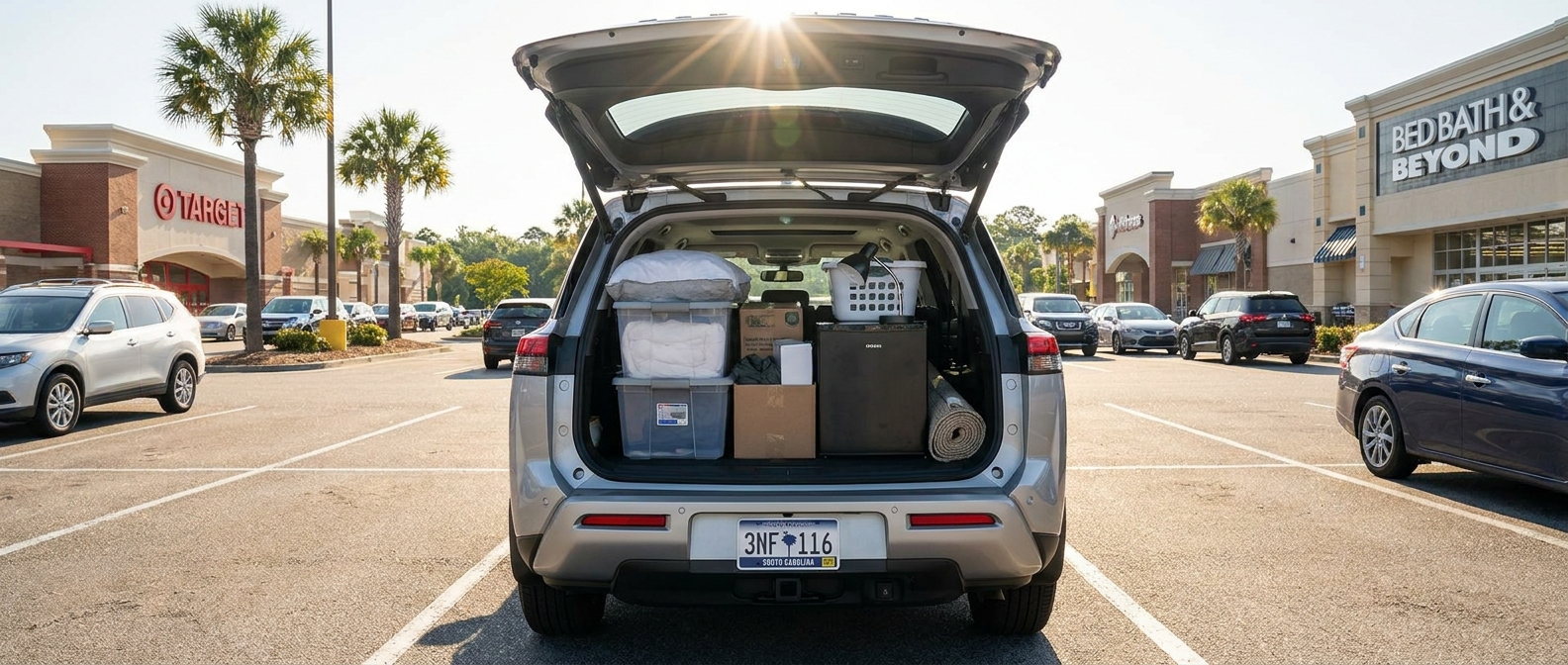
How much fits comes down to the numbers, and the three split cleanly, with the Rogue and Pathfinder swallowing a dorm load while the Murano trades some volume for a quieter cabin, so start by tallying what you're actually bringing. A dorm room's worth of supplies (bedding, a fan, storage cubes, a mini-fridge, a laundry basket, and the inevitable "just one more bag") stacks up fast. The table below compares the three Nissan models on our lot on the specs that matter most for this trip.

ModelCargo (seats up)Max cargoSeatingEPA combined MPG
2026 Rogue36.3 cu ft74.1 cu ft532 mpg (FWD)
2026 Pathfinder45 cu ft (3rd row down)80.5 cu ft7 or 8See note
2026 Murano32.9 cu ft63.5 cu ft523 mpg (AWD)

A few things are worth calling out in that table. The Rogue's 36.3 cubic feet behind the second row is Nissan's figure for the available Divide-N-Hide cargo system configuration. The EPA rates the 2026 Rogue FWD at 29 city, 36 highway, and 32 combined. That figure beats the other two by a notable margin, which adds up on repeated trips. The Pathfinder's fuel economy is lower (the 284-horsepower 3.5-liter V6 earns that), so if you're making multiple Columbia runs this semester, the Rogue rewards you at the pump.

The Murano is the one that surprises people. It seats five comfortably, and the cabin is impressively quiet and refined for a Nissan at this tier. The EPA rates it at 21 city, 27 highway, and 23 combined. You're looking at a real tradeoff there. If your priority is a calm, premium-feeling ride for parents who want the round trip to feel easy, the Murano earns it. If you need to haul a refrigerator and a bookshelf in one load, it's the wrong tool.

Where Does the I-26 Run Actually Feel Different Between These Models?

The differences show up in climate control and seat comfort more than in raw driving feel, because all three handle the interstate fine, but on a hot August run the Pathfinder's rear climate and the Murano's seats change the experience more than the Rogue does. August in South Carolina is not the time to find out your AC can't keep up. The drive from Orangeburg to Columbia runs about 47 miles on I-26, a straight and fast stretch. Short trip, sure. The AC matters. But it's also full sun, frequently over 90 degrees, families everywhere doing exactly what you're doing.

The Rogue and Pathfinder both come standard with Nissan Safety Shield 360, which includes automatic emergency braking, blind-spot warning, and rear cross-traffic alert. Those features matter when you merge onto I-26 East with a car stacked to the headliner and slightly reduced rear visibility.

The Pathfinder adds tri-zone automatic climate control as standard equipment. With kids in all three rows on a hot August day, that feature earns its keep. The rear passengers get their own temperature zone, not just vents. The Murano's Zero Gravity front seats (standard) take a different approach, and the ergonomic design genuinely reduces fatigue on repeated highway trips. Parents who make multiple Columbia runs in a Murano keep commenting on how the seat keeps the driver comfortable in ways a standard seat doesn't. That comfort adds up.

One real tradeoff comes with the Pathfinder. If you fold the third row flat to use the 45 cubic feet behind the second row, you lose those two seats. A family of five or six making the trip all together has to choose between people and stuff. We're not knocking it, just laying out the planning math.

Loading reality check: The Pathfinder's 16.6 cubic feet behind the third row (third row upright) won't fit a full dorm load with passengers in all three rows. Plan on the third row staying folded if cargo is your priority. The Rogue's Divide-N-Hide system lets you create a lower cargo floor or add a mid-level shelf, which helps organize boxes and bags so nothing shifts on the interstate.
  • [ ] Measure your largest items (mini-fridge, storage cubes, fan) before loading day
  • [ ] For the Pathfinder, decide in advance: people priority or cargo priority for this trip
  • [ ] Confirm your Rogue's Divide-N-Hide floor is in the right configuration for bulky versus stacked items
  • [ ] On August Columbia days, pre-cool the cabin with remote start before loading
  • [ ] Pack the car the night before so you're not rushing in peak morning heat
  • [ ] Keep a bag of essentials (chargers, snacks, paperwork) accessible in the front area, not buried in the back

Plan the Trip This Way

If you're a family of five or fewer doing one or two big shopping trips, the Rogue is your vehicle, and a larger crew or an end-of-semester furniture haul is what tips the choice toward the Pathfinder. The Rogue stays efficient on I-26, the cargo system is flexible, and Safety Shield 360 comes standard across every trim. If your crew is larger or you're thinking about pickup trips at the end of the semester (hauling furniture back), the Pathfinder gives you eight seats and 80.5 cubic feet of maximum cargo capacity when everything folds flat. Nissan lists towing capacity at up to 6,000 pounds when properly equipped on the Pathfinder, which matters if you're ever attaching a small utility trailer for that move-out day.

The Murano is the right answer for a parent doing the drive alone or with one other adult who values a calm, well-appointed cabin over maximum cargo volume. It's honest work, not a workhorse.

Come see us at Nissan of Orangeburg on St. Matthews Road. We can walk you through all three models, pull up whichever trims are on the lot right now, and let you see the cargo configurations in person before you commit to a shopping day plan.

Explore Financing Options

Check the lot with us, and we'll make sure the decision makes sense before the semester starts. Our team is here to help you figure out which Nissan fits the trip and the family, boxes and all.

Frequently Asked Questions

What is the cargo space in the 2026 Nissan Rogue for a back-to-school load?

The 2026 Rogue offers 36.3 cubic feet of cargo space behind the second row, and expands to 74.1 cubic feet with the second row folded. The available Divide-N-Hide cargo system creates multiple floor configurations so you can organize boxes, bags, and bulky items more efficiently for a trip like a Columbia school shopping run.

Is the 2026 Nissan Pathfinder big enough for a family and a full dorm load?

The Pathfinder seats up to eight passengers and offers 80.5 cubic feet of maximum cargo capacity with all seats folded. With the third row up, you have 16.6 cubic feet behind it, which is not enough for a full dorm load with a full passenger count. The practical planning choice is to fold the third row for a big cargo trip or run a separate people-only trip. For families of six or more, the Pathfinder is still the right platform because it handles both uses across separate trips.

How far is the drive from Orangeburg to Columbia for school shopping?

The drive from Orangeburg to Columbia on I-26 is approximately 47 miles and takes about 51 minutes under normal conditions. It's a straightforward interstate run, and any of the three Nissan models covered here will handle it comfortably. The Rogue's EPA-rated 32 mpg combined (FWD) makes it the most fuel-efficient choice for families making multiple trips during back-to-school season.

Nissan of Orangeburg

2827 St Matthews Rd, Orangeburg, SC 29118

(803) 813-1000

Read More
CATEGORIES »
TAGS »

08-24-26

3 Back-to-School Cargo Scenarios the 2026 Nissan Rogue Actually Handles

A practical guide to matching back-to-school cargo needs to the right 2026 Nissan Rogue setup. Learn how the 36.5 cubic-foot standard capacity, 60/40 split-fold rear seat, and available Divide-N-Hide panels work for daily school runs, youth sports transportation, and college dorm moves, plus which trims offer the organize-and-stow features that make the difference between one trip and two.

August gets loud in Orangeburg. Claflin University and South Carolina State are filling back up, youth soccer and football leagues are kicking off, and K-12 families are running laps between the school supply aisle and sports practices in 95-degree heat. The question worth answering before the year starts is a plain one. Does all of this stuff actually fit?

The answer depends on which cargo setup you're running, and that's the part nobody explains cleanly. The 2026 Nissan Rogue carries 36.5 cubic feet behind the rear seats and expands to 74.1 cubic feet with the second row folded flat (per Nissan). Three completely different families need three completely different configurations to make those numbers work. So let's match your actual August routine to the right setup.

The short version

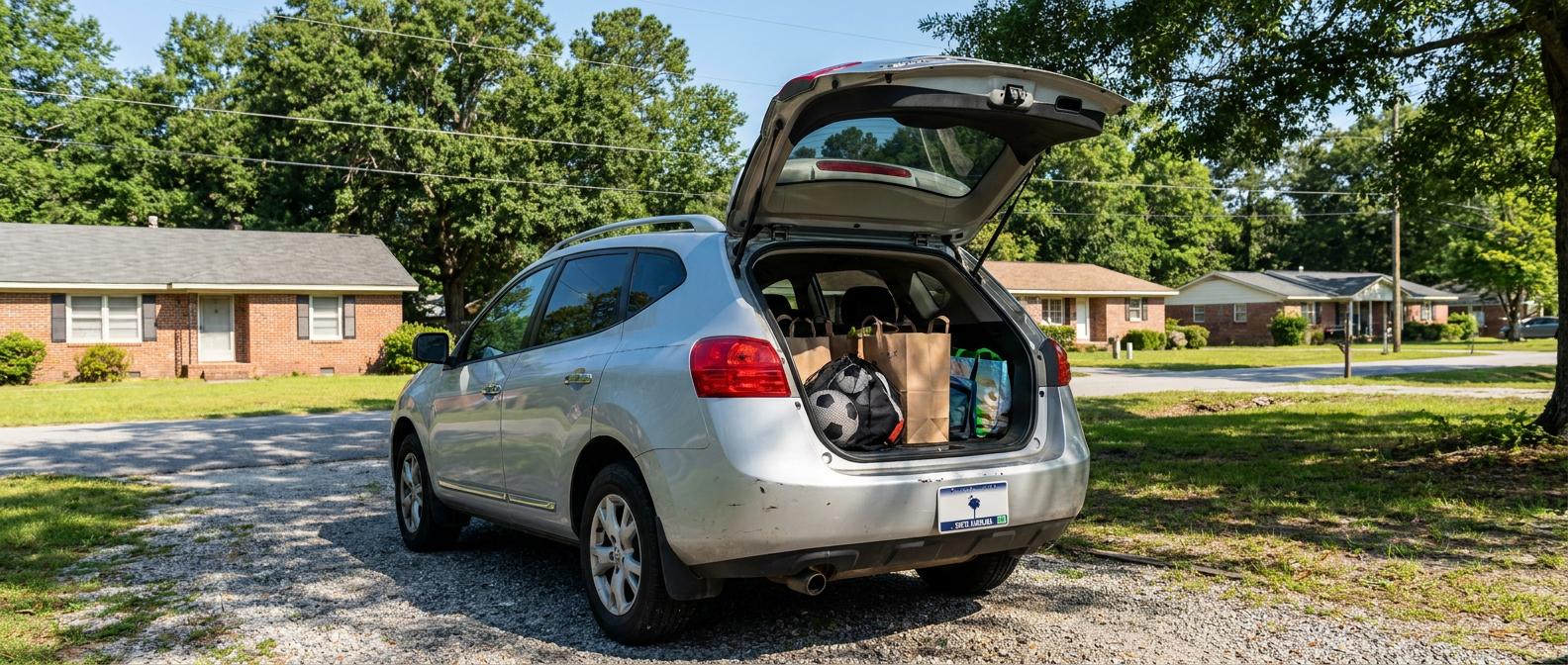
  • K-12 school run (seats up, cargo floor raised): 36.5 cu ft of usable space holds backpacks, lunch bags, and a sports duffel without touching the rear seat area.
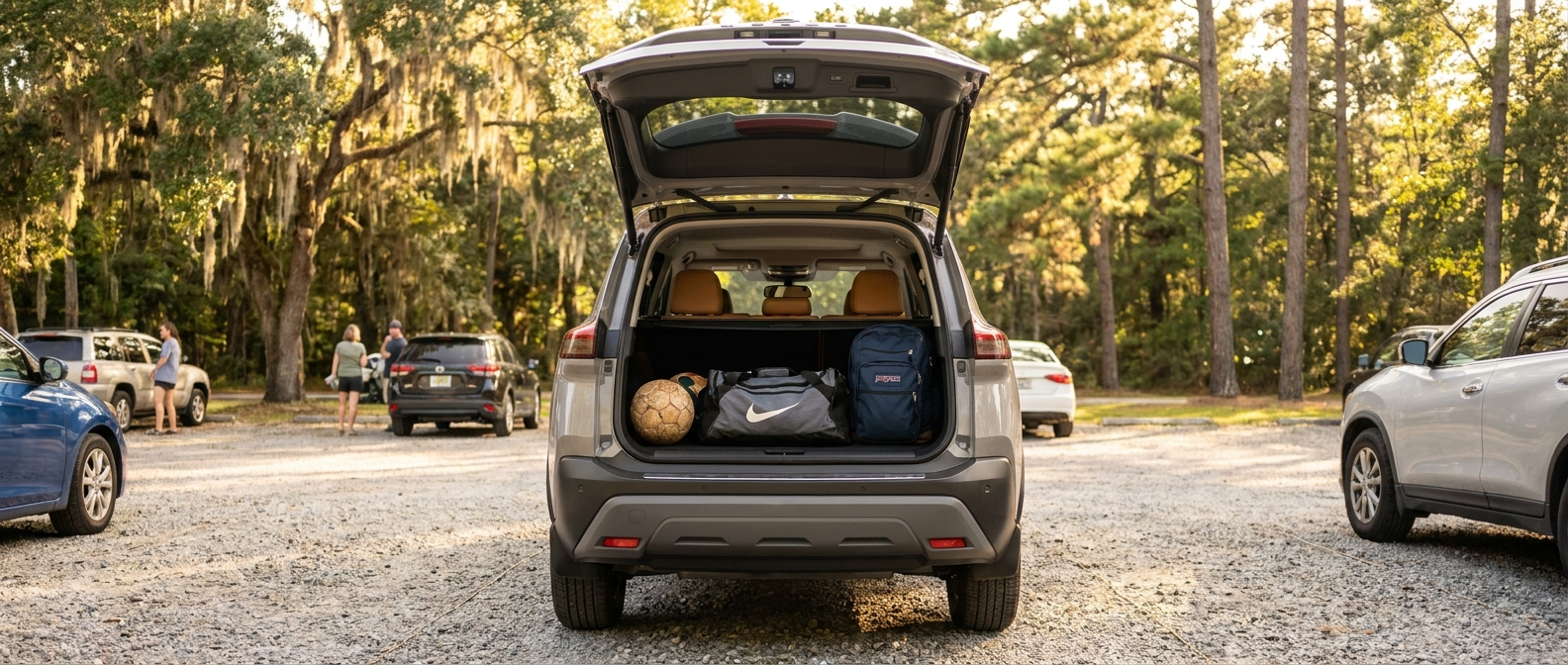
  • Youth sports parent (60/40 split, one side folded): A single seat-half folded opens a 72-inch load lane for lacrosse sticks and soccer bags while keeping a rear passenger seat available.
  • College move-in (both rows flat): 74.1 cu ft max cargo gives you room for a mini-fridge, dorm bins, and rolling luggage in a single Claflin or SC State dorm run.
  • The real tradeoff: Divide-N-Hide adjustable panels are only on SV, Dark Armor, Rock Creek, and Platinum trims. The base S has a flat floor with tie-down hooks and nothing else.
  • Bottom line: The Rogue fits all three scenarios. Knowing which mode you need is the difference between "it barely fits" and "we still have room."

How Do These Three Cargo Scenarios Actually Compare?

Raw cubic feet won't tell you whether a soccer bag survives the trip without rolling into your kid's lap on US-301, so the comparison that matters comes down to which mode you pick, not the headline number. The three back-to-school loads below each want a different setup, and matching them is where the space either works or barely works.

ScenarioCargo ModeApprox. Space AvailableRear Seats RetainedBest For
K-12 daily school runSeats up, Divide-N-Hide raised shelf36.5 cu ft (non-moonroof trim)All 4-5Multiple kids, daily backpack load, organized under-shelf storage
Youth sports (1-2 kids)60/40 split: 60-percent side foldedLong lane (43 in wide, up to 72 in)3-4Soccer and lacrosse bags flat, one passenger kept
College dorm move-inBoth rows folded flat74.1 cu ft maximumDriver onlyBins, mini-fridge, rolling bags in a single trip

Nissan lists the cargo floor at 43 inches wide and up to 72 inches long when the second row is folded. That 72-inch length is the number that matters here. A standard lacrosse bag or field hockey bag (typically 36 to 42 inches) slides in flat, no diagonal wrestling required.

Which Trim Gets You the Organize-and-Stow Setup?

The organize-and-stow setup lives on the upper trims, so the S trim decision quietly costs you here, and we'd rather you know that before you buy. Nissan lists the Divide-N-Hide system on SV, Dark Armor, Rock Creek, and Platinum, which is where the six adjustable cargo configurations come from.

The configuration that earns its keep on the daily school run is the raised-floor position. The panel lifts to create a shelf, backpacks slide underneath (out of sight, out of the way), and a soccer ball or smaller gym bag rides up top without rolling around. On the I-26 run home from an away game, that pays off. Items in the lower compartment stay put, and so does the stuff on the shelf.

The base S trim gives you a flat cargo floor and four standard tie-down hooks. Practical for basic loads. Not the same tool once you've got three different bag sizes that need separating.

Browse 2026 Rogue trims in our current inventory to see which configurations we have on the lot now.

Nissan lists the 2026 Rogue's maximum cargo volume at 74.1 cubic feet with the second row folded flat, consistent across every trim level.

Does the 60/40 Split Actually Work for Sports Equipment?

Yes, the 60/40 split is the configuration we'd steer Orangeburg youth-sports families toward first, with one caveat about full carpools we'll get to in a second. Fold the driver-side 60-percent section of the rear bench flat and you open a load lane that's roughly 43 inches wide and up to 72 inches long. A soccer bag fits with room to spare. A 40-inch lacrosse bag slides in without any angle adjustment. The remaining 40-percent of the rear seat stays upright, so you still carry a passenger. Carpool solved.

The load lane measures about 43 inches across. Nissan lists the length at up to 72 inches.

Cargo note from our team: Cylindrical duffel-style bags without a rigid frame are easier to stow in the Divide-N-Hide under-shelf area on SV and higher trims, freeing the main floor lane for longer stick bags or equipment cases. When both a lacrosse bag and two backpacks need to co-exist, that separation is the difference between one trip and two.

The limitation is worth stating plainly. A full carpool (four kids and equipment) means making a call. Fold both sides and skip a rear passenger seat, or make two runs. With the seats fully upright, the Rogue's 36.5 cubic feet can still fit two soft-sided duffel bags alongside backpacks, which covers more of these loads than you'd guess. None of that guarantees every load fits. Call it a realistic expectation for most.

If your family consistently carpools four to five kids plus gear to games across Orangeburg County, the Nissan Pathfinder's three-row layout changes the math for you. Worth a side-by-side look.

Explore Your Financing Options for the 2026 Rogue

What's the Right Rogue Setup for a Dorm Move-In at Claflin or SC State?

For a dorm move-in, the right setup is both rows folded flat, and the trick is to stage everything out of the garage first before you load a single bin. Nissan lists the maximum cargo volume at 74.1 cubic feet with the second row folded, across all trims.

Check the cargo floor before you stack anything. It sits nearly flat when the seatbacks go down, which matters for bins, since a floor with a raised hinge lip (common in some competitors) makes tall loads less stable. The Rogue's nearly flat surface handles stacked bins cleanly.

For a Claflin or South Carolina State move-in, a realistic single-trip load looks like this. One mini-fridge, three large storage bins, a floor lamp, a rolling carry-on, and a backpack. All of that fits. A twin XL mattress does not. Know that going in, and the Rogue handles the rest of a dorm setup without issue.

The efficiency angle is worth saying too. The EPA rates the 2026 Rogue FWD at 29 city / 36 highway / 32 combined mpg. That I-26 corridor between Orangeburg and Columbia runs about 40 miles, so even a two-trip dorm run won't burn a full tank. The efficiency is real math, not marketing.

Picking the Right Rogue Setup for Your August

Picking your August setup comes down to being honest about your load, and the 2026 Rogue isn't the answer if you're hauling long, rigid equipment every single day. A paddleboard, a full hockey bag, or a double jogging stroller plus gear daily is a different category of vehicle problem. It's a compact SUV and it doesn't pretend otherwise.

What it's genuinely well-suited to is the mixed August load. Backpacks and a duffel on Tuesday, soccer gear on Thursday, a dorm run over Labor Day weekend. The 60/40 split and the Divide-N-Hide panels (SV and above) give you three real configurations instead of a binary on/off. The flexibility is the actual value, and the cargo specs back it up.

For a family who doesn't need a new vehicle right now, our pre-owned Rogue inventory carries the same cargo configurations at a lower entry point. Same split-fold seats, same 74.1 cubic-foot maximum. Different price.

By the Nissan of Orangeburg Team | August 2026

Frequently Asked Questions

Does the 2026 Nissan Rogue fit both school bags and sports equipment without folding the rear seats?

In most everyday situations, yes. Nissan lists 36.5 cubic feet of cargo space behind the second row with all seats upright (36.3 cubic feet in moonroof-equipped trims). Standard backpacks, lunch bags, and a soft-sided sports duffel fit in that space without occupying the rear seat area. On SV, Dark Armor, Rock Creek, and Platinum trims, the available Divide-N-Hide system adds an adjustable under-shelf compartment that keeps smaller items separated and off the main cargo floor, which helps when you have three or four different bag sizes. If you need to load a longer rigid bag (a lacrosse stick bag or field hockey bag in the 36 to 42 inch range), folding the 60-percent side of the split rear seat opens a 72-inch load lane while keeping one rear passenger seat available.

How much cargo space does the 2026 Rogue have for a college move-in at Claflin University or South Carolina State?

With both second-row seatbacks folded flat, the 2026 Rogue reaches its maximum of 74.1 cubic feet of cargo volume, which Nissan lists as consistent across all trims. The cargo floor is nearly flat in the folded position, making it stable for stacked storage bins. A practical single-trip dorm load (mini-fridge, large storage bins, a lamp, rolling luggage, and personal bags) fits. A twin XL mattress does not. For the roughly 40-mile I-26 run between Orangeburg and Columbia, the EPA rates the FWD 2026 Rogue at 32 mpg combined, so even a second trip stays fuel-efficient.

Nissan of Orangeburg

2827 St Matthews Rd, Orangeburg, SC 29118

(803) 813-1000

Read More
CATEGORIES »
TAGS »

08-21-26

Your Sentra vs. Altima Decision Checklist for College Commuters in Orangeburg

A practical guide to choosing between two Nissan sedans for college commuting. Learn how daily mileage, highway driving frequency, parking constraints, passenger count, fuel economy, and cargo needs determine whether the 2026 Sentra or 2026 Altima better serves a student commuter in the Orangeburg area.

Our read comes down to your commute. If your daily loop is campus-to-campus and you're watching every dollar, the 2026 Sentra is the easier yes. If you're running the I-26 corridor to Columbia two or three days a week with a carload, the Altima earns its keep.

We're not hedging here. What follows is the actual split we see play out on our lot when students from Claflin University and South Carolina State walk in asking which sedan makes sense. Both are genuinely good cars. They serve different students, and this checklist will tell you which one you are.

Browse the 2026 Nissan Sentra at Nissan of Orangeburg

What Goes on the Checklist?

Run through these items before you set foot in a showroom, and be straight with yourself on each one, because a commuter sedan that fits your parking lot and your mileage will serve you better than the one wearing the bigger badge. Answer each one plainly and the decision mostly makes itself.

Your College Commuter Decision Checklist

  • [ ] Know your daily mileage. Is your commute under 20 miles round-trip (on-campus or around Orangeburg), or are you regularly running 40-plus miles out to Columbia or the Charleston corridor?
  • [ ] Count your highway miles. I-26 is real highway driving. If you're merging from US-601 onto the interstate at least twice a week, engine size starts to matter more than it does in town.
  • [ ] Check your parking situation. Some campus lots are tight. The 2026 Sentra is 183.3 inches long. The 2026 Altima stretches to 192.9 inches. You're looking at nearly a full foot of difference in a crowded row.
  • [ ] Be real about your cargo. Moving-in weekend is one thing. What does a normal Tuesday look like? Two backpacks and a gym bag, or a full back seat plus a crammed trunk?
  • [ ] Settle your budget range. The Sentra's entry trim sits meaningfully lower than the Altima's base. Finance terms aside, the gap between them is real and worth naming in your head before you walk in.
  • [ ] Decide how long you're keeping it. The Altima's lineup was trimmed to two trims for 2026, and it may be approaching the end of its production run. None of that is a dealbreaker, but it's worth knowing before you sign.
  • [ ] Think about fuel cost over a school year. The EPA rates the 2026 Sentra S/SV at 33 mpg combined. The 2026 Altima FWD comes in at 30 mpg combined. Across 12,000 annual miles, that difference is real gallons, real dollars.
  • [ ] Consider who else rides with you. The Altima gives rear passengers 35.2 inches of legroom. The Sentra offers 34.9 inches. Functionally the same for one tall friend, but four adults on a long drive will feel that half-inch gap in comfort after an hour.
  • [ ] Ask yourself whether you need AWD. The Sentra is FWD only. The Altima offers available all-wheel drive, which is genuinely useful if you go home to the Upstate or the mountains for breaks.

Understanding the Key Items

See the 2026 Nissan Altima at Nissan of Orangeburg

The checklist above marks the fork in the road, and each item on it maps to a real difference you'll feel driving out of Orangeburg, not just a number on a window sticker. Let's walk through why each one carries weight for a student behind the wheel.

The MPG Gap Is Smaller Than It Looks, Until It Isn't

The EPA-certified difference between these two is 3 mpg combined (33 for the Sentra S/SV, 30 for the Altima FWD). That sounds minor on paper. Spread over a full academic year on the I-26 corridor, it compounds. The Sentra also runs on a 12.4-gallon tank, which means every fill-up is a smaller hit. If you're budgeting tight on a student income, that rhythm matters more than the spec sheet suggests.

The other side of the ledger is power. The Altima's 2.5-liter engine delivers 188 horsepower against the Sentra's 149. Those 39 extra horses don't mean much in a parking lot, but you'll notice them merging onto I-26 at peak morning traffic with two passengers and a trunk full of weekend gear. We hear this from commuters who run the Columbia stretch. The Sentra handles the merge fine at normal loads. Add two more bodies and it works harder.

What we notice at Nissan of Orangeburg: Students who commute solo to class most days find the Sentra's power plenty. Those who carry a full back seat on longer corridors come to appreciate the Altima's quieter, more relaxed highway feel over 40-plus miles.

Explore financing options at Nissan of Orangeburg

Parking Reality on Tight Campus Lots

The Sentra is 183.3 inches long. The Altima is 192.9 inches. Nearly ten inches shorter means the Sentra fits more comfortably in compact spots, parallel parks with less stress, and slides into older lot designs that weren't built with midsize sedans in mind. On a campus with a packed commuter lot, that physical footprint is a daily quality-of-life difference. It isn't glamorous. But neither is circling for twenty minutes.

Claflin University and South Carolina State are both in Orangeburg. Their student lots sit a short drive apart.

Cargo: The 1.1 Cubic Foot Gap Is Smaller Than You Think

Nissan lists the Altima trunk at 15.4 cubic feet. The Sentra comes in at 14.3 cubic feet. That 1.1-cubic-foot difference is real but modest. Both have 60/40 split-folding rear seats. Both swallow a week's worth of groceries without drama. Where the Altima earns its extra space is on move-in/move-out weekend, or if you're hauling equipment for an internship, sports gear, or a commute that doubles as a delivery run.

Both sedans share the same core reliability reputation. Service and parts run through the same Nissan network.

The Altima's 2026 Lineup Context

For 2026, Nissan trimmed the Altima from four trim levels to two (SV and SR, plus limited special editions). It's still a strong, capable car. But it's worth understanding you're buying into a lineup that's being simplified, which can affect future parts availability and resale perception over a five-year horizon. We're not being alarmist. If you're keeping a car for two to three years through college and selling before graduate school, it may not matter at all. If you're planning to drive it for seven or eight years, file that information away.

Start Your Financing Application

Key fact: The EPA rates the 2026 Sentra S/SV at 29 city, 38 highway, 33 combined. The Altima FWD lands at 26 city, 36 highway, 30 combined. For a commuter whose heaviest use is I-26 highway miles, the Altima's highway rating closes much of the gap.

Browse pre-owned inventory at Nissan of Orangeburg

Item / Why It Matters

Checklist ItemWhy It Matters for Orangeburg Commuters
Daily mileage under 20 miles vs. 40-plusShorter loops reward the Sentra's fuel efficiency and easier parking; longer I-26 runs reward the Altima's highway composure
Engine size (149 hp vs. 188 hp)Sentra handles solo and light loads well; Altima gives a clearly more relaxed merge with 2-4 passengers
Car length (183.3" vs. 192.9")Ten-inch gap matters in tight campus lots and parallel spots on Russell Street or around the SC State campus
Trunk space (14.3 vs. 15.4 cu ft)Negligible for daily use; meaningful on move-in weekend or heavy haul days
FWD only vs. AWD availableOrangeburg winters are mild, so AWD is optional comfort, not a necessity, unless you travel to the Upstate or mountains
Altima trim count (2 trims for 2026)Simpler lineup means fewer choices but also signals a model at or near end-of-production
EPA combined MPG (33 vs. 30)Three mpg difference adds up over a full school year on consistent commuting miles
Rear legroom (34.9" vs. 35.2")Functionally identical for two adults; a long ride with four adults may show the Altima's slight edge

Your Print-and-Go Recap

You don't need the spec sheets memorized to make a smart call here. You do need clear answers to three things before you visit us. How far you drive, how many people ride along, and how tight your parking runs.

Choose the 2026 Sentra if:

  • Your daily drive is within Orangeburg or under 20 miles round-trip
  • You park in tight campus lots regularly
  • Fuel economy over the school year is your primary concern
  • You're usually driving solo or with one passenger

Choose the 2026 Altima if:

  • You're running the I-26 corridor to Columbia or the Charleston direction multiple times a week
  • You routinely carry three or four passengers
  • You want the option of AWD for trips home to the Upstate
  • Rear passenger comfort on 45-minute-plus drives matters to you

The Altima is the more capable car at highway speed with a full load. The Sentra is the smarter daily-use tool for tight budgets and tight parking. Neither choice is wrong. They're just built for different commuters.

When you're ready, our team at Nissan of Orangeburg is here to put you in the seat of each one and let the drive do the talking. No pressure. Just two good sedans and some straight questions.

Frequently Asked Questions

Is the 2026 Nissan Sentra powerful enough for regular highway driving on I-26?

Yes, with one honest caveat. The 2026 Sentra's 2.0-liter engine produces 149 horsepower, which is adequate for solo and light-load highway driving on I-26 between Orangeburg and Columbia. Merge and passing power feel slightly more strained when the car is fully loaded with passengers and cargo, especially at higher highway speeds. If your commutes run mostly in town or lightly loaded, you'll find it perfectly comfortable. If you're regularly carrying three or four passengers on 40-plus mile stretches, the Altima's 188-horsepower 2.5-liter engine gives you a noticeably more relaxed experience on the interstate.

Does the 2026 Altima being discontinued mean I shouldn't buy one?

Not necessarily. The 2026 Altima is a current, fully supported model on sale right now, and it remains a well-rounded midsize sedan. For 2026 Nissan has trimmed the lineup from four trims to two, which does signal the model is approaching the end of its run. For a student who plans to own the car for two to three years and then sell or trade, that timeline likely doesn't create a practical problem. If you're planning a longer ownership of seven or more years, it's worth factoring in that parts sourcing and resale demand may shift as the model ages out. Ask our team about the current inventory and your specific situation so we can give you a straight answer.

Nissan of Orangeburg

2827 St Matthews Rd, Orangeburg, SC 29118

(803) 813-1000

Read More
CATEGORIES »
TAGS »

Uncategorized Archives - Page 3 of 10 - Nissan Orangeburg

Your Matches
Filters

Contact Us:

Name:
Email:
Message: