
Connect with us!

CATEGORIES

08-24-26

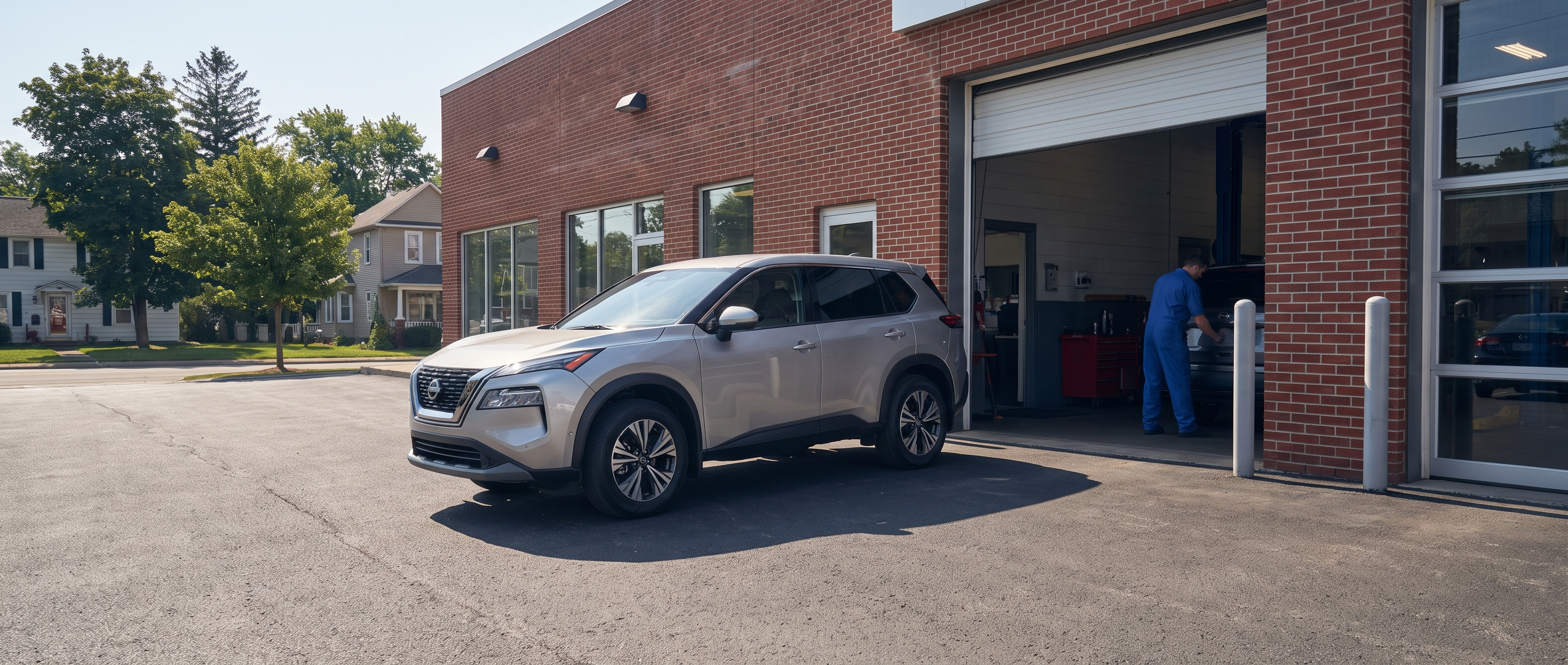
3 Back-to-School Cargo Scenarios the 2026 Nissan Rogue Actually Handles

A practical guide to matching back-to-school cargo needs to the right 2026 Nissan Rogue setup. Learn how the 36.5 cubic-foot standard capacity, 60/40 split-fold rear seat, and available Divide-N-Hide panels work for daily school runs, youth sports transportation, and college dorm moves, plus which trims offer the organize-and-stow features that make the difference between one trip and two.

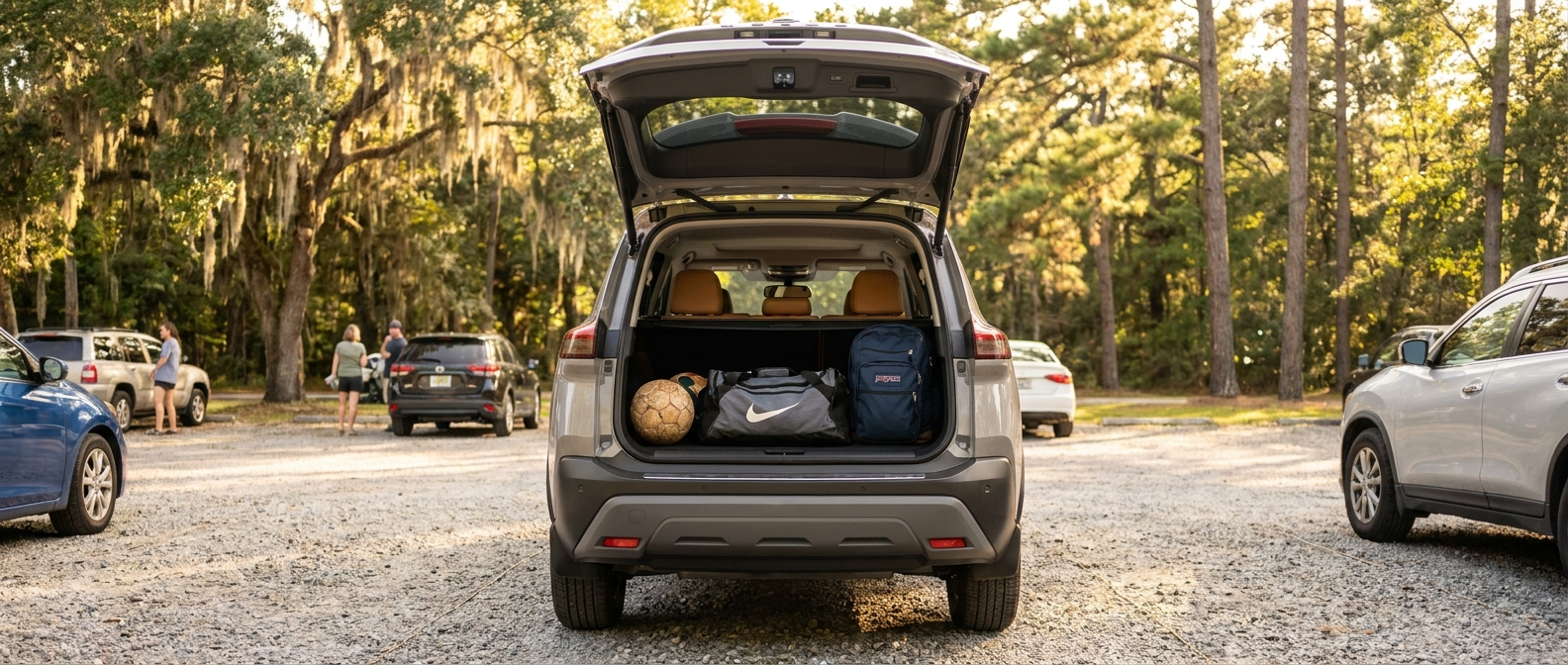
August gets loud in Orangeburg. Claflin University and South Carolina State are filling back up, youth soccer and football leagues are kicking off, and K-12 families are running laps between the school supply aisle and sports practices in 95-degree heat. The question worth answering before the year starts is a plain one. Does all of this stuff actually fit?

The answer depends on which cargo setup you're running, and that's the part nobody explains cleanly. The 2026 Nissan Rogue carries 36.5 cubic feet behind the rear seats and expands to 74.1 cubic feet with the second row folded flat (per Nissan). Three completely different families need three completely different configurations to make those numbers work. So let's match your actual August routine to the right setup.

The short version

  • K-12 school run (seats up, cargo floor raised): 36.5 cu ft of usable space holds backpacks, lunch bags, and a sports duffel without touching the rear seat area.
  • Youth sports parent (60/40 split, one side folded): A single seat-half folded opens a 72-inch load lane for lacrosse sticks and soccer bags while keeping a rear passenger seat available.
  • College move-in (both rows flat): 74.1 cu ft max cargo gives you room for a mini-fridge, dorm bins, and rolling luggage in a single Claflin or SC State dorm run.
  • The real tradeoff: Divide-N-Hide adjustable panels are only on SV, Dark Armor, Rock Creek, and Platinum trims. The base S has a flat floor with tie-down hooks and nothing else.
  • Bottom line: The Rogue fits all three scenarios. Knowing which mode you need is the difference between "it barely fits" and "we still have room."

How Do These Three Cargo Scenarios Actually Compare?

Raw cubic feet won't tell you whether a soccer bag survives the trip without rolling into your kid's lap on US-301, so the comparison that matters comes down to which mode you pick, not the headline number. The three back-to-school loads below each want a different setup, and matching them is where the space either works or barely works.

ScenarioCargo ModeApprox. Space AvailableRear Seats RetainedBest For
K-12 daily school runSeats up, Divide-N-Hide raised shelf36.5 cu ft (non-moonroof trim)All 4-5Multiple kids, daily backpack load, organized under-shelf storage
Youth sports (1-2 kids)60/40 split: 60-percent side foldedLong lane (43 in wide, up to 72 in)3-4Soccer and lacrosse bags flat, one passenger kept
College dorm move-inBoth rows folded flat74.1 cu ft maximumDriver onlyBins, mini-fridge, rolling bags in a single trip

Nissan lists the cargo floor at 43 inches wide and up to 72 inches long when the second row is folded. That 72-inch length is the number that matters here. A standard lacrosse bag or field hockey bag (typically 36 to 42 inches) slides in flat, no diagonal wrestling required.

Which Trim Gets You the Organize-and-Stow Setup?

The organize-and-stow setup lives on the upper trims, so the S trim decision quietly costs you here, and we'd rather you know that before you buy. Nissan lists the Divide-N-Hide system on SV, Dark Armor, Rock Creek, and Platinum, which is where the six adjustable cargo configurations come from.

The configuration that earns its keep on the daily school run is the raised-floor position. The panel lifts to create a shelf, backpacks slide underneath (out of sight, out of the way), and a soccer ball or smaller gym bag rides up top without rolling around. On the I-26 run home from an away game, that pays off. Items in the lower compartment stay put, and so does the stuff on the shelf.

The base S trim gives you a flat cargo floor and four standard tie-down hooks. Practical for basic loads. Not the same tool once you've got three different bag sizes that need separating.

Browse 2026 Rogue trims in our current inventory to see which configurations we have on the lot now.

Nissan lists the 2026 Rogue's maximum cargo volume at 74.1 cubic feet with the second row folded flat, consistent across every trim level.

Does the 60/40 Split Actually Work for Sports Equipment?

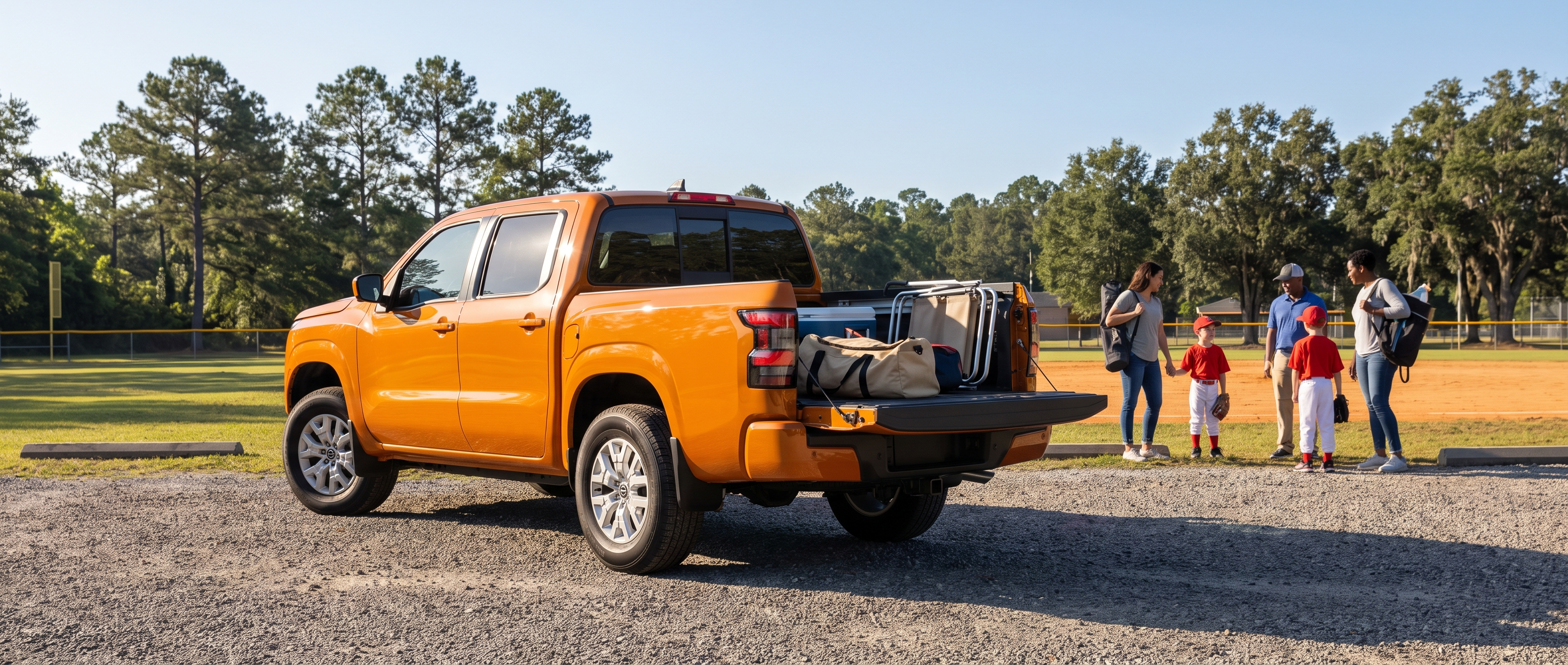
Yes, the 60/40 split is the configuration we'd steer Orangeburg youth-sports families toward first, with one caveat about full carpools we'll get to in a second. Fold the driver-side 60-percent section of the rear bench flat and you open a load lane that's roughly 43 inches wide and up to 72 inches long. A soccer bag fits with room to spare. A 40-inch lacrosse bag slides in without any angle adjustment. The remaining 40-percent of the rear seat stays upright, so you still carry a passenger. Carpool solved.

The load lane measures about 43 inches across. Nissan lists the length at up to 72 inches.

Cargo note from our team: Cylindrical duffel-style bags without a rigid frame are easier to stow in the Divide-N-Hide under-shelf area on SV and higher trims, freeing the main floor lane for longer stick bags or equipment cases. When both a lacrosse bag and two backpacks need to co-exist, that separation is the difference between one trip and two.

The limitation is worth stating plainly. A full carpool (four kids and equipment) means making a call. Fold both sides and skip a rear passenger seat, or make two runs. With the seats fully upright, the Rogue's 36.5 cubic feet can still fit two soft-sided duffel bags alongside backpacks, which covers more of these loads than you'd guess. None of that guarantees every load fits. Call it a realistic expectation for most.

If your family consistently carpools four to five kids plus gear to games across Orangeburg County, the Nissan Pathfinder's three-row layout changes the math for you. Worth a side-by-side look.

Explore Your Financing Options for the 2026 Rogue

What's the Right Rogue Setup for a Dorm Move-In at Claflin or SC State?

For a dorm move-in, the right setup is both rows folded flat, and the trick is to stage everything out of the garage first before you load a single bin. Nissan lists the maximum cargo volume at 74.1 cubic feet with the second row folded, across all trims.

Check the cargo floor before you stack anything. It sits nearly flat when the seatbacks go down, which matters for bins, since a floor with a raised hinge lip (common in some competitors) makes tall loads less stable. The Rogue's nearly flat surface handles stacked bins cleanly.

For a Claflin or South Carolina State move-in, a realistic single-trip load looks like this. One mini-fridge, three large storage bins, a floor lamp, a rolling carry-on, and a backpack. All of that fits. A twin XL mattress does not. Know that going in, and the Rogue handles the rest of a dorm setup without issue.

The efficiency angle is worth saying too. The EPA rates the 2026 Rogue FWD at 29 city / 36 highway / 32 combined mpg. That I-26 corridor between Orangeburg and Columbia runs about 40 miles, so even a two-trip dorm run won't burn a full tank. The efficiency is real math, not marketing.

Picking the Right Rogue Setup for Your August

Picking your August setup comes down to being honest about your load, and the 2026 Rogue isn't the answer if you're hauling long, rigid equipment every single day. A paddleboard, a full hockey bag, or a double jogging stroller plus gear daily is a different category of vehicle problem. It's a compact SUV and it doesn't pretend otherwise.

What it's genuinely well-suited to is the mixed August load. Backpacks and a duffel on Tuesday, soccer gear on Thursday, a dorm run over Labor Day weekend. The 60/40 split and the Divide-N-Hide panels (SV and above) give you three real configurations instead of a binary on/off. The flexibility is the actual value, and the cargo specs back it up.

For a family who doesn't need a new vehicle right now, our pre-owned Rogue inventory carries the same cargo configurations at a lower entry point. Same split-fold seats, same 74.1 cubic-foot maximum. Different price.

By the Nissan of Orangeburg Team | August 2026

Frequently Asked Questions

Does the 2026 Nissan Rogue fit both school bags and sports equipment without folding the rear seats?

In most everyday situations, yes. Nissan lists 36.5 cubic feet of cargo space behind the second row with all seats upright (36.3 cubic feet in moonroof-equipped trims). Standard backpacks, lunch bags, and a soft-sided sports duffel fit in that space without occupying the rear seat area. On SV, Dark Armor, Rock Creek, and Platinum trims, the available Divide-N-Hide system adds an adjustable under-shelf compartment that keeps smaller items separated and off the main cargo floor, which helps when you have three or four different bag sizes. If you need to load a longer rigid bag (a lacrosse stick bag or field hockey bag in the 36 to 42 inch range), folding the 60-percent side of the split rear seat opens a 72-inch load lane while keeping one rear passenger seat available.

How much cargo space does the 2026 Rogue have for a college move-in at Claflin University or South Carolina State?

With both second-row seatbacks folded flat, the 2026 Rogue reaches its maximum of 74.1 cubic feet of cargo volume, which Nissan lists as consistent across all trims. The cargo floor is nearly flat in the folded position, making it stable for stacked storage bins. A practical single-trip dorm load (mini-fridge, large storage bins, a lamp, rolling luggage, and personal bags) fits. A twin XL mattress does not. For the roughly 40-mile I-26 run between Orangeburg and Columbia, the EPA rates the FWD 2026 Rogue at 32 mpg combined, so even a second trip stays fuel-efficient.
Nissan of Orangeburg

2827 St Matthews Rd, Orangeburg, SC 29118

(803) 813-1000

Read More
CATEGORIES »
TAGS »

08-21-26

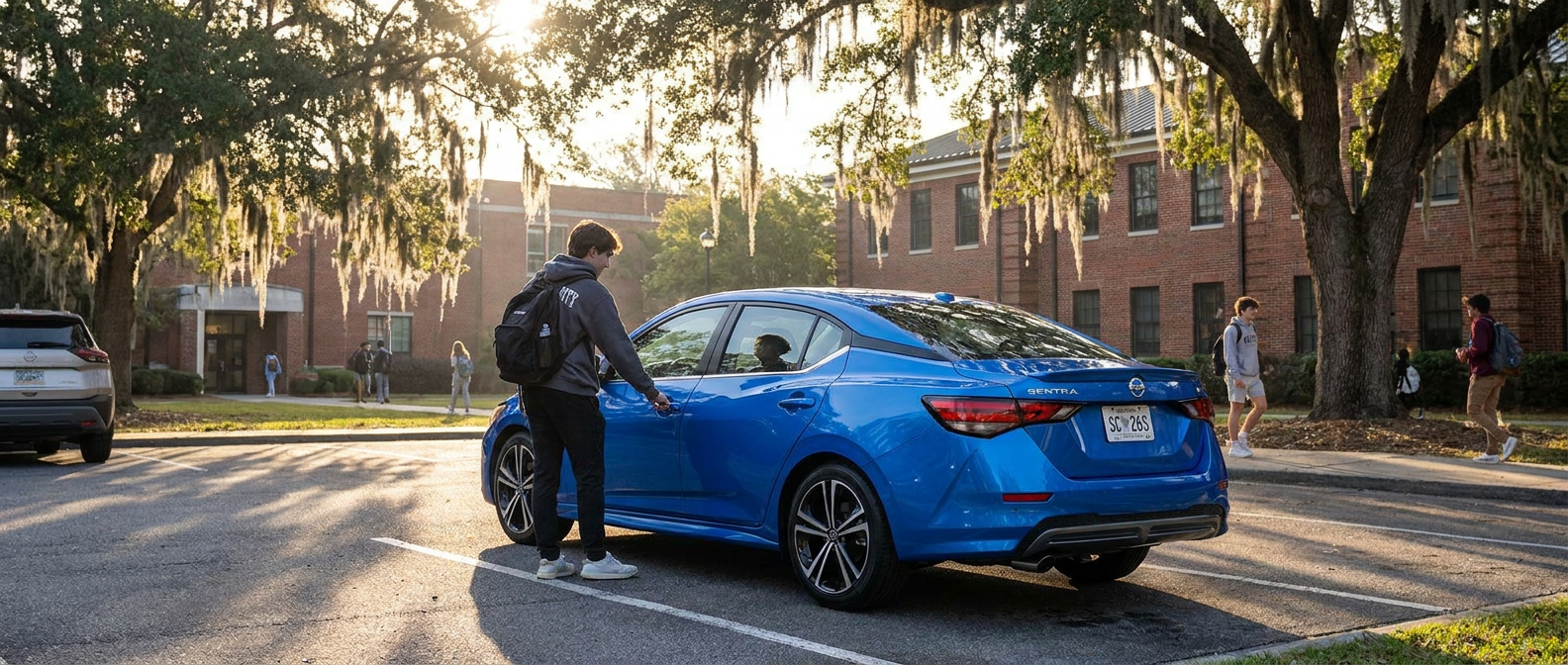
Your Sentra vs. Altima Decision Checklist for College Commuters in Orangeburg

A practical guide to choosing between two Nissan sedans for college commuting. Learn how daily mileage, highway driving frequency, parking constraints, passenger count, fuel economy, and cargo needs determine whether the 2026 Sentra or 2026 Altima better serves a student commuter in the Orangeburg area.

Our read comes down to your commute. If your daily loop is campus-to-campus and you're watching every dollar, the 2026 Sentra is the easier yes. If you're running the I-26 corridor to Columbia two or three days a week with a carload, the Altima earns its keep.

We're not hedging here. What follows is the actual split we see play out on our lot when students from Claflin University and South Carolina State walk in asking which sedan makes sense. Both are genuinely good cars. They serve different students, and this checklist will tell you which one you are.

Browse the 2026 Nissan Sentra at Nissan of Orangeburg

What Goes on the Checklist?

Run through these items before you set foot in a showroom, and be straight with yourself on each one, because a commuter sedan that fits your parking lot and your mileage will serve you better than the one wearing the bigger badge. Answer each one plainly and the decision mostly makes itself.

Your College Commuter Decision Checklist

  • [ ] Know your daily mileage. Is your commute under 20 miles round-trip (on-campus or around Orangeburg), or are you regularly running 40-plus miles out to Columbia or the Charleston corridor?
  • [ ] Count your highway miles. I-26 is real highway driving. If you're merging from US-601 onto the interstate at least twice a week, engine size starts to matter more than it does in town.
  • [ ] Check your parking situation. Some campus lots are tight. The 2026 Sentra is 183.3 inches long. The 2026 Altima stretches to 192.9 inches. You're looking at nearly a full foot of difference in a crowded row.
  • [ ] Be real about your cargo. Moving-in weekend is one thing. What does a normal Tuesday look like? Two backpacks and a gym bag, or a full back seat plus a crammed trunk?
  • [ ] Settle your budget range. The Sentra's entry trim sits meaningfully lower than the Altima's base. Finance terms aside, the gap between them is real and worth naming in your head before you walk in.
  • [ ] Decide how long you're keeping it. The Altima's lineup was trimmed to two trims for 2026, and it may be approaching the end of its production run. None of that is a dealbreaker, but it's worth knowing before you sign.
  • [ ] Think about fuel cost over a school year. The EPA rates the 2026 Sentra S/SV at 33 mpg combined. The 2026 Altima FWD comes in at 30 mpg combined. Across 12,000 annual miles, that difference is real gallons, real dollars.
  • [ ] Consider who else rides with you. The Altima gives rear passengers 35.2 inches of legroom. The Sentra offers 34.9 inches. Functionally the same for one tall friend, but four adults on a long drive will feel that half-inch gap in comfort after an hour.
  • [ ] Ask yourself whether you need AWD. The Sentra is FWD only. The Altima offers available all-wheel drive, which is genuinely useful if you go home to the Upstate or the mountains for breaks.

Understanding the Key Items

See the 2026 Nissan Altima at Nissan of Orangeburg

The checklist above marks the fork in the road, and each item on it maps to a real difference you'll feel driving out of Orangeburg, not just a number on a window sticker. Let's walk through why each one carries weight for a student behind the wheel.

The MPG Gap Is Smaller Than It Looks, Until It Isn't

The EPA-certified difference between these two is 3 mpg combined (33 for the Sentra S/SV, 30 for the Altima FWD). That sounds minor on paper. Spread over a full academic year on the I-26 corridor, it compounds. The Sentra also runs on a 12.4-gallon tank, which means every fill-up is a smaller hit. If you're budgeting tight on a student income, that rhythm matters more than the spec sheet suggests.

The other side of the ledger is power. The Altima's 2.5-liter engine delivers 188 horsepower against the Sentra's 149. Those 39 extra horses don't mean much in a parking lot, but you'll notice them merging onto I-26 at peak morning traffic with two passengers and a trunk full of weekend gear. We hear this from commuters who run the Columbia stretch. The Sentra handles the merge fine at normal loads. Add two more bodies and it works harder.

What we notice at Nissan of Orangeburg: Students who commute solo to class most days find the Sentra's power plenty. Those who carry a full back seat on longer corridors come to appreciate the Altima's quieter, more relaxed highway feel over 40-plus miles.

Explore financing options at Nissan of Orangeburg

Parking Reality on Tight Campus Lots

The Sentra is 183.3 inches long. The Altima is 192.9 inches. Nearly ten inches shorter means the Sentra fits more comfortably in compact spots, parallel parks with less stress, and slides into older lot designs that weren't built with midsize sedans in mind. On a campus with a packed commuter lot, that physical footprint is a daily quality-of-life difference. It isn't glamorous. But neither is circling for twenty minutes.

Claflin University and South Carolina State are both in Orangeburg. Their student lots sit a short drive apart.

Cargo: The 1.1 Cubic Foot Gap Is Smaller Than You Think

Nissan lists the Altima trunk at 15.4 cubic feet. The Sentra comes in at 14.3 cubic feet. That 1.1-cubic-foot difference is real but modest. Both have 60/40 split-folding rear seats. Both swallow a week's worth of groceries without drama. Where the Altima earns its extra space is on move-in/move-out weekend, or if you're hauling equipment for an internship, sports gear, or a commute that doubles as a delivery run.

Both sedans share the same core reliability reputation. Service and parts run through the same Nissan network.

The Altima's 2026 Lineup Context

For 2026, Nissan trimmed the Altima from four trim levels to two (SV and SR, plus limited special editions). It's still a strong, capable car. But it's worth understanding you're buying into a lineup that's being simplified, which can affect future parts availability and resale perception over a five-year horizon. We're not being alarmist. If you're keeping a car for two to three years through college and selling before graduate school, it may not matter at all. If you're planning to drive it for seven or eight years, file that information away.

Start Your Financing Application

Key fact: The EPA rates the 2026 Sentra S/SV at 29 city, 38 highway, 33 combined. The Altima FWD lands at 26 city, 36 highway, 30 combined. For a commuter whose heaviest use is I-26 highway miles, the Altima's highway rating closes much of the gap.

Browse pre-owned inventory at Nissan of Orangeburg

Item / Why It Matters

Checklist ItemWhy It Matters for Orangeburg Commuters
Daily mileage under 20 miles vs. 40-plusShorter loops reward the Sentra's fuel efficiency and easier parking; longer I-26 runs reward the Altima's highway composure
Engine size (149 hp vs. 188 hp)Sentra handles solo and light loads well; Altima gives a clearly more relaxed merge with 2-4 passengers
Car length (183.3" vs. 192.9")Ten-inch gap matters in tight campus lots and parallel spots on Russell Street or around the SC State campus
Trunk space (14.3 vs. 15.4 cu ft)Negligible for daily use; meaningful on move-in weekend or heavy haul days
FWD only vs. AWD availableOrangeburg winters are mild, so AWD is optional comfort, not a necessity, unless you travel to the Upstate or mountains
Altima trim count (2 trims for 2026)Simpler lineup means fewer choices but also signals a model at or near end-of-production
EPA combined MPG (33 vs. 30)Three mpg difference adds up over a full school year on consistent commuting miles
Rear legroom (34.9" vs. 35.2")Functionally identical for two adults; a long ride with four adults may show the Altima's slight edge

Your Print-and-Go Recap

You don't need the spec sheets memorized to make a smart call here. You do need clear answers to three things before you visit us. How far you drive, how many people ride along, and how tight your parking runs.

Choose the 2026 Sentra if:

  • Your daily drive is within Orangeburg or under 20 miles round-trip
  • You park in tight campus lots regularly
  • Fuel economy over the school year is your primary concern
  • You're usually driving solo or with one passenger

Choose the 2026 Altima if:

  • You're running the I-26 corridor to Columbia or the Charleston direction multiple times a week
  • You routinely carry three or four passengers
  • You want the option of AWD for trips home to the Upstate
  • Rear passenger comfort on 45-minute-plus drives matters to you

The Altima is the more capable car at highway speed with a full load. The Sentra is the smarter daily-use tool for tight budgets and tight parking. Neither choice is wrong. They're just built for different commuters.

When you're ready, our team at Nissan of Orangeburg is here to put you in the seat of each one and let the drive do the talking. No pressure. Just two good sedans and some straight questions.

Frequently Asked Questions

Is the 2026 Nissan Sentra powerful enough for regular highway driving on I-26?

Yes, with one honest caveat. The 2026 Sentra's 2.0-liter engine produces 149 horsepower, which is adequate for solo and light-load highway driving on I-26 between Orangeburg and Columbia. Merge and passing power feel slightly more strained when the car is fully loaded with passengers and cargo, especially at higher highway speeds. If your commutes run mostly in town or lightly loaded, you'll find it perfectly comfortable. If you're regularly carrying three or four passengers on 40-plus mile stretches, the Altima's 188-horsepower 2.5-liter engine gives you a noticeably more relaxed experience on the interstate.

Does the 2026 Altima being discontinued mean I shouldn't buy one?

Not necessarily. The 2026 Altima is a current, fully supported model on sale right now, and it remains a well-rounded midsize sedan. For 2026 Nissan has trimmed the lineup from four trims to two, which does signal the model is approaching the end of its run. For a student who plans to own the car for two to three years and then sell or trade, that timeline likely doesn't create a practical problem. If you're planning a longer ownership of seven or more years, it's worth factoring in that parts sourcing and resale demand may shift as the model ages out. Ask our team about the current inventory and your specific situation so we can give you a straight answer.

Nissan of Orangeburg

2827 St Matthews Rd, Orangeburg, SC 29118

(803) 813-1000

Read More
CATEGORIES »
TAGS »

08-20-26

August Heat in Orangeburg Is the Best Reason to Service Your Nissan Right Now

A practical guide to summer vehicle maintenance in Orangeburg heat. Learn why August is the ideal time to service your Nissan before fall driving season, including battery load testing, CVT fluid inspection, coolant system checks, tire rotation, and wiper blade replacement. Discover how sustained heat damages specific systems and why scheduling now beats waiting until cooler weather arrives.

Bring your Nissan in this month and you'll leave with a vehicle that's ready for fall. August in Orangeburg sits right at the hinge between summer's worst heat and the fall road-trip window, so a service visit now catches the damage that humidity and 90-degree days have quietly been stacking up, before it turns into a breakdown on I-26.

We'll give you one honest caveat before you come in. August is a busy service month, so book ahead; a same-day drop-in rarely gets a quick turnaround. It's worth it.

What's the Plan at a Glance?

Service ItemWhy August SpecificallyTypical TimeWhat to Do Nearby
Battery load testHeat accelerates internal corrosion faster than cold does15-20 minGrab coffee in town
Xtronic CVT fluid inspectionFluid works harder through summer heat cyclesChecked with oil serviceWalk Edisto Memorial Gardens
Coolant system checkOld coolant loses heat-resistance; flush if due at 60,000 mi30-45 min if flush neededWalk Edisto Memorial Gardens
Tire inspection and rotationHot pavement accelerates sidewall stress and uneven wear30-45 minLunch in downtown Orangeburg
Wiper blade replacementSummer thunderstorm cycles shred blades; fall brings more rain5-10 minCombined with other services
Multi-point inspectionFluid levels, brakes, air filters checked in one visitRuns alongside other itemsNo extra wait time

Orangeburg's August Heat Does Real Things to Your Nissan

Temperatures in Orangeburg average in the upper 80s to low 90s Fahrenheit in August, and that heat does more than make the cabin uncomfortable, because it puts real strain on specific systems, with the battery being the first one worth talking about plainly. Start there.

Automotive batteries fail more often in summer heat than in winter cold. Heat speeds up the internal chemical reactions inside a battery, which drives faster fluid evaporation and wears down internal components. If your battery is more than two years old, get a professional load test right now, not in October after it strands you at a stoplight on US-601. Our service team can run that load test in about 15 minutes alongside your oil change. Voltage alone won't tell the story. What matters is cold-cranking amps and internal resistance under real load.

The CVT question comes up often, and we'll be direct about it. Nissan's Xtronic CVT runs cooler than a conventional stepped automatic because there's no gear-change friction generating extra heat. That's genuinely good design. But sustained ambient temperatures in the upper 80s and 90s, paired with stop-and-go driving on Russell Street or the US-301 corridor, still stress the fluid over time. Nissan's published maintenance schedule recommends CVT fluid inspection as part of your regular service interval. August makes a natural checkpoint, since your fluid has been working through the hardest months of the year. If you're within your mileage window, this is the visit.

Book your service appointment online before your slot fills.

The Edisto Memorial Gardens Are Three Minutes Away

The experience part of this visit pays off just up the road, since Edisto Memorial Gardens sits right on US-301, less than a mile from our location at 2827 St. Matthews Road, and it's free to walk into any day you drop your Nissan off. Plan to wander a while.

The Gardens cover more than 150 acres of botanical grounds, wetland boardwalk, and riverfront green space along the Edisto River. The roses peak in spring, but the 2,600-foot Horne Wetland boardwalk through the cypress-tupelo wetland is worth the walk even in August, especially in the morning before the heat settles in.

If your Nissan is in for a multi-service visit (oil change, tire rotation, and a coolant inspection), you've got 45 minutes to an hour. Our Nissan Pathfinder owners who come in from the Santee and Holly Hill areas often do exactly this. Walk the boardwalk, see the Edisto River up close, then come back to a Nissan that's been checked over by technicians who know the platform. A service errand turns into a decent Tuesday morning.

From our service lane: The Gardens open at dawn and close at dusk with no admission. You'll find parking along Cannon Bridge Road. After a rain, the shaded boardwalk can be the most comfortable spot in Orangeburg before 10 a.m.

Why Right Before Fall Is the Smart Window

Servicing now beats waiting because of what's coming in the next 90 days, from back-to-school runs to weekend trips south toward Santee State Park and Lake Marion, plus the I-26 haul to Columbia or the long run toward Charleston once the weather finally breaks. Those are the miles where a worn wiper blade in a September thunderstorm or a marginal battery on a cool October morning becomes an actual problem, not a theoretical one.

August gives you a real buffer. Coolant that's been in service since before 60,000 miles loses measurable heat-resistance over time, per Nissan's service documentation. A coolant flush now means your cooling system is ready for the temperature swings that start in October. Wiper blades that have baked in the UV and cycled through summer downpours won't improve on their own.

A Nissan Sentra running a daily Orangeburg-to-Columbia I-26 commute puts real miles on these systems faster than local-only driving does. Same goes for anyone hauling gear or a boat trailer down to Lake Marion, where brakes and fluids take on the kind of load that makes a summer-end inspection genuinely worthwhile.

Nissan's service documentation calls for CVT fluid inspection at each service interval and a coolant flush at the 60,000-mile mark -- two items that August's sustained heat makes directly relevant for Orangeburg drivers heading into fall.

Book Your Spot Before the Back-to-School Rush Fills the Schedule

Our team at Nissan of Orangeburg is on St. Matthews Road, and the service calendar fills up as August moves toward Labor Day, so the practical window is now, whether your Nissan is due for an oil change or it's been a full year since a multi-point inspection. Appointments are open today. You'll leave with a battery tested, fluids addressed, tires rotated, and a clear picture of what your vehicle actually needs before fall travel begins.

Don't let the heat you've already driven through become the breakdown you didn't see coming.

Nissan of Orangeburg

2827 St Matthews Rd, Orangeburg, SC 29118

(803) 813-1000

Read More
CATEGORIES »
TAGS »

08-19-26

Is the 2026 Nissan Altima a Smart Safety Choice for Young Drivers in Orangeburg?

A practical guide to evaluating the 2026 Nissan Altima for young drivers in Orangeburg. Learn how its standard Safety Shield 360 suite of six active safety systems addresses local road hazards, from I-26 merging to rural night driving, and why standard inclusion of these features matters for a first-time driver's protection.

Orangeburg County roads don't forgive much. US-301 runs fast and busy right through town. US-601 out toward Santee gives you long rural stretches with no median and almost no margin if a young driver looks away at the wrong second. When your family hands the keys to a new driver this fall (a college student headed to Claflin or SC State, a new grad running the I-26 corridor to Columbia), the car you pick does real, measurable work before a collision ever happens.

The 2026 Nissan Altima is a solid answer to that problem, and we'll be straight with you about exactly why and where that holds true.

Every 2026 Altima (every single trim, no upgrade required) ships with Nissan Safety Shield 360, six active safety systems working at once to warn, alert, and brake for a young driver who's still building the instincts an experienced driver takes for granted.

Browse 2026 Nissan Altima inventory at Nissan of Orangeburg

Why Does the Altima Fit Orangeburg's Roads for a Young Driver?

The Altima fits because its standard driver aids line up with the exact hazards a young driver runs into here, whether that's hot summer glare on US-301 or a pedestrian stepping off the curb on Russell Street downtown, and no system on any car replaces seat time and steady habits behind the wheel. These aren't hypothetical scenarios for Orangeburg families. The table below maps each local driving condition a young driver faces to the Altima feature that answers it, and it shows you how.

Local Condition / UseThe Feature That Handles ItWhy It Matters Here
Merging onto I-26 toward Columbia, traffic moving fastBlind Spot Warning with rear indicatorsFlags vehicles in adjacent lanes the driver can't see in mirrors. Critical during I-26 on-ramps where gap judgment is still developing
Backing out of a crowded parking lot (Russell Street, campus lots)Rear Cross Traffic Alert + Rear Automatic BrakingAlerts to oncoming traffic from the side while reversing, and applies brakes automatically if needed (standard on every trim)
Night driving on unlit rural roads (US-301, US-601)High Beam AssistAutomatically dims high beams when oncoming traffic appears, so the driver never has to think about it
Following too close on highway (I-26, US-601)Automatic Emergency Braking with Pedestrian DetectionDetects a slower or stopped vehicle ahead and applies brakes without driver input. Covers the moment a young driver's reaction is a half-second too slow
Drifting out of lane on long rural stretchesLane Departure WarningAlerts the driver with audible and visual cues when the car crosses lane markings without a turn signal
Long highway run (Columbia or Charleston corridor)Available ProPILOT AssistMaintains lane centering and following distance on the highway, reducing fatigue load on new drivers during longer trips
First-time parallel parking or tight lotEasy-Fill Tire AlertGuides the driver to proper tire inflation with audible beeps at each valve. A small thing young drivers often ignore until it becomes a problem

Safety Shield 360 Is Standard. That Changes Everything.

On this one point, the driver aids don't live on an optional package or hide behind a higher trim, and Nissan puts Safety Shield 360 on the base SV and every trim above it. For a family in Orangeburg making a practical call about a young driver's car, that matters because you don't have to negotiate your way up to the safety features. You get them on day one.

See the full 2026 Altima lineup in Orangeburg

We meet young buyers on our lot who figure active safety tech is a luxury add-on, the kind of thing that pushes the sticker up. On the 2026 Altima, it's the floor. Practical for the commute. Protected from the jump.

The 2.5-liter engine returns up to 36 mpg highway per Nissan's EPA figures. A student driving I-26 every week will feel that on the commute.

The straight version: We want families to have it. The NHTSA gave the 2026 Altima a 5-star overall safety rating, with 5 stars in the side crash and rollover tests and 4 stars in the frontal crash test. Solid work. The IIHS picture is more nuanced, since its side crash test rating comes in lower under the updated protocol.

Check both rating sets if you're weighing a detailed side-by-side crashworthiness call. What we can tell you plainly is that the active prevention features (the stuff that tries to stop a crash before it starts) are strong across every trim.

Explore financing options for the 2026 Altima

"Motor-vehicle crashes continue to be the number one cause of preventable death for U.S. teens." (National Highway Traffic Safety Administration, via the National Safety Council, 2024 data)

South Carolina adds its own weight to that statistic. A US Department of Transportation study covering 2020 through 2024 ranked South Carolina sixth-most-dangerous in the nation for drivers ages 15 to 19, with a teen fatality rate 62% above the national average. Orangeburg County sits in the rural-road driving environment that shapes that number. Safety Shield 360 answers the failure modes most common in that setting (following distance, lane drift, reversing blind spots), and it does it on every trim without asking a family to spend more.

Local detail: Both Claflin University and South Carolina State University sit within a mile of US-601. Campus parking lots, pedestrians on Claflin Avenue, and the crossing traffic at the intersection of Russell and Middleton all create exactly the low-speed, high-distraction environment where Rear Cross Traffic Alert and Automatic Emergency Braking with Pedestrian Detection do their most useful work.

Check Your Financing Options for a 2026 Altima

The Real-World Fit: What the Altima Does Well for a Young Driver's First Year

A young driver's first year carries the highest crash risk, and the reason isn't carelessness. The mental load is still high and reaction patterns haven't gone automatic yet, so the Altima's suite works as a second set of eyes through exactly that phase, even though it never takes the wheel away from the driver.

Blind Spot Warning shows up as a small amber light in the mirror housing when a vehicle slips into the zone you can't see. It doesn't brake and it doesn't steer. It just tells the driver something is there, which is the right level of help for building awareness without removing judgment. Lane Departure Warning runs the same logic, an alert rather than a correction. ProPILOT Assist (available on the SR Premium Package) goes further on the highway, holding lane centering and following distance at once, and that's a genuine help on the long straight stretches of I-26 where attention can wander.

The 2026 Altima's trim lineup got simpler this model year. Two primary grades (SV and SR) plus special editions of each, and Safety Shield 360 is standard at both levels. ProPILOT Assist arrives with the SR Premium Package. If the main use case is Orangeburg-to-Columbia commuting, a young driver gets active crash prevention at the entry trim and can step up to highway assist features when the budget allows.

Compare the Nissan Sentra if you're weighing a slightly smaller first-car option

Nissan of Orangeburg

2827 St Matthews Rd, Orangeburg, SC 29118

(803) 813-1000

Read More
CATEGORIES »
TAGS »

08-18-26

Nissan Kicks Parking Guide for Downtown Orangeburg and Campus Areas

A practical guide to parking downtown Orangeburg near SC State and Claflin University campuses. Learn how the compact dimensions of a subcompact SUV navigate tight downtown streets and metered parking, and discover timing strategies for securing spots on busy game days and campus event weekends.

Downtown Orangeburg fills up faster than you'd guess. The square anchored by Broughton and Russell Streets was laid out long before anyone pictured the crowds that pack in for a game at SC State, a campus visit to Claflin, or a Saturday on the block. So the play is simple, and we'll be blunt about it. Arrive early, learn which lots absorb the Kicks' compact footprint best, and you'll walk to wherever you're going in five minutes. Roll in late and hope to circle into something? Different story.

The 2026 Nissan Kicks is built for exactly this kind of parking puzzle. At 171.9 inches long and 70.9 inches wide, it slides into a standard 8.5-foot-wide parking stall with genuine breathing space on both sides (not white-knuckle clearance, actual room). The hard part isn't the car. It's the timing.

Bottom line: Get downtown before 10 AM for on-street spots on Broughton. For SC State game days or Claflin move-in, use the Orangeburg County Fairgrounds and walk or shuttle. The Kicks fits anywhere in that downtown grid, and what changes is how early you show up.

Where Do You Park, and When Does It Actually Fill Up?

Timing runs everything downtown, and the short version is that you'll park easily before 10 AM but end up fighting for space by mid-morning, once game-day or campus activity fills the square around Russell and Broughton Streets and pushes everyone toward the same handful of metered stalls. The metered on-street spots along the square stay in high demand from mid-morning onward whenever there's campus activity nearby.

Arrive ByBest OptionKicks Fit / Space NoteTip
Before 10 AMOn-street along Broughton St.Parallel spots comfortable at 171.9 in. lengthOne block off the square means shorter walk, zero competition
10 AM to noonCity off-street lots, Middleton St. corridorAngled and pull-through spots; easy at 70.9 in. wideAngled stalls suit the Kicks' 34.8-ft turning diameter
Noon to event startOrangeburg County Fairgrounds (published SC State overflow site)Open surface lot; flat, wide lanesConfirm shuttle service for major event days
Event overflowRussell Street vacant lots near county officesOpen surface; wide lanesA small day-use fee may apply depending on the event

We'll say this plainly, since it changes your plan. SC State has publicly confirmed that ongoing campus construction is reducing on-site parking spaces through the current football season. Their stated contingency includes the Orangeburg County Fairgrounds as an alternative, with shuttle service to campus. That plan is published, not a rumor. Factor it into your arrival window.

The Maneuvering Play on Tight Campus Streets

Maneuvering here comes down to size, and the Kicks stays easy while a bigger SUV turns into a chore, so on a narrow campus block with cars on both sides and a stopped delivery truck, the compact car simply has the advantage. That gap shows up the moment you try to slot into a spot mid-block.

College Avenue: sits next to Claflin University. The corridors threading between the two campuses are classic small-college-town streets. Narrow. Cars parked on both sides. The kind of block where a larger SUV suddenly feels like a lot of vehicle.

The Rogue is a fantastic family hauler on I-26. It is not what you want threading through a two-lane campus street when a delivery truck is stopped in the right lane. We'll call that a genuine tradeoff and leave it right there.

Nissan lists the Kicks' turning diameter at 34.8 feet. The wheelbase measures 104.6 inches.

That compact turning circle lets you recover from a tight entry into an angled spot without a three-point turn, and the short wheelbase keeps the nose and tail well within the lane while you maneuver. On a busy game-day street, that helps more than the number suggests.

The Sentra is the only other vehicle in our lineup that matches the Kicks for street-parking ease in these corridors. It's close, we'll admit. Where the Kicks pulls ahead is visibility, because the taller ride height (up to 64.2 inches, per Nissan's specifications) gives you a cleaner sightline over parked cars when you back in, and that pays off in a crowded lot.

Parking etiquette: On residential streets near SC State and Claflin, leave a full car-length clear of every driveway cut. These neighborhoods absorb a lot of event overflow, and the people living on those blocks are neighbors, not parking inventory. It costs you nothing.
Insider tip: The city lot off Middleton Street often stays overlooked even when Broughton is packed. Short flat walk to the square. Angled stalls, easy entry, and the Kicks' tight turning circle means no finessing the approach.
Next step: If you're sizing up the Kicks before the fall semester ramp-up, come by Nissan of Orangeburg on St. Matthews Rd. We can walk you through which trim fits your campus-and-commute routine before the back-to-school rush hits.

Go Enjoy It: Your Pre-Departure Checklist

Skip this checklist and you'll feel it in the lot on a busy afternoon, so run through it at home before you leave, because two quiet minutes in the driveway beat a stressful lap around a full square in downtown Orangeburg. Most of it takes no time at all.

  • Know your parking type. Street meter, open lot, or event overflow each wants a different target arrival time. On a SC State game day, add 20 minutes to whatever you think you need.
  • Charge your phone. Navigation apps update lot availability in real time, and you want that working before you're already circling the square.
  • Cash or card? Some event overflow lots take cash only, so know before you go or you're making an extra stop on a full lot.
  • Arrive with fuel. Circling burns more than you'd think on a warm August afternoon in Orangeburg, SC. The EPA rates the 2026 Kicks FWD at 28 mpg city, so you won't drain the tank quickly, but don't show up on fumes.
  • Back in when you can. The Kicks has solid rear visibility, and reversing into an angled spot while it's still uncrowded beats backing out into a packed lot at event end. Anyone who's tried to exit a full SC State game-day lot on a Saturday knows exactly what we mean.
  • Set a meter timer. Sounds obvious, and it's still easy to forget. Most Orangeburg downtown meters are on-street, so no app alert is coming to save you.
  • Use the cargo space. Thirty cubic feet behind the rear seats means you can stow your gear and walk light to wherever you're headed. Lock it, leave it, enjoy your afternoon.

Visit us at Nissan of Orangeburg on St. Matthews Road when you're ready to put the right Nissan in your driveway before fall gets rolling.

Explore Financing Options for the 2026 Kicks

The size is genuinely right for Orangeburg. We're not spinning a marketing angle. The Kicks is a 171.9-inch subcompact SUV built for the places real people actually drive. Come see it in person and find out.

Nissan of Orangeburg

2827 St Matthews Rd, Orangeburg, SC 29118

(803) 813-1000

Read More
CATEGORIES »
TAGS »

08-17-26

4 Best Used Nissan Cars for Students Near Claflin University

A practical guide to finding the right used Nissan for students near Claflin University. Learn why the 2021-2024 Sentra leads the field with its fuel efficiency and low ownership costs, and explore three alternative models the Kicks, Altima, and Rogue each suited to different student scenarios. Discover which model years to prioritize, what recalls to check, and how to match a vehicle to your actual driving needs and budget.

A 2021 or newer Sentra is the best used Nissan for a Claflin student right now, and we'll say that plainly. It returns up to 39 mpg highway per EPA estimates, fits into any apartment lot on Magnolia Street, and its total ownership footprint runs about as low as a modern car gets. But the Sentra isn't always the right call for every student, and the other three picks each win a specific scenario. We rank them below, with model-year guidance you can actually use.

Browse our used Sentra inventory

Our Top 4 Picks at a Glance

RankModelBest ForStandout Spec
1Nissan Sentra (2021-2024)Daily campus runs, first car, tight budgetUp to 39 mpg hwy (EPA)
2Nissan Kicks (2022-2023)Cargo flexibility, ride height, off-campus living33 mpg combined (EPA)
3Nissan Altima (2021-2022)I-26 commuters, carpoolers, longer trips homeUp to 39 mpg hwy (EPA)
4Nissan Rogue (2021-2022)Students hauling gear, dorm moves, family hand-me-down upgradeUp to 35 mpg hwy (EPA)
Buying caution: Before you hand over a deposit on any used car, run the VIN through NHTSA.gov for open recalls. Several Nissan models from 2019-2021 have recall repairs that are free at any Nissan dealer, but only if the previous owner never brought the car in. That free fix can disappear fast once you take title if you don't know it's there.

1. Nissan Sentra (2021-2024): The Smartest First Car in Orangeburg

The 2021 Sentra was a full-generation redesign, and it changed the calculus for used-car shoppers considerably. EPA rates the 2022 Sentra S and SV at 29 city / 39 highway mpg, which shows up on the stretch of US-601 between Magnolia Street and Walmart faster than you'd expect. You fill up twice a month instead of four times.

See used Sentras at Nissan of Orangeburg

The tradeoff is straightforward. The Sentra runs FWD-only, and its 149-horsepower four-cylinder won't excite anyone. It's just competent. For a student who needs a car that starts every Monday morning without a repair fund on standby, competence is the whole point. We do flag one documented issue. NHTSA issued a recall covering 2020-2022 Sentras for tie rods that may bend, affecting steering feel (Nissan recall R23B3). Any repair under that recall is done free of charge at our service department, so confirm it's been addressed before you buy.

Sweet spot years: 2021-2024. The redesign brought standard automatic emergency braking and a proper 8-inch touchscreen with Apple CarPlay. Avoid pre-2020 models for this use case; the outgoing generation carried a weaker 1.8-liter engine and the interior quality gap is noticeable.

Claflin freshmen can't park on campus. Your Sentra lives off-campus and gets driven a few miles per day, and that low-mileage, short-trip pattern is exactly where a fuel-sipping, low-maintenance compact shines.

Explore Financing Options for Your Used Nissan

2. Nissan Kicks (2022-2023): The Sub-Compact SUV That Actually Gets Gas Mileage

Pick the Kicks if you need a little more cargo flexibility than a sedan gives you, or if you're sharing a house off Broughton Street and hauling groceries plus a bike on the weekends. The EPA rates the 2023 Kicks at 33 mpg combined (31 city / 36 highway), which is genuinely impressive for something with crossover ride height and a hatchback opening.

The tradeoff here is the CVT under hard acceleration. Owner forums are clear on this. The Kicks' continuously variable transmission gets noisy and feels "rubber-band" when you push it (especially at highway entry speeds on I-26). It's not a mechanical flaw, just the nature of the powertrain paired with 122 horsepower. For relaxed campus-to-grocery driving, you'll never notice it. Plan ahead for the 40-minute run to Columbia on a tight merge.

Sweet spot years: 2022-2023. Consumer Reports rated the 2022 Kicks as more reliable than other cars from its model year. Prefer 2022-2023 over 2019-2021 (earlier CVT complaint rates were higher, and a 2021 power-steering recall covered some EPS torque sensor failures).

  • Standard automatic emergency braking on all Kicks trims from 2020 onward
  • Apple CarPlay and Android Auto standard starting with the 2021 refresh
  • Hatchback opening fits a twin XL mattress topper flat, which matters on move-in day

3. Nissan Altima (2021-2022): The Road-Trip Sedan for Students Who Commute or Carpool

The Altima earns its spot for any student who's running I-26 to Columbia regularly, sharing rides to internships, or whose parents handed them a "real car" budget. It's a midsize sedan with genuinely adult cabin space, a 188-horsepower engine that handles four passengers without straining, and EPA estimates of 28 city / 39 highway mpg for the standard FWD four-cylinder.

We have to be direct here. Skip the 2020 Altima. NHTSA records show the 2020 model carried 6 recalls and 162 owner complaints, with electrical system problems dominating the complaint log. The 2021 Altima had just 2 recalls and is rated much more reliable by Consumer Reports. One model year of patience on the used lot is worth it. Also note that 2019-2021 Altimas had a rearview camera harness recall (Nissan recall R23C3); dealers repair it free of charge, but verify it's been completed before you buy.

Sweet spot years: 2021-2022. The 2022 Altima had zero NHTSA recalls on file and a strong owner-complaint record. For students sharing a car with a roommate or needing trunk space for a semester's worth of gear, the Altima's 15.4 cubic feet of trunk is meaningfully more than the Sentra's 14.3.

The Short List: What to Check Before You Buy Any Used Nissan

  • Pull the VIN on NHTSA.gov for open recalls (free, takes 30 seconds)
  • Confirm any applicable recall repairs were completed at a dealer
  • Ask for the maintenance history, specifically CVT fluid changes on Kicks and Altima
  • Test the rearview camera on 2019-2021 Altimas and 2020-2021 Sentras (harness recall history)
  • Budget for renter's or commuter insurance before your first monthly expense, not after

4. Nissan Rogue (2021-2022): When a Student Has More Gear Than a Sedan Can Hold

The Rogue is the practical outlier on this list. It's bigger, it costs more to own, and if your daily reality is Magnolia Street to class and back, it's more car than you need. But if you're an upperclassman or grad student who has a placement off-campus, moves between Orangeburg and home regularly, or carries sports equipment and lab supplies, the Rogue's 36.5 cubic feet of cargo space behind the rear seat earns it a look.

The EPA rates the 2022 Rogue S and SV FWD at 30 city / 37 highway mpg, which is competitive for a compact SUV. The tradeoff is that a used Rogue typically costs more upfront than the Sentra or Kicks, and Nissan Safety Shield 360 (blind-spot warning, rear cross-traffic alert, lane departure warning) didn't become standard across all Rogue trims until the 2021 redesign. If you're buying a Rogue, make the 2021 redesign your floor.

Sweet spot years: 2021-2022. The 2021 redesign brought a roomier cabin, standard safety tech, and a smoother three-cylinder engine option that helped fuel economy without hurting real-world usability.

Our team's read on the student buyer in Orangeburg comes down to fit. A clean 2021-2023 Sentra or Kicks serves most student driving here, hitting the intersection of low fuel cost, manageable ownership, and enough tech to feel current. The Altima is the right step up when you need midsize room and you'll shop more carefully by year. And the Rogue answers a very specific set of circumstances, not a default choice.

Nissan of Orangeburg

2827 St Matthews Rd, Orangeburg, SC 29118

(803) 813-1000

Read More
CATEGORIES »
TAGS »

08-14-26

Rogue vs Pathfinder Tire Rotation: What US-301 Parents Actually Need to Know

A practical guide to tire rotation intervals for the 2026 Nissan Rogue and Pathfinder. Learn why front-wheel-drive and all-wheel-drive vehicles demand different rotation schedules, how US-301 driving conditions accelerate wear, and what tread-depth checks mean for safety systems like Nissan Safety Shield 360.

If you're running school pickups, weekend grocery runs, and the occasional stretch down US-301 toward Santee or up toward Columbia, your tires are working harder than you'd guess. Your Rogue and your neighbor's Pathfinder don't follow the same rotation schedule, and getting that wrong costs you a set of tires years before it should.

The short version

  • The 2026 Nissan Rogue (FWD standard) needs a tire rotation every 5,000 to 7,500 miles; its front axle handles both steering and power, so it wears faster up front.
  • The 2026 Nissan Pathfinder in AWD configuration needs rotation every 3,000 to 5,000 miles; all four tires share torque load constantly, and any tread-depth gap stresses the drivetrain.
  • US-301's mix of stop-and-go through Orangeburg and long rural straights accelerates front-tire wear on FWD vehicles specifically.
  • Skipping one rotation on an AWD Pathfinder can create enough tread variation to damage the transfer case. A repair that costs far more than the service itself.
  • Both models share Nissan Safety Shield 360, but worn or unevenly worn tires degrade how that system can physically perform.

What's the Real Difference Between How These Two Vehicles Wear Tires?

The difference comes down to where the engine's power lands, and in the front-drive Rogue nearly all of it rides on the two front tires, while the all-wheel-drive Pathfinder splits that same work across all four corners at once, which changes everything about how each one wears. The 2026 Nissan Rogue runs a turbocharged 1.5-liter three-cylinder making 201 horsepower, and in its standard FWD setup, every bit of acceleration, braking grip, and steering load falls on those two front tires. Bridgestone's rotation guidance (which mirrors what Nissan recommends in the Rogue owner's manual) puts FWD vehicles in the 5,000 to 7,500 mile rotation window precisely because the front tires are doing triple duty.

The 2026 Nissan Rogue weighs noticeably less and rides on a shorter, more nimble platform than the Pathfinder. A lighter platform works in its favor for rotation longevity, since lower curb weight means less pound-per-square-inch load on each contact patch.

Now flip to the Pathfinder. The 3.5-liter V6 produces 284 horsepower and 259 lb-ft of torque (295 hp on the Rock Creek trim, per Nissan), and in AWD configuration, it's sending power to all four corners simultaneously. Michelin and Bridgestone both specify that AWD vehicles demand rotation every 3,000 to 5,000 miles because even small tread-depth differences between axles create drivetrain bind (the kind that quietly damages your transfer case over time). A Pathfinder in AWD is heavier, too, which puts more load on every tire at every moment.

Spec2026 Nissan Rogue (FWD)2026 Nissan Pathfinder (AWD)
Engine1.5L Turbo 3-cyl, 201 hp3.5L V6, 284-295 hp
Rotation interval5,000-7,500 miles3,000-5,000 miles
Primary wear axleFront (steering + power)All four (shared torque load)
Rotation patternRearward crossForward cross or X-pattern
EPA combined MPGUp to 33 mpg (FWD)23 mpg combined (FWD SV)
Cargo (max, seats folded)74.1 cu ft80.5 cu ft
Towing (properly equipped)N/A ratedUp to 6,000 lb
Ground clearance8.2 in7.1 in
On an AWD Pathfinder, Michelin's guidance calls for rotation every 3,000 to 5,000 miles. Miss one interval and tread variation between axles can begin causing drivetrain stress (quietly, before you'd ever notice it on the road).

Does Your Driving on US-301 Change the Math?

Your driving does change the math, and by more than most guides admit, since US-301 through Orangeburg County runs as three roads in one, with stop-and-go signals downtown, patchy pavement mid-route, and long open straights the moment you clear the town limits toward Santee. Past downtown you'll hit rougher asphalt near older bridge approaches (the Cooper Swamp bridge corridor has seen repair work), then long stretches of open rural road once you're clear toward Santee or Elloree. That combination hits differently depending on which Nissan you're driving.

On a 2026 Nissan Pathfinder, frequent stops in town put short, sharp braking loads on all four tires, which on AWD means all four wear. Even wear across axles is the upside there, but it compresses your mileage quickly if you're also running a school route plus errands. Parents covering 15,000 miles a year under those conditions may be looking at three rotations annually rather than two.

The Rogue takes its hardest hit from our August heat. When pavement temperatures push past 140 degrees Fahrenheit on a South Carolina summer afternoon (which happens often in the Midlands), heat becomes the enemy of even wear. Hot pavement softens tread compounds and accelerates front-axle wear on FWD vehicles. We tell customers here that a Rogue running US-301 in summer months will consistently hit the lower end of that 5,000-mile window rather than stretching toward 7,500, at least through the summer.

The Tread-Depth Rule Both Parents Should Know

Both the Rogue and Pathfinder ship with Nissan Safety Shield 360 as standard equipment, so automatic emergency braking, blind-spot monitoring, and rear cross-traffic alert come on every trim, but none of those systems can override physics once the tread is gone. Automatic emergency braking initiates a stop. Worn or unevenly worn tires determine how short that stop actually is.

Tread depth matters because Bridgestone documents a clear relationship between tread depth and wet stopping performance. Fresh tires channel water away efficiently. A tire at 3/32 of an inch of remaining tread (the threshold where handling begins to degrade noticeably) may add significant feet to your stopping distance on a wet US-301. And US-301 in Orangeburg gets summer thunderstorms that make the pavement shine fast.

Check tread depth with a quarter placed head-down in the groove. If you can see the top of Washington's head, you're at or below 4/32 of an inch, and that's a re-tire conversation. A penny at the same test marks the legal minimum in South Carolina. Use the quarter, not the penny, especially with kids in the car.

Pros and Cons: Rotation Commitment for Each Model

ProsCons
Rogue (FWD)Longer interval (5,000-7,500 mi); simpler rotation pattern; lighter wear overallFront tires bear all driving load; summer heat compresses toward the shorter end of the window
Pathfinder (AWD)Wear distributed across all four tires; better traction in rain and on rural roadsShorter required interval (3,000-5,000 mi); missing a rotation risks drivetrain damage, not just tire wear

So Which Should You Pick for Your Routine?

We'll give you a straight read here rather than a hedge, and the choice splits cleanly by household, with a single-vehicle family that runs kids and errands leaning Rogue while a bigger crew that hauls and tows leans Pathfinder, and the rotation commitment the quiet deciding factor either way.

If you're a single-vehicle household running one to two kids to school in Orangeburg, doing grocery runs to Walmart off US-601, and occasionally making the I-26 run to Columbia or Charleston on weekends, the Rogue is your vehicle. The 8.2-inch ground clearance handles South Carolina's back roads and bridge approaches well, the EPA-rated 33 mpg combined keeps fuel costs sensible, and the 74.1 cubic feet of max cargo eats soccer gear without drama. Your rotation schedule stays simpler and your intervals run longer, which adds up to real ownership ease.

If you've got three kids, a boat trailer, or regularly haul family members for a Santee weekend (Lake Marion is about 30 miles south via US-301 and I-95), the Pathfinder earns its place. Eight seats, up to 80.5 cubic feet of cargo, and up to 6,000 pounds of towing capacity when properly equipped. You'll do rotations more often, but you're also getting a 284-horsepower V6 that doesn't flinch when loaded. The tradeoff is real. Commit to that 3,000-to-5,000-mile AWD rotation interval or accept the mechanical risk. There's no middle ground with AWD.

Our service team notices a pattern worth naming. Pathfinder owners in AWD who skip a single rotation cycle are often the ones asking why there's a vibration at highway speed. The tires themselves aren't always the culprit. Sometimes it's a wear-pattern asymmetry instead. A rotation would have caught it.

Schedule your Nissan service appointment online

By the Nissan of Orangeburg Team | August 2026

Frequently Asked Questions

Does AWD really need more frequent tire rotation than FWD?

Yes. On an AWD vehicle like the Pathfinder, all four tires are working under power load simultaneously, which means any tread-depth difference between front and rear creates resistance and stress in the drivetrain. Michelin and Bridgestone both specify a 3,000-to-5,000-mile rotation interval for AWD vehicles, compared to the 5,000-to-7,500-mile window for FWD vehicles like the standard Rogue. On a FWD vehicle, the rear tires are passengers along for the ride and wear much more slowly, so a longer interval is safe. On AWD, all four are pulling weight, and the interval is tighter by design.

Can I just rotate tires at every oil change to keep it simple?

It depends on your vehicle and how often you change your oil. If you're on a 5,000-mile oil change schedule and driving a FWD Rogue, rotating at every oil change lands you right in the middle of the recommended window, and that's a reasonable approach. On an AWD Pathfinder with a 5,000-mile oil change schedule, rotating at every change puts you at the outer edge of what's recommended, not the middle. For Pathfinder AWD owners who drive heavily in town (short-trip stop-and-go on US-301, school pickups, errands), our service team recommends thinking of rotation as a stand-alone appointment at the 3,000-to-4,000-mile mark rather than tying it exclusively to oil changes. Your owner's manual is the authoritative word on your specific trim and year.

Nissan of Orangeburg

2827 St Matthews Rd, Orangeburg, SC 29118

(803) 813-1000

Read More
CATEGORIES »
TAGS »

08-13-26

How to Pick the Right Brake Service for Your Nissan Before School Traffic Returns

A practical guide to choosing the right brake service for a Nissan before school traffic returns. Learn how to evaluate pad thickness, brake fluid condition, and rotor wear to determine whether ceramic, semi-metallic, or organic pads best suit your driving patterns around Orangeburg's school zones and commute routes.

August in Orangeburg moves fast. The Orangeburg County School District brings students back on August 3, Claflin University and South Carolina State begin move-in shortly after, and all at once Russell Street and US-601 stop looking anything like they did in July. On those first school mornings, you're braking more often, over shorter distances, with far less margin than a lazy summer commute ever asked of you. Whether your Nissan's brakes are genuinely ready or just close enough for now is exactly the question that starts to matter.

This guide walks you through deciding which brake service your Nissan actually needs. The goal is more than whether the car "passes" a quick look-over.

The short version

  • Pad thickness under 3mm means replacement now, before school traffic starts.
  • Spongy or soft brake pedal points to brake fluid, not pads. South Carolina's summer humidity accelerates moisture contamination, dropping the fluid's effective boiling point.
  • Squealing on dry days is a wear-indicator alert. Grinding is metal on metal. Both need service without delay.
  • Ceramic pads outlast organic pads and run quieter in school-zone stop-and-go. Semi-metallic pads handle sustained heat better but wear rotors faster.
  • Book service now. Once school starts, our service calendar fills fast with families on the same deadline you're on.

Nissan Rogue families and every Nissan driver in Orangeburg County can run through this before that first school-zone morning arrives.

What Actually Matters When Choosing a Brake Service?

Choosing a brake service really comes down to three overlapping decisions, pad material, rotor condition, and fluid health, and getting any one of them wrong means the other two can't fully make up the difference. So the honest answer is that no single part tells the whole story. Below is how they stack up against the kind of driving Orangeburg families actually do.

ComponentBest ForKey Spec / SignalHonest Tradeoff
Ceramic padsDaily commuters, school-zone stop-and-goQuieter, minimal dust, longest life (often 70,000+ miles per industry data)Higher upfront cost than organic
Semi-metallic padsTowing, load-carrying, higher heat loadsSuperior heat dissipation across a wide temp rangeMore rotor wear over time; slightly noisier
Organic padsLighter use, shorter commutesGentle on rotors, quietShorter life (roughly 20,000-40,000 miles); fade faster in sustained heat
Rotor resurfaceLight scoring, rotor above Nissan's minimum thicknessRestores smooth braking surface, extends rotor lifeOnly an option when enough material remains per spec
Rotor replacementBelow minimum thickness, deep groovesFull stopping-power restorationRequired once resurfacing would drop the rotor below spec
Brake fluid flushDiscolored fluid, spongy pedal, 2+ years since last changeFresh DOT 3 or DOT 4 restores proper boiling thresholdFluid type must match your owner's manual; mixing types is not recommended

Treat that table as a starting point. What it can't do is measure your specific pad thickness or test the actual condition of your fluid. Only an inspection does that.

Pad Thickness Is the Number That Matters Most

Scheduling a service visit before school starts is the single most useful move you can make, and once your Nissan is on the rack, the first concrete step is measuring pad thickness, because that number decides everything else. Nissan recommends checking brake pads every 10,000 to 15,000 miles and replacing them once thickness drops below 3mm. The 3mm mark is the hard floor.

New pads carry between 8/32" and 12/32" of friction material. By the time you're down to 3/32", right at that 3mm threshold, the wear indicators built into the pad are already brushing the rotor or nearly there. You hear the result as a high-pitched squeal on dry days. Ignore it long enough and the metal backing plate starts riding the rotor directly. Now you've got grinding, a scored rotor, and a repair that costs considerably more than a simple pad swap ever would.

What we see in Orangeburg: The stop-and-go pattern around school drop-off zones, particularly on routes that feed Orangeburg-Wilkinson High School, generates repeated short braking cycles. That kind of driving builds pad heat in bursts throughout the morning and afternoon. The pattern punishes front pads more than a 30-minute I-26 highway stretch, even though it never feels aggressive from the driver's seat.

Between ceramic and semi-metallic pads, the honest tradeoff is worth spelling out. Ceramics run quieter, throw off almost no brake dust, and can last well past 70,000 miles in normal use, which is why they're the pads we steer school-run drivers toward when we walk through the options. Semi-metallic pads shed heat more aggressively, which matters if you're towing a trailer or carrying steady work loads in a Nissan Frontier. The Pathfinder, loaded with three rows of passengers, lands somewhere in between, closer to the ceramic case for most families.

Schedule Your Pre-School Brake Check

Brake Fluid Is the Part People Miss

A spongy or soft brake pedal isn't always a pad problem, and more often than people assume it points to moisture-contaminated brake fluid instead, which is something South Carolina's summer humidity brings on faster than most drivers would guess. The humidity does the damage quietly.

Brake fluid is hygroscopic, meaning it pulls moisture out of the surrounding air over time. Fresh DOT 3 fluid carries a dry boiling point above 400 degrees Fahrenheit. After two to three years, moisture contamination can drag that threshold down to around 300 degrees Fahrenheit or lower. In a school zone, you're probably not getting anywhere near 300 degrees. But drive down I-26 to Columbia in August heat with a full car, then drop into stop-and-go downtown, and the margin narrows faster than people realize.

South Carolina's summer humidity accelerates brake fluid moisture absorption, and two percent water content can drop the DOT 3 boiling threshold by more than 100 degrees Fahrenheit.

Nissan vehicles run DOT 3 or DOT 4 fluid depending on the model, so go by your owner's manual rather than a general assumption. For the Nissan Rogue, the published service interval is every 15,000 miles or 24 months, whichever comes first. Pop the hood and look at the reservoir. If the fluid reads dark or brownish instead of clear-to-light-yellow, the chemistry has shifted and a flush is likely overdue. We test fluid condition directly during a brake inspection and give you a straight answer on whether now's the time or whether you can wait.

Match the Service to How You Actually Drive in Orangeburg

Because no two Nissans in Orangeburg County see the same kind of use, brake service shouldn't be treated as one-size-fits-all, and the right combination of pads and fluid work depends far more on how and where you drive than on the badge on the tailgate.

  • School-run commuters (15 miles or less each way): Pad thickness and fluid health are your two priorities. Short, repeated braking in drop-off traffic builds heat in cycles that add up over a morning. Pair ceramic pads with a fluid check at or before the 24-month mark and you're set.
  • I-26 commuters heading to Columbia: Long highway segments feed straight into city-traffic braking downtown. Semi-metallic pads handle that thermal swing between highway and city stops a bit better. Still inspect fluid annually, because the heat-and-stop pattern is a genuine stressor.
  • Frontier and Armada owners hauling or towing: Semi-metallic pads earn their extra rotor wear here, since they keep heat out of the fade-producing range under load. Nissan Armada owners should ask us to measure rotor thickness at every pad inspection. Heavier vehicles put more sustained thermal load on the rotors.
  • Student drivers heading to Claflin or SC State: If your student is taking a family vehicle back to campus, get the brakes looked at before they leave. A car with 40,000 miles and never-inspected pads isn't a safe assumption. We'd rather tell you everything's fine than field that call from Columbia.

Let me put the tradeoff plainly. No brake pad lasts forever at zero cost. With organic pads you pay less upfront and replace more often; with ceramics you pay more now and leave them alone considerably longer. For most Orangeburg families running a Rogue or Pathfinder as the daily school vehicle, the ceramic math works out in their favor over time.

Frequently Asked Questions

My brakes squeal after rain but go quiet after a few stops. Is that a real problem?

Probably not. Brake pads can squeal briefly after sitting in wet or overnight conditions because a thin film of surface oxidation forms on the rotor face. It's usually cleared within the first few brake applications. The signal to watch for is squealing that happens consistently on dry days, especially at low speeds in a school zone or parking lot. That persistent dry-day squeal is the wear indicator, a small metal tab in the pad, contacting the rotor. Measuring the pad thickness tells you whether you've got time left or whether you're at the replacement threshold now.

How do I tell if my Nissan needs rotors, not just pads?

A few specific symptoms point to rotors rather than pads alone. Vibration or pulsation through the brake pedal, particularly when slowing from highway speeds, usually indicates warped or uneven rotor surfaces. Visible grooves or scoring on the rotor face when you look through the wheel spokes are another indicator. When your vehicle comes in, we measure rotor thickness against Nissan's published minimum specification for that model. If the rotor's above spec with only light surface scoring, resurfacing can restore the smooth braking surface. Below the minimum spec, replacement is the only correct path. We'll tell you which situation you're in before any work begins.

Nissan of Orangeburg

2827 St Matthews Rd, Orangeburg, SC 29118

(803) 813-1000

Read More
CATEGORIES »
TAGS »

08-12-26

A Day on the Road from Bowman to Orangeburg: 3 Stops, Three 2026 Nissans

A practical guide to matching the right 2026 Nissan to your actual driving routine between Bowman and Orangeburg. Learn how the Sentra, Rogue, and Altima each address different commuting needs, from fuel-efficient solo runs to family highway trips and mixed-use errand days along this 15-mile corridor and its I-26 connections.

About 15 miles of US-178 separate Bowman from Orangeburg. Sounds simple. On a map it's, until you factor in the I-26 on-ramp you merge onto three mornings a week for Columbia, or the minivan-full of soccer equipment on Friday, or the August heat that turns a quick errand run into a sweaty ordeal without a well-vented cabin. We map a real three-stop day along this corridor and match each leg to the 2026 Nissan that makes the most sense for your specific situation. We're not ranking these vehicles. We're showing you which one fits your actual routine.

The 2026 Nissan Altima is where a lot of Orangeburg-area buyers land, and for good reason. It won't be right for everyone, though, and we mean that. Read all three stops first.

What Does the Route Actually Look Like?

The Bowman-to-Orangeburg leg runs roughly 15 miles northwest on US-178, flat and open through farmland and pine, two lanes most of the way, with stop signs and the occasional slow-moving farm equipment to mind. Nothing technical about it. What makes the route interesting is where it connects. It feeds straight onto I-26, putting Columbia about 40 minutes northwest and Charleston roughly 75 minutes southeast. The daily drive from Bowman is rarely just Bowman to Orangeburg. It keeps expanding. A run to South Carolina State, a haul down I-26 to Charleston, a commute into Columbia for work all start on this 15-mile stretch.

The table below maps three common driver profiles along this corridor to the 2026 Nissan we'd put them in.

StopDriver ProfileTrip TypeBest Fit
Stop 1: Bowman to OrangeburgSolo commuter or student15 miles daily, fuel economy priority2026 Sentra
Stop 2: Orangeburg onto I-26Family hauling cargo and passengers40-75 miles highway, weekly2026 Rogue
Stop 3: Around OrangeburgMulti-stop errands, city and campusMixed city/highway in one trip2026 Altima

The Stops, Step by Step

Stop 1: Bowman to Orangeburg (The Solo Commuter's Case for the Sentra)

You leave Bowman on US-178 and reach the Orangeburg city limits in about 21 minutes on a clear morning, which turns fuel economy into the number that matters once you do the run five days a week. The 2026 Nissan Sentra (S and SV trims) earns EPA-estimated 30 city and 38 highway mpg from a 2.0-liter four-cylinder paired with a CVT. Its 12.4-gallon tank means you're not stopping for fuel every other day, even when you add an occasional I-26 run up toward Columbia.

Now the honest tradeoff. The Sentra is a compact sedan with 14.3 cubic feet of trunk space. A backpack and a laptop, no problem. A family of four with weekend gear is a different conversation. If you're a Claflin or SC State student making this run solo, or a single commuter heading into Orangeburg for work, the Sentra is the most economical choice on our lot. Hauling people or cargo regularly? Then keep reading.

August timing note: The US-178 corridor has very little shade canopy and full sun exposure by 8 a.m. Any dark-colored vehicle will run a hot cabin. Give the Sentra's air conditioning two or three minutes to pull the temperature down before you expect real comfort. Same goes for any non-hybrid compact in Midlands summer heat, not just Nissans.

Stop 2: Orangeburg onto I-26 (The Family's Case for the Rogue)

You clear Orangeburg city traffic, find your on-ramp, and settle into I-26 running northwest toward Columbia or southeast toward Charleston, and that merge is exactly where the 2026 Nissan Rogue earns its spot in the conversation. Nissan's 1.5-liter VC-Turbo engine produces 201 horsepower and delivers EPA-estimated 29 city / 36 highway / 32 combined mpg on FWD trims. Practically speaking, you merge onto I-26 with real power instead of coaxing the engine, and you don't punish your fuel economy to get there.

Cargo is where the Rogue separates itself from the other two. Nissan lists 36.5 cubic feet behind the rear seats and up to 74.1 cubic feet with them folded flat. Sports gear, a cooler, a stroller, groceries on the return trip (it all fits). The available Divide-N-Hide cargo system offers six storage configurations so things don't slide around on a 45-minute stretch of interstate.

The tradeoff worth naming is size. The Rogue is a larger vehicle. Parking around Orangeburg's downtown blocks and near the SC State campus is manageable, but you'll feel the difference. It's no reason to avoid it, just a real distinction from the Sentra or Altima. For families running this corridor with cargo and passengers on a regular basis, the Rogue's highway capability and cargo capacity justify the footprint.

The 2026 Rogue's VC-Turbo engine continuously adjusts its compression ratio for efficiency at highway cruise and power on acceleration. Genuinely different from a conventional turbocharged engine.
  • [ ] Check tire pressure before any I-26 highway run (South Carolina summer heat shifts pressure faster than a cold-garage reading suggests)
  • [ ] Pre-cool the cabin two to three minutes before loading kids or cargo in August
  • [ ] Pack water for passengers on any run longer than 30 minutes (I-26 rest areas between Orangeburg and Columbia are limited)
  • [ ] Map your destination before leaving Bowman so you're not adjusting navigation while merging at speed
  • [ ] Set the Rogue's Drive Mode Selector to Eco on steady I-26 cruise legs for better fuel efficiency
  • [ ] For Edisto Memorial Gardens: the main parking lot off Boulevard Street in Orangeburg is free and partially shaded on the north end

Stop 3: Around Orangeburg (The All-Arounder Case for the Altima)

The third stop is the mixed-use day, a pass through downtown Orangeburg on John C. Calhoun Drive, a stop at Edisto Memorial Gardens, the 175-acre public garden along the Edisto River with free admission and a 2,600-foot wetlands boardwalk, maybe a run down Russell Street toward the SC State campus or a quick errand loop. The 2026 Altima fits most people here, not because it's the most efficient vehicle in this lineup or the most cargo-capable, but because it balances both without leaning too far either way.

Nissan confirms the 2026 Altima FWD at EPA-estimated 26 city / 36 highway / 30 combined mpg. The 2.5-liter direct injection engine makes 188 horsepower, more responsive than the Sentra when you're pulling from a traffic light onto a busier Orangeburg arterial. Standard Nissan Safety Shield 360 on the 2026 Altima includes Automatic Emergency Braking with Pedestrian Detection, Blind Spot Warning, and Rear Cross Traffic Alert. All of these matter when you're mixing city stops and highway legs in one trip. The Zero Gravity front seats are standard and genuinely well-designed for multi-stop days that stretch past two hours of total drive time.

Our team sees a consistent pattern here. Buyers who run a combination of daily Orangeburg errands and at least one longer I-26 trip per week tend to be most comfortable in the Altima over the long haul. It doesn't ask them to trade efficiency for a longer drive, or headroom for a shorter one. The specs back that up, not just the sales pitch.

Apply for Financing

Tweak It to Your Crew

Not every day is a three-stop plan, so match the vehicle to the drive you actually repeat. If your entire routine is Bowman to Orangeburg and back, five days a week, and you never touch I-26, the Sentra's fuel efficiency and compact footprint are genuinely hard to beat. Don't let us or anyone else talk you into more vehicle than your routine actually requires.

If your household runs kids to activities and you need cargo plus passenger space on a regular basis, the Rogue's 74.1 cubic feet of max cargo capacity and 201 horsepower for I-26 merges make a real practical argument. The AWD variant (EPA-estimated 28 city / 35 highway) adds traction for those foggy or wet winter mornings on US-178, though South Carolina Midlands winters rarely demand it.

If your life looks like a mix of all three (some solo commuting, some family hauling, some campus-and-errand days), the Altima is usually the answer. That model is the one vehicle in this set that handles every leg of this corridor without needing a second trip.

Browse our new inventory to see exactly which 2026 trims and configurations are on the lot right now. Our team at 2827 St. Matthews Road is here to help you match the right model to the drive you're actually doing. Not the one that sounds best on paper.

Nissan of Orangeburg2827 St Matthews Rd, Orangeburg, SC 29118

(803) 813-1000

Read More
CATEGORIES »
TAGS »

08-11-26

Orangeburg Parks Run: How to Load and Drive Your Frontier Like a Coach

A practical guide to preparing a Nissan Frontier for youth sports outings at Orangeburg parks. Learn how to load the Crew Cab bed efficiently, secure cargo using the Utili-track Channel System, manage rear seat space for passengers, engage Tow-Haul Mode when towing, and navigate parking lots safely with the truck's standard safety features.

The 2026 Nissan Frontier can handle a Saturday at Orangeburg Recreation Park or Hillcrest Complex without any drama. The short answer is simple. Load the bed smart, use Tow-Haul Mode if you're pulling a trailer, and lean on what the Crew Cab's rear seat actually gives five real people. Those three moves are the whole playbook. Everything below is the detail that keeps you from arriving frazzled.

The Game-Day Do's and Don'ts

The Frontier Crew Cab's short bed gives you 40.1 cubic feet of cargo space with 44.5 inches of width between the wheel wells. Load with a plan. Your equipment bags, folding chairs, a pop-up canopy, and a cooler all have to live in that slot, so you'll want them stacked right.

DoDon't
Bed loadingStack bags vertically along the cab wall first, then fill toward the tailgatePile gear randomly. You'll hit the wheel wells and lose usable width.
Securing gearUse the Utili-track Channel System channels to anchor straps (three channels, included)Rely on friction alone over bumpy park entry roads
Cooler placementKeep it low and centered between the wheel wellsPut it behind the rear wheel arches (it shifts on turns)
Towing a trailerEngage Tow-Haul Mode before you leave the drivewayLeave it in normal mode. The transmission will hunt unnecessarily.
Parking lot entryChoose a pull-through space (North Road's lot has 500 spaces)Back into a tight end-cap with other families walking behind you
Rear seat accessFold or remove any gear bag from the second row before kids loadHand bags to kids in the back seat. 33.2 inches of rear legroom disappears fast.
Cab tempStart the truck five minutes early in August Orangeburg heatLeave black equipment bags on second-row seats in direct sun

The One Thing That Matters Most: Loading Order

Loading order is where coaches lose twenty minutes they didn't have. Get it wrong and you're rearranging bags in the heat while kids stand around. Get it right and you're rolling in a couple of minutes.

Pull forward so the tailgate clears the car behind you. Drop the gate all the way (the struts hold it steady). Bags go in first, flat against the cab wall. The Crew Cab configurations we see on our lot pair the short bed with rear legroom of 33.2 inches. You'll seat three kids and a parent back there, but not if someone leaves a bat bag wedged across the floor.

Run it in this order.

  1. Set the heaviest gear bags on the bed floor flush against the cab wall, upright.
  2. Stack lighter bags or backpacks on top, bungeed into the Utili-track channels.
  3. Slide the cooler in last, centered between the wheel wells.
  4. Pull the tailgate up and confirm it's latched before anyone gets in the cab.
  5. Load passengers once the tailgate is secured. Not before.

The Frontier's fully boxed ladder frame means the bed floor won't flex under an uneven load, which matters when you're hauling across the rougher access lane into Hillcrest Soccer Complex on State A&M Road. Nissan lists the payload ceiling at up to 1,590 lbs when properly equipped. A full load of baseball gear and a family of five won't touch that ceiling.

Team note: Safety Shield 360 comes standard on every 2026 Frontier trim. Automatic Emergency Braking with Pedestrian Detection, Blind Spot Warning, and Rear Cross Traffic Alert are all active. Rear Cross Traffic Alert is genuinely useful in a packed park lot when kids are cutting between cars. It works whether you're in the S or the PRO-4X.

If you're pulling a small utility trailer with extra equipment, the Frontier's 3.8-liter V6 produces 310 horsepower and 281 lb-ft of torque and is rated to tow up to 7,150 lbs when properly equipped. For a lightweight ball field trailer, that's easy. Financing options are worth a conversation with our team if you're deciding between trims (the towing ceiling varies by cab and drivetrain configuration).

One Caveat Worth Saying Out Loud

Midsize beds carry a real limit, and it's fair to name that before you buy so nobody's caught out on a Saturday. If you're coaching a travel team that hauls a full pitching machine, a complete batting cage net, and folding tables, the Crew Cab's 59.5-inch short bed isn't enough by itself. A trailer earns its keep then. We don't say this to talk you out of a Frontier, not at all. The truck handles a standard youth league load without issue. Still, we'd rather you know the fit upfront than find out in the Orangeburg Recreation Park parking lot on a 94-degree August morning.

See what your current vehicle is worth if you're considering making the move.

The Bottom Line on Orangeburg Park Days

The 2026 Frontier Crew Cab is a solid fit for most youth sports families in Orangeburg County. Load in order, use the cargo channels, and activate Tow-Haul when you're hitched up. The truck handles the rest.

Value Your Trade-In

Nissan of Orangeburg

2827 St Matthews Rd, Orangeburg, SC 29118

(803) 813-1000

Read More
CATEGORIES »
TAGS »

Blog | Nissan Of Orangeburg | The Latest Nissan Lineup

Your Matches
Filters

Contact Us:

Name:
Email:
Message: